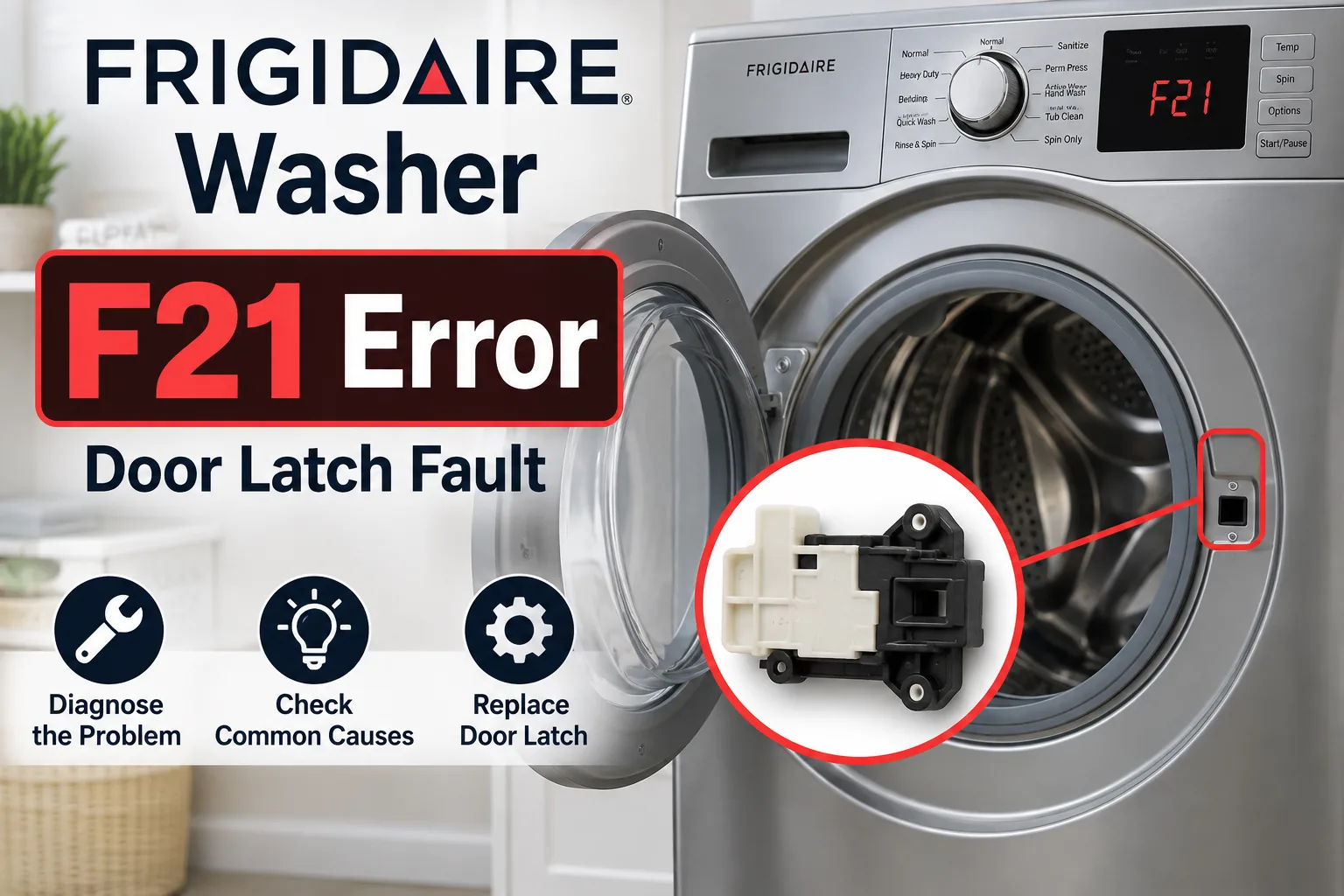
That F21 code isn’t subtle — the washer just quits, the display flashes the code, and the door won’t open for a good while afterward because the control board thinks it’s still mid-lock cycle. I’ve spent close to three decades taking things like this apart, and the pattern with F21 is consistent enough that you can usually narrow it down before you even pull the top panel.
Before you go pulling wires, watch this walkthrough on diagnosing and clearing the F21 fault on a Frigidaire front load washer — it covers the same lock assembly and wiring checks I’d run on this exact model line.
Once you’ve seen where the lock assembly sits, the rest of this gets a lot more concrete. F21 specifically means the control board sent voltage to the door lock, waited for the switch inside it to close and confirm “locked,” and never got that confirmation — or it lost the signal partway through a cycle. That’s different from a door that simply won’t latch mechanically. On these washers the lock isn’t just a mechanical hook; it’s an electromechanical assembly with a motor, a bimetal or wax-motor release, and a set of switches the control board reads constantly.

What Actually Triggers F21
In my experience the door lock assembly itself is the most common culprit — the switch contacts inside it wear out or the small motor that drives the latch fails, and the board never sees a locked signal even though the door physically closed fine. Second most common is the wiring harness running from the lock to the main control board; connectors there get brittle or a wire chafes against the tub over years of vibration. Less often, it’s the control board itself misreading a good signal, but I wouldn’t jump there first — that’s the expensive part, and it’s rarely the actual cause.
A few other things worth ruling out before you replace anything: make sure nothing is physically blocking the door from seating fully — a stray sock or a warped door boot gasket can keep the strike from engaging even when the lock motor and switches are fine. Also check that the door strike (the part on the door itself that the lock grabs) isn’t cracked or loose, since that’s a cheap plastic part that takes abuse over time.
How To Check The Door Lock Assembly
With power disconnected, pull the front panel or top panel depending on your exact model to access the lock assembly, then test it with a multimeter for continuity across the switch contacts as you manually actuate the latch. If the switch doesn’t show continuity when the latch is engaged, that assembly is bad and needs replacing — no amount of cleaning or adjusting fixes a worn-out internal switch. This is the same failure point covered in general terms on our washing machine error code reference for front and top load machines, since door lock faults show up as similar codes across most brands, not just Frigidaire.
If you’re staring at the lock assembly and it looks physically fine — no cracks, no burnt smell, switch tests good — trace the wiring harness back to the control board next. Look for a connector that’s not fully seated, a pin that’s backed out of its housing, or insulation that’s worn through where the harness runs near a moving part. I’d rather spend ten minutes with a flashlight checking connectors than replace a lock assembly that was never the problem.
Replacing The Door Lock Assembly
If testing confirms the lock is bad, it’s a straightforward swap — a handful of screws holding it to the door boot or front panel, one or two wiring connectors, and you’re done. RepairClinic has a solid breakdown of the door lock/unlock failure on Frigidaire washers if you want a second reference on the exact steps. For parts, PartSelect lists the OEM door lock and switch assembly (part 131763256) that fits most Frigidaire front load models, typically around $45–$60, and they also carry a broader page of Frigidaire washer latches if your model number pulls up a different part.
One thing I’d flag: always match the part number to your specific model rather than assuming all Frigidaire front load lock assemblies are interchangeable. They look nearly identical across several years of production, but the switch configuration inside isn’t always the same, and a mismatched part will throw the same F21 code right back at you.
If The Door Is Stuck Locked Right Now
After an F21 fault, most of these washers hold the door locked for a cool-down period — sometimes several minutes — before it’ll release, even after you cancel the cycle. Give it time before assuming the lock mechanism itself is jammed. If it’s still locked after a genuine wait and a full power cycle (unplug it for a minute, plug it back in), that’s a stronger sign the lock assembly’s release mechanism has actually failed and needs replacing rather than just resetting.
This same logic — a locked mechanism refusing to release because the control board never got its confirmation signal — shows up in other appliance categories too, which is part of why lock/latch faults are one of the more common code families across brands, not just something unique to Frigidaire washers.

Written by Keith Schneerer
Certified Appliance Tech · Founder, RemoveAndReplace.com
Keith has spent 30+ years repairing machines, starting as a military mechanic and later maintaining food processing equipment before moving into appliance repair. He founded RemoveAndReplace.com to share field-tested repair advice.
More about Keith →