Tighten the drain hose clamp at the pump before you look anywhere else — that single check clears up a Samsung dishwasher water leak from the bottom more often than anything else on this list. If the clamp’s already snug, move on to the water inlet hose or the door gasket next.

- Two connections to check before buying any parts: the drain hose clamp and the water inlet hose fitting
- A bad door gasket usually shows wet spots along the sides of the door, not just underneath
- A musty smell paired with the leak often points to the drain pump seal, not the hose
- Cracked tubs are rare — most “tub” leaks turn out to be a pump housing seal instead
| Cause | Likelihood | Fix Cost | DIY Time |
|---|---|---|---|
| Loose drain hose connection | Most common | Free-$8 | 15 min |
| Water inlet valve hose | Common | $20-35 | 20 min |
| Worn door gasket | Occasional | $20-35 | 30 min |
| Drain pump seal | Less common | $15-25 | 1 hr |
| Cracked tub/spray arm seal | Rare | $100+ or pro | Pro recommended |
A Loose Drain Hose Connection Causes Most of These Leaks
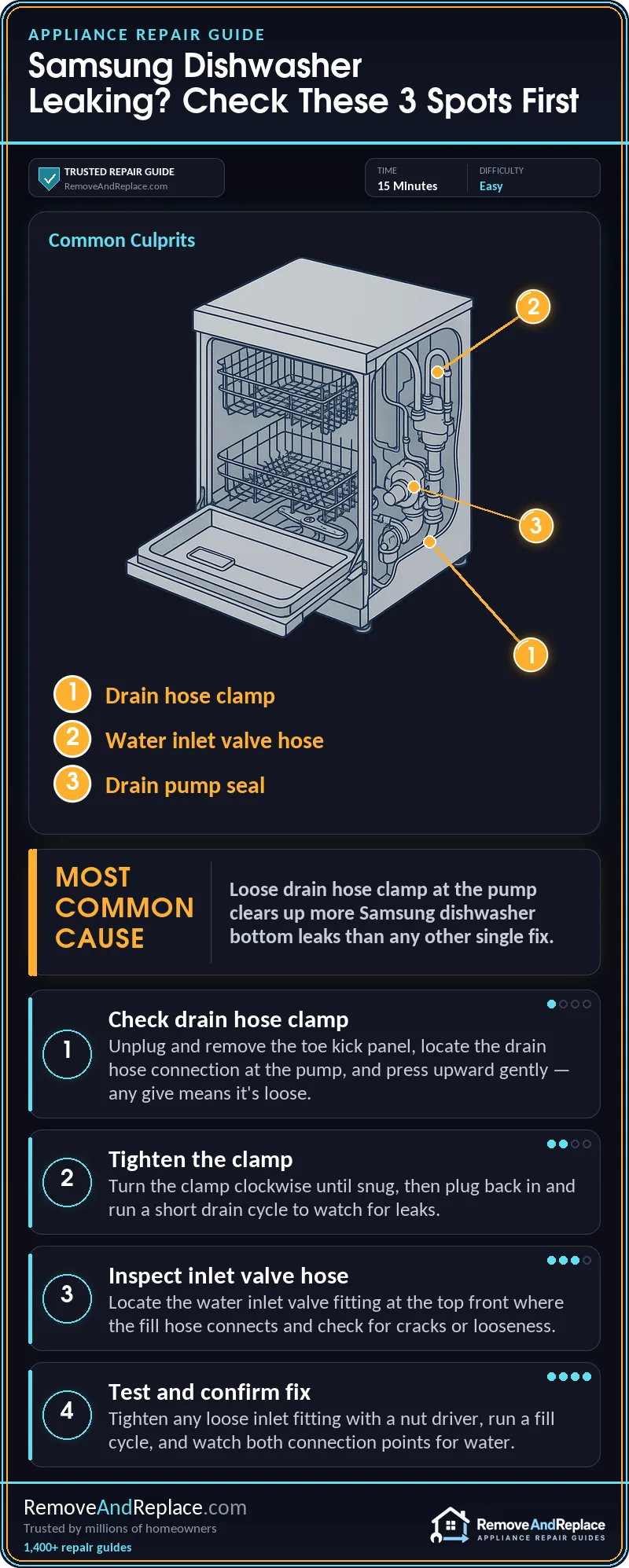
The drain hose connection, where it clamps onto the pump housing under the tub, is the first place to check. Solid plastic tubs don’t have seams to fail, so a crack there isn’t the likely culprit. More often, the plastic spring clamp Samsung uses on these models loses tension over time, or the hose itself gets brittle and pulls loose just enough to weep water every time the drain motor kicks on — the same kind of connection fatigue I saw plenty of during 19 years maintaining aircraft in the Air Force, long before I ever touched a dishwasher. That fitting doesn’t need to fail completely to leak, it just needs to lose its seal. Press upward gently on the drain hose right at the clamp — if you feel any give at all, that’s your leak. A solid connection won’t move even under decent hand pressure (trust me on this one).
Quick way to check it yourself:
- Unplug the dishwasher and pull the toe kick panel off the bottom front — it usually just pulls straight off, no screws.
- Grab a flashlight and locate the drain hose connection where it clamps onto the pump housing.
- Plug it back in, start a short cycle, and watch that exact spot for the first few minutes of the drain phase.
After tightening the clamp, run a quick test cycle — if the control panel throws an error from all the excess water it detected, here’s how to reset a Samsung dishwasher so it clears the fault and runs normally again.
The Water Inlet Valve Hose Is the Second Most Likely Spot
The next place to check is the water inlet valve, up near the top front of the tub where the fill hose connects. A cracked or loosened fitting right at that valve is the next most common cause of a Samsung dishwasher water leak — you’ll usually catch it because the leak shows up early in the cycle, during fill, rather than during wash or drain. Work through it in this order before ordering a new valve:
- Locate the water inlet valve near the top front of the tub, where the fill hose connects.
- Check the fitting itself for a crack or a loose connection before assuming the valve body has failed.
- Tighten the fitting with a nut driver if it’s just loose — a $28 valve won’t fix a hose clamp that needs a quarter-turn.
- Run a short cycle and watch that spot during the fill phase to confirm the leak has stopped.
If tightening that connection doesn’t stop it, and the dishwasher also seems to keep running water on its own afterward, that’s usually a separate problem — check out why Samsung dishwashers won’t stop draining if that’s what you’re seeing too. Samsung’s own leak and leakage error code troubleshooting page covers this same connection point if your model throws an LE or 5C code instead of just puddling quietly.
Is It Actually the Door Gasket?
Don’t order a new door gasket the moment you see water on the floor — a soaked floor doesn’t automatically mean the rubber seal failed. A worn or gunked-up gasket is a common cause of these leaks, but a bad gasket almost always shows itself as water along the sides of the door or pooling right at the front edge, not spreading out from dead-center under the unit. While you’re at the door anyway, it’s worth knowing that a soap dispenser that won’t latch is a completely separate, easy fix on the same panel.
- Run your finger around the entire gasket track, checking for stiffness or cracking.
- Look for a permanent kink where the door has been closing on the same spot for years.
- If it still feels pliable and seats evenly all the way around, keep looking elsewhere before spending $25-35 on a part you don’t need.
AppliancePartsPros’ guide on Samsung dishwasher leaking causes and fixes has decent photos of what a worn gasket track actually looks like, if you want a visual before committing to buying one (don’t ask me how many perfectly good gaskets I’ve seen thrown in the trash over this).
A Failing Drain Pump Seal Causes Slow, Intermittent Leaks
A drain pump seal going bad shows up differently than the other two — you won’t see a puddle spreading, just a damp spot under the pump area that often smells faintly musty, showing up only after the drain cycle runs, not during fill or wash. This is a less common cause than the hose or the valve, but it’s also the one people misdiagnose first, jumping straight to a full pump replacement — that’s a $90-120 part and more than the job usually needs. Check it in this order before you order anything:
- Unplug the dishwasher and pull the pump assembly per your model’s service instructions.
- Inspect the seal where it meets the sump housing for cracking or a hardened, brittle edge.
- If the seal alone looks worn, order just the seal — it’s a $15-25 part and doesn’t require touching any wiring.
- Reinstall the pump and run a test cycle, watching the same spot during the drain phase.
Rare Case: A Cracked Tub Seam or Spray Arm Seal
These are rare, but not impossible — and when they happen on Samsung dishwashers, it’s mostly on the DW80R5060 series and other units from around 2017-2020 with the stainless-tub-and-plastic-sump combination, right where the two materials meet near the spray arm hub. The plastic can develop a hairline crack from years of hot-cold cycling long before the stainless shows any wear at all, and it’s easy to miss because the leak only shows up mid-cycle, when the wash arm is spinning and water’s hitting that exact spot. If you’ve replaced the hose clamps, the inlet valve, the gasket, and the pump seal and you’re still chasing a leak, pull the lower spray arm and look for a crack right at the base where it locks onto the sump. This one usually isn’t a DIY part swap — it’s a full tub or sump replacement, and at that point the repair cost starts competing with a new dishwasher.
Whoever decided a plastic spring clamp was good enough to hold a permanent water connection under a dishwasher never had to fix one of these five years later. It’s kinda flimsy by design, and it’s annoying that it’s the single biggest cause of this whole problem.
See the Hose Connection and Drain Seal Check in Action
Reading about a hose clamp is one thing — seeing exactly where it sits under the tub is another. The video below walks through pulling the toe kick panel, locating the drain hose connection and the pump seal, and testing both before anything gets replaced. It covers the same two spots just walked through above, from the angle you’ll actually be working in.
How to Fix a Leaking Samsung Dishwasher, Step by Step
You’re not gonna need anything fancy for most of this — a 1/4-inch nut driver, a flathead screwdriver, a pair of adjustable pliers, and a flashlight covers almost every version of this repair. Budget 45 minutes the first time you do this, closer to 15 once you know where everything sits.
- Unplug the dishwasher or shut off the breaker. Don’t just turn it off at the door control — you’re about to have your hands near a water connection and a motor.
- Pull the toe kick panel off the bottom front. On most Samsung models it just pulls forward, no screws involved.
- Locate the drain hose clamp at the pump housing. Tighten it with pliers if it’s a screw clamp, or reseat and squeeze the tabs if it’s the plastic spring style.
- Check the water inlet hose fitting near the top front of the tub. Tighten the connection with the nut driver if it’s loose.
- Run your finger around the door gasket. Replace it if it’s stiff or cracked — expect to spend $20-35 and about 30 minutes.
- If none of that stops it, pull the drain pump and inspect the seal. A $15-25 replacement seal usually solves it without touching the pump motor itself.
- Run a full test cycle with the toe kick panel off. Watch each connection point through fill, wash, and drain before buttoning everything back up.
PartSelect’s Samsung dishwasher leak repair guide has part diagrams if you need to confirm which clamp or seal fits your specific model number before ordering. If the original clamp is too corroded to reuse, a replacement runs $5-8 at most hardware stores.
Unplug the dishwasher at the outlet or shut off the breaker before you pull any panel — don’t just switch it off at the door control. You’ll have your hands near live wiring and a water line at the same time, and that’s not a combination worth rushing.
Most of these repairs land in the $15-35 parts range if you’re comfortable pulling the toe kick panel and reaching under the tub yourself. A service call for the same diagnosis and repair typically runs $150-250, so doing it yourself saves real money on most of these fixes.
- Call a pro if you find an actual crack in the tub or sump housing, not just a worn seal
- Call a pro if the leak shows up alongside an electrical smell or a tripped breaker
- Call a pro if you’ve replaced the hose, valve, gasket, and pump seal and it’s still leaking
How to Stop This Leak From Coming Back
Cleaning the dishwasher filter every month or so keeps debris from working its way down into the pump housing and stressing that seal before its time — it’s the cheapest insurance against this whole problem coming back. Wipe down the door gasket track while you’re at it, and once a year, give the connections under the toe kick panel a once-over. Five minutes now beats a puddle under the cabinets later.
Frequently Asked Questions
Why is my Samsung dishwasher leaking from the bottom during the wash cycle but not during fill?
That points toward the spray arm hub or the pump seal rather than the inlet valve. Water’s only moving through those spots once the wash arm starts spinning, so a leak that only shows up mid-cycle usually means one of those two, not the fill-side connections.
Can a Samsung dishwasher water leak damage my floor if I don’t fix it right away?
Yes, and it gets expensive fast — subfloor and cabinet water damage from a small, ongoing drip adds up a lot quicker than people expect. A slow leak from a loose clamp might only be a cup of water per cycle, but that’s a cup of water every single day sitting under your flooring.
Is a Samsung dishwasher leak always the drain pump?
No — the pump itself is one of the least common causes, not the most common.
How much does it cost to fix a Samsung dishwasher leaking from the bottom?
Parts alone typically run $8-35 depending on whether it’s the hose clamp, the inlet valve, or the door gasket. If it turns out to be the drain pump seal, budget $15-25. Expect to spend more than that only in the rare cracked-tub scenario, which usually means a bigger repair or a full replacement conversation.
Do I need to replace the whole tub if it’s leaking from the bottom?
Almost never — see the cracked tub section above. Check the hose connections and the seals first; that’s where this leak starts far more often than the tub itself.
Work through the connections in order rather than guessing — clamp, inlet valve, gasket, pump seal — and keep the receipt on whatever part you buy first, in case it turns out to be one of the others further down the list.

Written by Keith Schneerer
Certified Appliance Tech · Founder, RemoveAndReplace.com
Keith has spent 30+ years repairing machines, starting as a military mechanic and later maintaining food processing equipment before moving into appliance repair. He founded RemoveAndReplace.com to share field-tested repair advice.
More about Keith →