Look at three things before you do anything else: where the crack starts, what it looks like, and what the cooktop was doing when you found it. A cracked top is almost never random. The crack’s origin and shape point at a cause, and that decides whether you’re looking at a one-time accident or a problem that will crack the next piece of glass too.
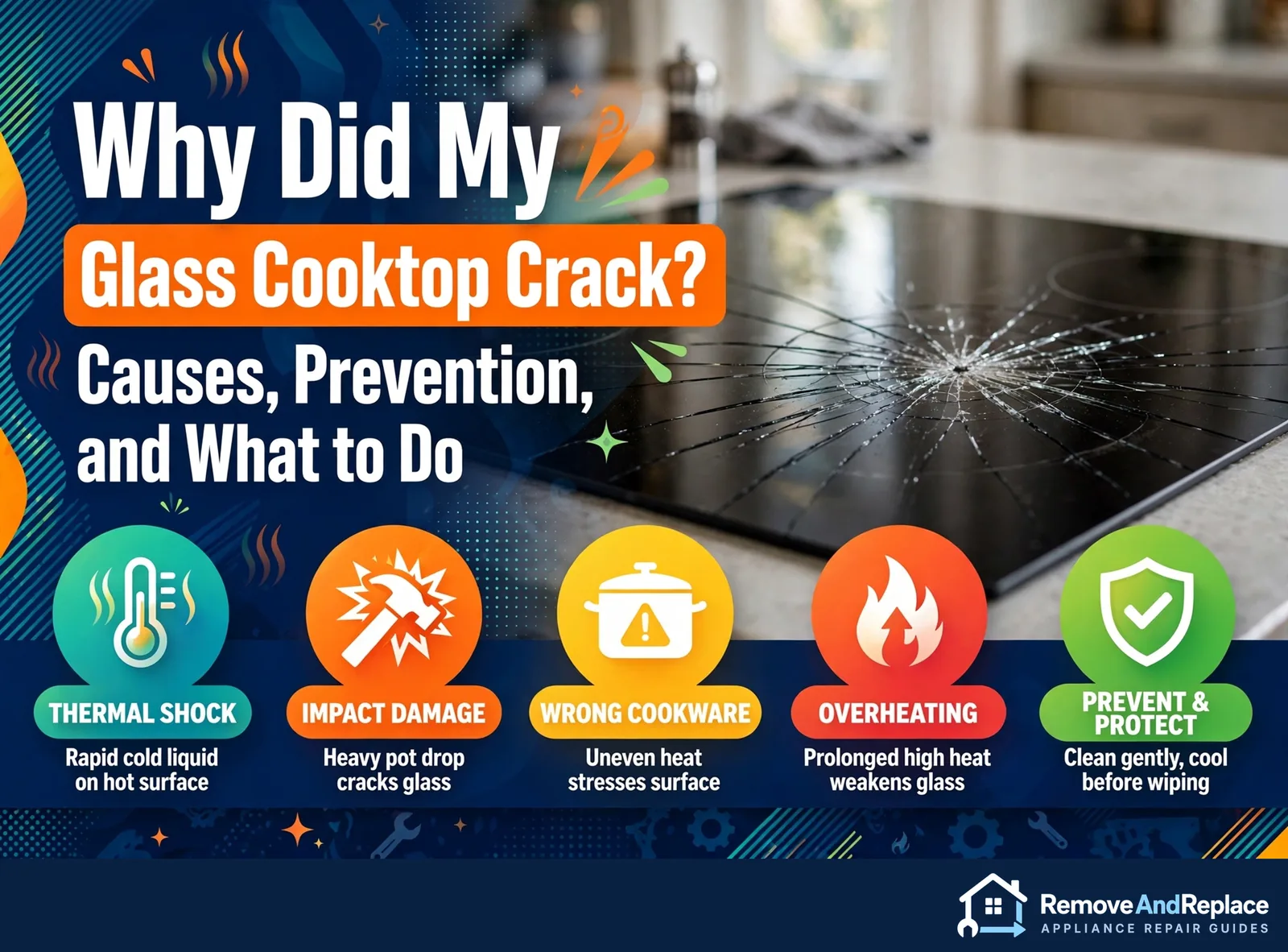
Glass cooktop cracked causes prevention starts with the crack’s origin. A single point near a burner suggests impact or thermal shock; a crack from an edge suggests installation stress on unsupported glass. Check the origin before buying anything, then stop cooking and shut off power at the breaker until the glass is replaced. For the circuit side, see what size breaker a range, dryer or dishwasher needs.
How Do You Read a Cracked Glass Cooktop?
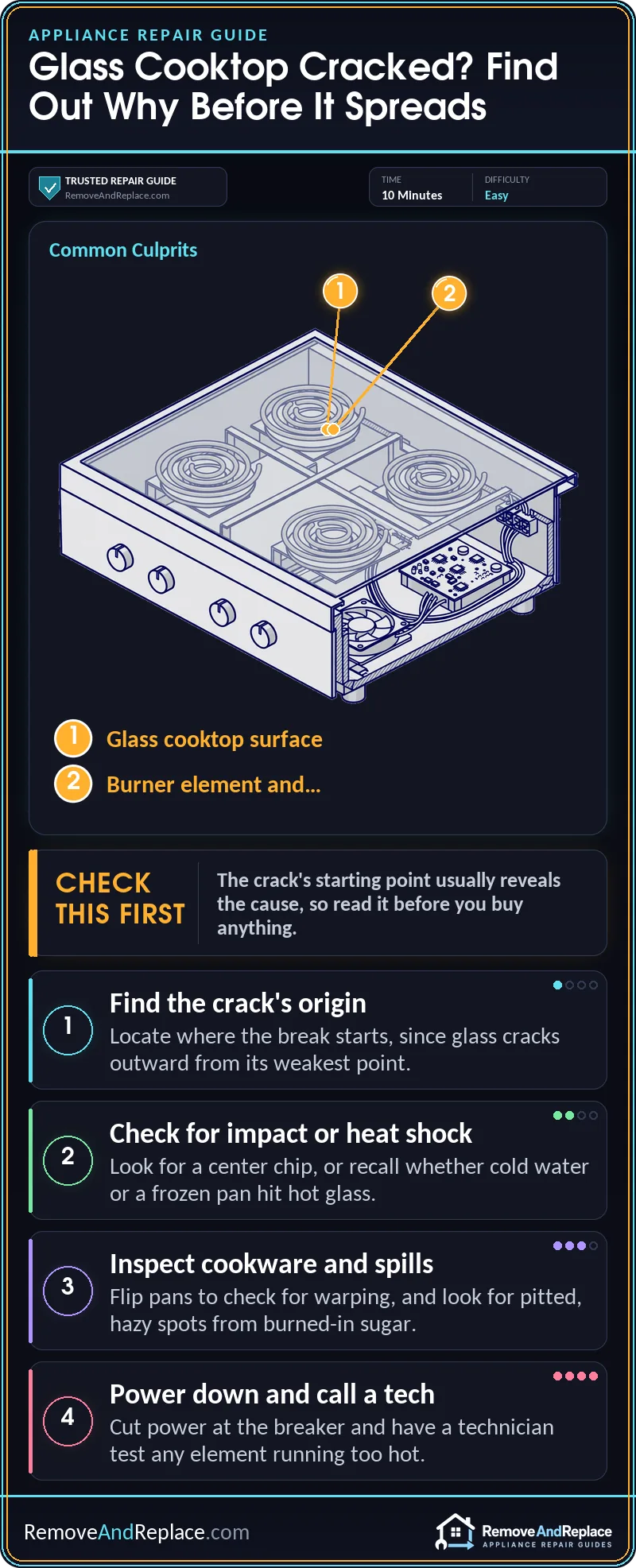
Treat the crack like evidence. For glass cooktop cracked causes prevention, the crack tells you more than any list of generic causes will, and I read it the same way I’d read a failed part on a commercial oven, something I did for 11 years in food service equipment repair. Find the spot where the crack begins, because glass breaks outward from its weakest or most stressed point. Note whether it’s a single line, a star pattern, or a web. Then ask when it appeared: during cooking, right after you turned a burner off, or while the cooktop sat cool and untouched.
Most people assume the cooktop was defective, or that a cold pot did it. Either can be true, but the origin point usually tells you. A crack with a clear starting dent points one way, and a crack that creeps in from an edge points to the installation. Don’t wipe, scrub or pick at the break while you look, because loose glass edges are sharp.
This is the ranked list I’d work through, each with the quick test that confirms it:
- Impact or a dropped heavy pot: look for a small chip, pit or white crush mark at the center of the crack.
- Thermal shock: think back to whether cold water, a frozen pan or a wet lid hit the glass while it was hot.
- Rough or warped cookware: flip the pan over; a warped base or rough, scratched bottom concentrates heat and scratches the glass.
- Sugar or melted debris: look for a pitted, hazy patch where a spill burned in before the crack.
- Installation stress: check whether the crack starts at an edge or corner and whether the glass sits unevenly in the counter cutout.
- A failed temperature limiter or element fault: a crack under one element that happens with no impact, and where that zone has been running hotter than the others.
The Crack Starts at One Point Near a Burner
This is the pattern I’d bet on first when there’s a visible dent at the center. Something hard landed on the glass: a dropped pot, a jar, a heavy lid. Sometimes the glass doesn’t break right away. A small chip or hairline sits there until the next heat cycle stretches it into a full crack. So if you remember a bang a week ago, that’s your answer even though the crack is new.
OK, so there’s no dent and no bang. That narrows it down to heat, which is the next section. Rough, warped or oversized cookware is the other quiet cause here. A pan that rocks or has a scratchy base scratches the glass, and a scratch is a weak line that heat can open up.
It Cracked While Cooking, With Nothing Dropped
Now the heat suspects. Thermal shock happens when a hot surface meets something cold or wet, like water splashed on a hot zone or a frozen pan set on a burner at full heat. Sugary spills are a quieter cause. They can burn into the surface and pit it, and a pitted spot is a place cracks start. GE’s cleaning guidance for glass cooktops covers sugary spills and melted plastic, and it’s worth reading in its glass cooktop cleaning instructions.
If none of that fits and the crack runs under a single element, suspect the element or its temperature limiter running too hot. I can’t diagnose that from a photo, and I wouldn’t guess. A tech can test whether the zone is overheating before you put new glass over the same fault. If it is, replacing the glass alone just sets up a repeat.
A good deal of the damage I’d flag on these is a customer-side habit, not a defect, and a hot-zone fault is one of the few things you can’t spot by looking.
The Crack Runs In From an Edge or Corner
Edge cracks that show up with no impact and no heat event often come from how the cooktop sits in the counter. An oversized or uneven cutout, a counter that has shifted, or glass resting unevenly on its support puts constant stress on the edge until it gives. Same idea as a floor tile cracking over an unsupported spot, which I cover in how to remove and fix a cracked floor tile: the surface is fine until the support underneath isn’t.
The test is simple. With the unit cold and unplugged, look at the gap around the glass and check whether it sits flat and evenly. If the install looks off, replacing the glass without fixing the support is likely to lead to another crack. That’s one for the installer or a pro.
This video walks through why glass cooktops crack and what to look for in the damage. Watch it with your own crack in front of you, then come back for the steps and the aftermath below.
Unplug the appliance or switch off its breaker before you touch anything. A cracked top can let liquid reach live parts, and the edges are sharp, so wear gloves. Mr. Appliance covers the dangers of using a cracked glass stove in more detail.
What Should You Do Right After It Cracks?
- Stop cooking on it. Even a hairline crack can spread and let spills in.
- Cut the power. Switch off the breaker for the range or cooktop.
- Photograph the crack. Take wide and close shots, including the origin point. You’ll want these for the warranty or an insurance claim.
- Don’t try to glue it or tape it. A patch won’t hold through heat cycles, and you can’t trust it.
- Find the model and serial number. Check the rating plate and the manual for where your model lists it. Often it’s on the frame, under the edge or underneath the unit.
- Get a replacement-glass price and a new-cooktop price. The glass is a separate part on many models, but it isn’t always sold alone, and installing it can be a bigger job than people expect.
Is It Worth a Warranty or Insurance Claim?
Depends on cause. Manufacturer warranties usually cover defects, not impact or misuse, so a dropped-pot crack is unlikely to qualify while an edge crack with no impact may. Check your model’s warranty terms. For homeowners insurance, compare your deductible with the replacement cost; for a single glass top it often isn’t worth a claim, but I’d still ask. Your photos matter either way.
Replace the glass if it’s offered and the cost is a modest fraction of a new unit. Replace the whole cooktop if the glass price is close to new, or if you found an element or installation fault.
How Do You Prevent a Cracked Glass Cooktop?
For glass cooktop cracked causes prevention, a few habits cover most of it. Lift pots instead of sliding them. Use flat-bottomed cookware that matches the burner. Let a hot zone cool before wiping it with a wet cloth. Clean sugary spills while the surface is warm, carefully, with a scraper; SCHOTT CERAN’s tips and care guidance for glass-ceramic cooktops covers the right approach. The same don’t-force-it rule applies to other glass in your home, like a sliding glass door that’s hard to move.
FAQ
Can I keep using a cracked glass cooktop?
No. Spills can reach the electrical parts under the glass, and the crack can spread suddenly. Switch off the breaker and don’t cook on it.
Can a cracked glass cooktop be repaired?
Not with glue or tape. The fix is replacement glass, or a new cooktop if the glass part isn’t sold alone or the price is close to new.
Will my homeowners insurance cover it?
Sometimes, depending on your policy and the cause. Compare the replacement cost with your deductible before you file. I’d check the policy first, since many cracked tops end up under the deductible.
Why did mine crack when I wasn’t doing anything?
Usually one of two things: an earlier chip finally opened up, or the glass was under installation stress. The origin point of the crack is usually the best way to tell them apart.
One small habit worth keeping: after cooking, leave a wet cloth in the sink until the burner light goes out.

Written by Keith Schneerer
Certified Appliance Tech · Founder, RemoveAndReplace.com
Keith has spent 30+ years repairing machines, starting as a military mechanic and later maintaining food processing equipment before moving into appliance repair. He founded RemoveAndReplace.com to share field-tested repair advice.
More about Keith →