That little red button popped again, and you’re standing there with cold water and a decision to make. Before you push it a third time, figure out when it trips — that’s the first question I ask on every one of these, and it narrows things down faster than anything else you can do.

The red reset button is a high-limit safety cutout (the ECO), not a switch. It trips when tank water reaches about 180°F or when a shorted heating element pulls current it shouldn’t. So if your water heater reset button keeps tripping, kill the breaker, pull the upper access panel, and ohm-test both elements before replacing any parts — a shorted element is the usual culprit.
The short version
- The button is reporting a fault, not creating one — replacing it fixes nothing
- A 4500-watt element should read about 12.8 ohms; near zero or open means it’s shot
- Any continuity between an element terminal and the bare tank means a short to ground
- Burnt smell, brown discoloration, or buzzing at the panel — stop resetting and shut the breaker off
Start Here: How Fast Does It Trip After You Reset It?
That red button isn’t a switch — it’s a high-temperature cutout, usually called the ECO, mounted flat against the tank wall behind the upper access panel. It pops when it senses water around 180°F, or when a shorted element pulls current through the circuit it was never meant to carry. A safety device that trips is reporting a fault, not causing one, and across 28 years of hands-on repair work I’ve never once seen it work the other way around. So when a water heater reset button keeps tripping, the button itself is almost never the problem — something upstream of it is. The timing tells you where. Trips within seconds of resetting? I’d suspect a shorted element or a direct short to the tank. Trips after an hour or two with scalding water at the tap? A thermostat is stuck closed. Trips randomly every few days with normal-feeling water? Loose wiring or an ECO that isn’t seated tight against the tank.

| Cause | Likelihood | Fix Cost | DIY Time |
|---|---|---|---|
| Heating element shorted to ground | Most common | $12-20 | 45 min |
| Thermostat contacts welded closed | Common | $12-30 | 30 min |
| Loose or burnt wire terminal | Common | Free-$5 | 20 min |
| ECO not seated flat / failed ECO | Less common | $20-30 | 30 min |
| Sediment baking the lower element | Less common | Free (flush) | 1 hour |
The Button Trips Again Within Seconds
If you press reset, hear the click, and it pops right back — you have a heating element shorted to the tank. That’s the answer nearly every time I’ve chased this particular symptom. Water has gotten inside the element sheath, or the sheath has corroded through, and now current is finding a path straight to grounded steel instead of through the resistance coil. The ECO senses that and drops out immediately, which is exactly what it’s supposed to do. Shut the breaker off and leave it off. Don’t keep resetting it — you’re re-energizing a live short every time you push that button, and I’ve watched that turn a $15 element job into a rewire.
This is where hard water matters more than most articles admit. Out here in the Phoenix area, mineral scale packs around the lower element and insulates it, so it runs hotter than it was designed to and the sheath fails years earlier than the national-average lifespan the manual assumes. If your heater is on well water or hard municipal water and it’s past year six, the lower element is where I’d start looking. On anything that age, I ohm the lower element first every single time.
The Water Gets Scalding, Then It Trips
Different failure entirely. If your taps run dangerously hot for an hour or two and then the button pops, a thermostat has welded its contacts closed and is feeding the element nonstop. The water climbs past the setpoint, keeps climbing, and at about 180°F the ECO does its job and cuts everything off. The element is probably fine here — I’ve replaced very few elements on a scalding-water complaint. The thermostat that’s supposed to shut it off isn’t shutting it off.
You can usually confirm this by feel before you open anything up. I set the tap to full hot and pay attention to whether the water is genuinely uncomfortable rather than just hot. A properly working system holds around 120°F. Scalding means the control side failed, not the heating side.
Before you open any panel: turn the breaker off at the panel, then verify with your meter across the upper thermostat terminals — you want to read 0 volts, not 240. Electric water heaters run on two hot legs, so switching one leg off isn’t enough. And never energize a tank that isn’t full of water. An element will dry-fire and burn open in about ten seconds.
It Trips Every Few Days And The Water Seems Fine
OK, so nothing is scalding and nothing trips instantly — it just quits on you every few days for no obvious reason. That pattern points at the connections, not the components.
Pull the upper panel and fold the fiberglass insulation back. What I’m hunting for is heat damage: brown or amber discoloration on the wire insulation, a chalky white residue on a terminal screw, a screw you can turn with your fingers. A loose terminal arcs, arcing makes heat, and the ECO sitting an inch away reads that heat as tank temperature and drops out.
Now the one almost nobody mentions. The ECO has to sit flat against the bare tank wall to read temperature correctly. If somebody replaced a thermostat and didn’t get the retaining bracket snapped in evenly — or if the insulation got shoved behind it — the ECO can trip on a false reading while the water is perfectly normal. I’ve found that more than once on units that had already had a “repair” done. Pop the bracket, reseat it, and make sure the metal face is touching bare steel with nothing behind it. I check that on every thermostat I install.
How To Test The Element And Thermostat With A Multimeter
This is the part every other article skips, and it’s the part that saves you from buying parts you don’t need. You need a multimeter, a 1/4-inch nut driver or #2 Phillips, and a 1-1/2-inch element wrench if you end up pulling an element. I’d budget 45 minutes your first time, about 20 once you’ve done it.
- Kill the breaker and verify it. Meter across the two upper thermostat terminals. Zero volts or you stop right here.
- Remove both access panels, fold the insulation back, and pop off the plastic safety covers. Look before you touch — melted insulation, scorch marks, or standing water changes the whole job.
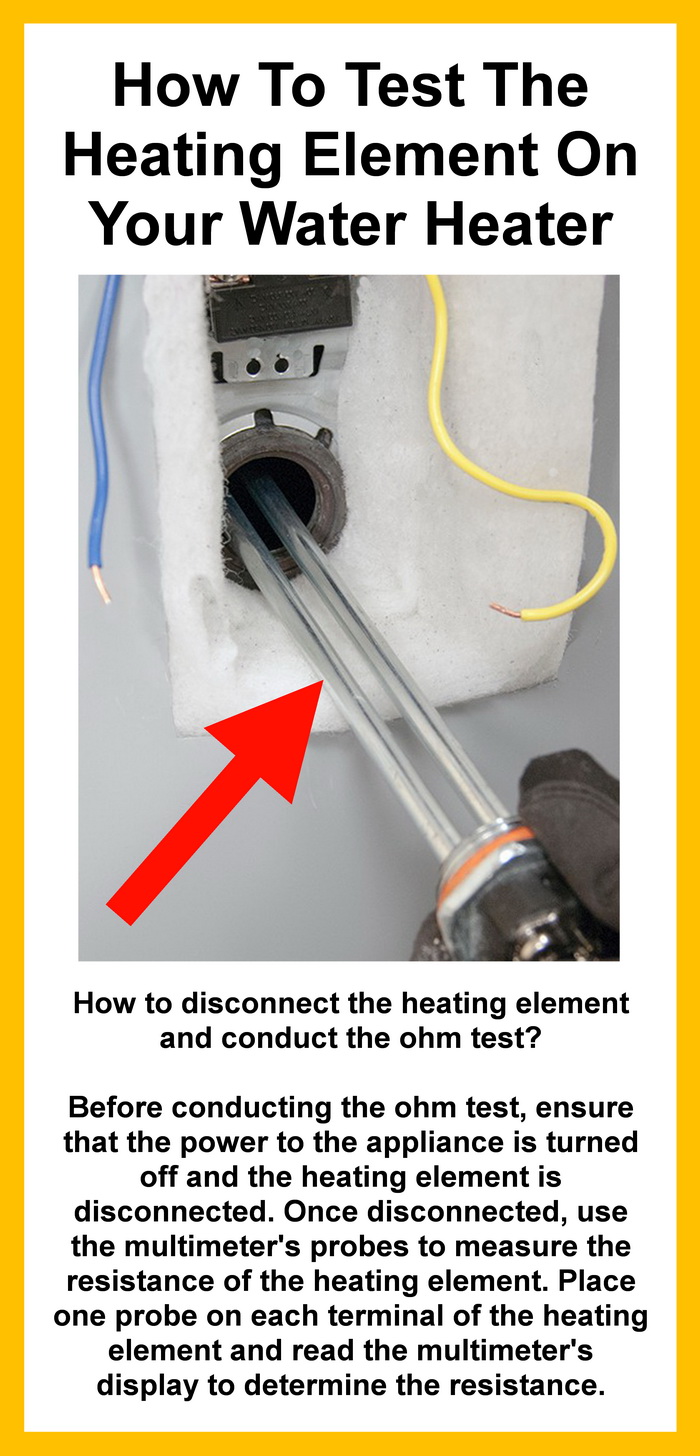
- Disconnect one wire from each element. This isolates the element from the rest of the circuit so your readings mean something. Skip this and you’ll be measuring the whole system, not the part.
- Set the meter to ohms (200 range) and probe across the two element terminals. A healthy 4500-watt, 240-volt element reads about 12.8 ohms — anything near zero or reading open means that element is finished. A 3500-watt element should read around 16 ohms, a 5500-watt around 10.
- Now the test that matters. Put one probe on an element terminal and the other on the bare metal mounting flange or the tank itself. You want no reading at all — open circuit. Any continuity here means the element is shorted to ground, and that is what’s tripping your button.
- Check the ECO. Press reset, then probe across the two ECO terminals. Continuity means the cutout itself is good. No continuity after a reset means the ECO has failed internally and needs replacing along with whatever caused it.
- Check the thermostat. Turn the dial to its lowest setting — the contacts should open. If they stay closed with the dial all the way down, the thermostat is welded and that’s your scalding-water cause.
My first instinct used to be to replace the upper thermostat, because it’s the part physically attached to the reset button and it looks guilty. I did that for years. Then I started ohming the elements first, and most of those thermostats I’d been swapping turned out to be perfectly good — the element had shorted to the tank and was dragging the whole circuit down with it. Test first, buy second.
If you want to see the sequence run in real time, I think this walkthrough covers the same ground well:
Repair Clinic has a solid thermostat test procedure if you want a second reference on the control side, and InspectAPedia goes deep on the high-temp cutoff itself.
How Many Times Can You Safely Reset A Water Heater?
Once. Maybe twice if you’re genuinely convinced it was a one-off power blip. After that you’re gambling, and I wouldn’t.
The wrong move I see constantly: people push that button over and over across a week, treating it like a stuck breaker that just needs persuading. Every reset re-energizes whatever fault is there. If it’s a shorted element, you’re sending current into grounded steel again and again, cooking wire insulation a little more each cycle. That’s how a cheap element failure becomes a burnt-out junction and a service call.
It also helps to remember that not every reset means the same thing. Clearing a fault code the way you would when you reset a Samsung washing machine error code or reset a Samsung dishwasher just tells a control board to start over. This red button is a thermal safety device on a 240-volt circuit, and I treat it completely differently.
Shut the breaker off and leave it off if you get any of these:
- A burnt-plastic or hot-electrical smell at the access panel
- Brown, amber, or blackened wire insulation, or a terminal screw with white residue around it
- Buzzing or humming from the panel area with the breaker on
- The breaker itself feels warm to the touch
- Any water inside the panel cavity
None of those are nuisance trips. Those are a fire risk telling you to stop. A water heater reset button keeps tripping for a reason, and once the wiring shows heat damage the reason has already gotten worse than a $15 part. If you’re also seeing lukewarm water between trips, I’d read our guide on what to check when a water heater isn’t heating — it covers the element-and-thermostat side in more depth.
Parts, Costs, And When To Hand It Off
Screw-in elements run $12-20. A lower thermostat is $12-18, and an upper thermostat with the ECO built in runs $20-30 — Rheem, Ruud, and Richmond share the same parts, and A.O. Smith and State do too, so I match by wattage and mounting style rather than by brand name. A plumber charges $150-250 just to diagnose, and $250-450 for an element and thermostat replacement. You’re saving real money doing this yourself, and it’s genuinely a screwdriver-and-meter job.
I hand it off when the tank is leaking from the seam, when the element won’t break loose after soaking (a seized element usually means a corroded flange, and cracking that tank is a much worse day), or when the wiring inside the panel is heat-damaged past the terminals.
Keeping It From Tripping Again
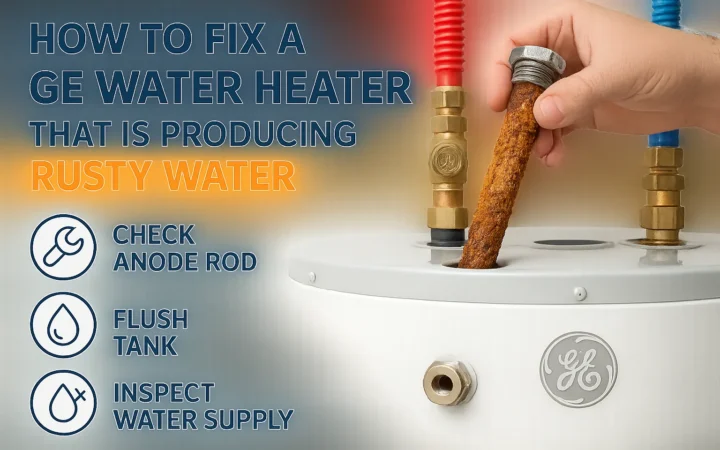
Flush the tank once a year — twice if you’re on hard water. Sediment insulates the lower element and drives it hotter, which is what kills elements early in the first place. I set the thermostats to 120°F, not 140°F; you get plenty of hot water and you’re not asking the system to run near the ECO threshold. When you close the panel back up, snug every terminal screw firmly (they loosen from thermal cycling over the years), and make sure the ECO bracket is flat against bare tank with no insulation behind it. Replace the anode rod every three to five years and the whole tank lasts longer — well, longer than it would otherwise, anyway. Water chemistry is gonna do what water chemistry does. For the wider maintenance picture, our rundown of common water heater problems and how to troubleshoot them covers the other failures I run into most.
Where That Leaves You
Kill the breaker, ohm both elements, and check for continuity between an element terminal and the tank. That three-step sequence identifies the problem on most of these, and everything after it is just a screwdriver and a $15 part. You’ve gotta test before you buy — that’s the whole game here. And if your water heater reset button keeps tripping after all three checks come back clean, I’d go straight back to that ECO bracket and make sure it’s sitting flat before I spent another dollar.
Frequently Asked Questions
Can I just keep pressing the reset button until I can get a plumber out?
No, and I’d push back hard on that one. Each reset re-energizes the fault. If it’s a short, you’re adding heat damage to the wiring every cycle. Shut the breaker off and take a cold shower for two days — it’s cheaper than a burnt junction box.
Why does my reset button keep tripping after I replaced the element?
Three things I’d check in order. First, ohm the other element — people replace the one they suspect and the other one was the shorted one. Second, make sure the ECO bracket got reseated flat against the tank, because a loose bracket causes false trips. Third, check that the thermostat isn’t welded closed and cooking the water past 180°F with the new element.
Can a bad circuit breaker cause the reset button to trip?
Not directly. They’re separate devices doing separate jobs — the breaker protects the wiring, the ECO protects against overheated water. What a weak breaker can do is trip on its own alongside the ECO, which confuses the diagnosis. If both are dropping out, you’re looking at a short, and the short is usually the element.
Does sediment buildup make the reset button trip?
Indirectly, yes. Scale packs around the lower element and traps heat against it, which can push localized temperature high enough to trip the cutout and will absolutely shorten the element’s life. If you hear popping or rumbling when the heater runs, that’s sediment, and a flush is overdue.
Should I just replace the whole water heater?
Depends on age. Under eight years, fix it — you’re spending $30 on parts versus $1,100-1,800 installed for a new 50-gallon unit. Past twelve years with a leaking seam or a corroded element flange, I’d put the money toward a new tank. Anything in between, I’d fix it and start budgeting.

Written by Keith Schneerer
Certified Appliance Tech · Founder, RemoveAndReplace.com
Keith has spent 30+ years repairing machines, starting as a military mechanic and later maintaining food processing equipment before moving into appliance repair. He founded RemoveAndReplace.com to share field-tested repair advice.
More about Keith →