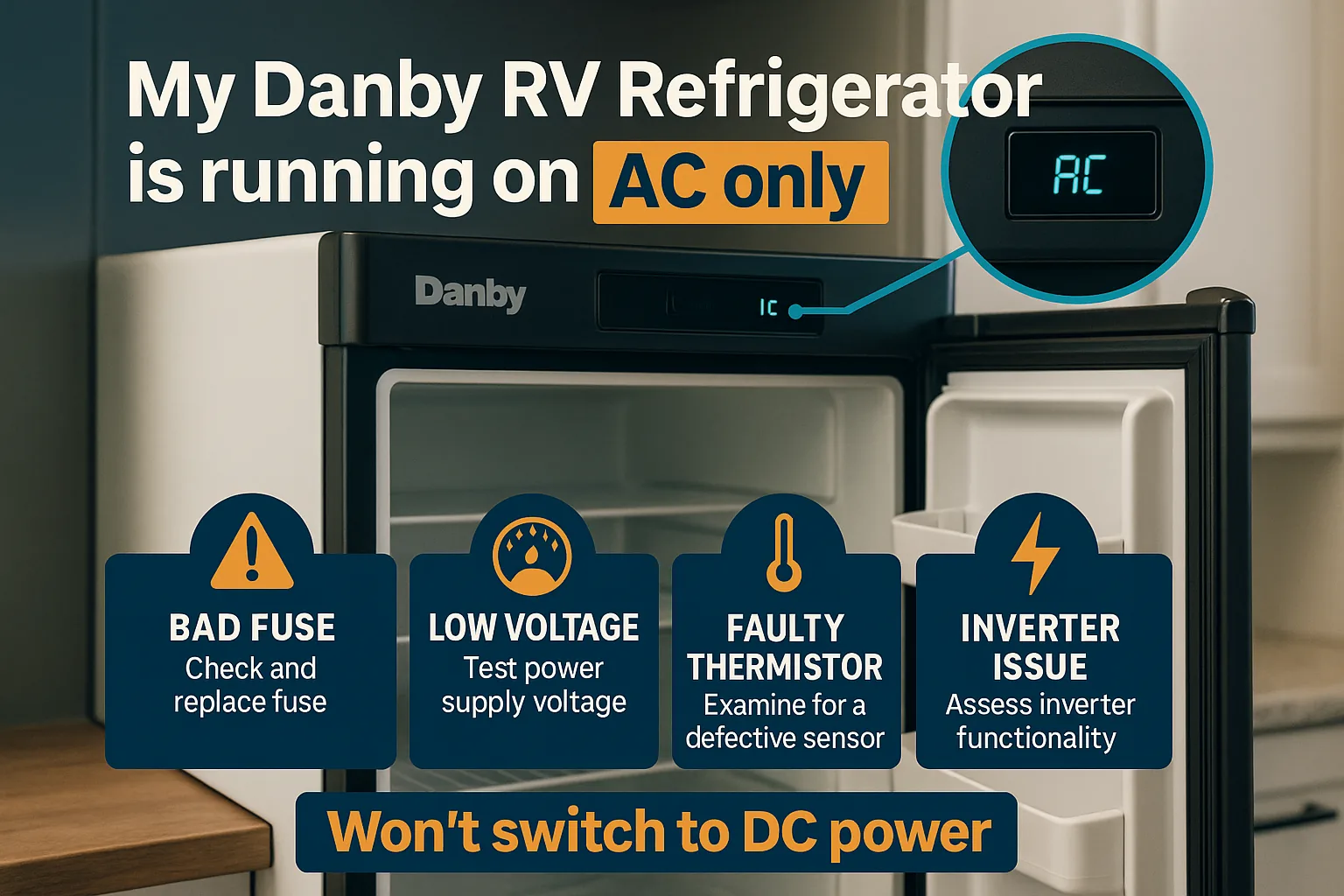
A Danby RV refrigerator that cools fine on AC but won’t switch to propane isn’t dying — it’s starved for the 12-volt power that runs the gas ignition side. The cooling unit itself is rarely involved. Check the house battery, the small fuse feeding the fridge’s control board, and the LP tank valve before you assume anything worse. That’s the fix, more often than not.
- A mobile RV tech typically charges $150–300 to diagnose this — most causes here cost under $40 to fix yourself.
- The gas ignition circuit board is electrically separate from the AC heating element, so a bad board never touches AC performance.
- Air in the propane line after a tank swap can mimic a dead board completely — purge before you replace anything.
- A fouled or misaligned igniter electrode is common on units that sat all winter without running.
| Cause | Likelihood | Fix Cost | DIY Time |
|---|---|---|---|
| Low/dead 12V battery or blown fuse | Most likely | Free–$5 | 10–15 min |
| Failed gas ignition circuit board | Common | $80–150 | 1–1.5 hrs |
| Air in the LP line or low tank | Fairly common | Free | 15–30 min |
| Fouled or misaligned igniter electrode | Less common | $20–40 | 30–45 min |
| Flame sensor (thermocouple) fault | Rare | $15–25 | 20 min |
Here’s What’s Actually Going On Inside a Two-Way Danby Fridge
A Danby RV refrigerator running on AC only is doing exactly what it’s designed to do when the propane side can’t fire — the two systems barely share any hardware. The AC heating element is a resistive coil wired straight to shore power or a generator; flip the switch and it heats, no board, no spark involved. Propane mode needs a circuit board to run the ignition sequence, an electrode to spark the burner, a flame sensor to confirm it lit, and 12-volt DC power to run that whole sequence. That split between the two power sources is something I’ve run into over and over across 30+ years of hands-on repair work: one side runs on house power, the other runs entirely on a separate 12-volt circuit. If the house battery is low, disconnected, or the fuse feeding the board is blown, the AC side keeps working fine while propane just doesn’t.
This fix is almost always cheaper and faster than swapping a cooling unit — most of the causes below cost under $40 and take less than half an hour to sort out. If you’ve ever chased an error code on a Danby portable washing machine, you know the brand throws a fault long before the part behind it actually fails — the same thing happens here. This symptom shows up often enough that even outside guides cover it — Camping World’s own troubleshooting piece walks through the same AC-works-propane-doesn’t scenario we’re diagnosing right now.

The 12-Volt Battery and Fuse Are the First Things I Check
Most of the time, this comes down to something almost embarrassingly simple: the control board isn’t getting the 12-volt DC power it needs, even though the AC element works fine straight off shore power. Check these three things in order:
- Test the house battery’s resting voltage with a multimeter, not the dash gauge — you want to see at least 12 volts.
- Check the battery disconnect switch. It’s easy to bump this off while loading gear into a rear storage bay.
- Check the small ATC-style fuse feeding the fridge board, usually a 3 or 5-amp fuse on the board itself or on the RV’s 12-volt distribution panel. A blown one shows a snapped filament inside the plastic housing — hold it up to the light and you’ll see it.
On Danby’s absorption units, that fuse is often tucked behind a lower access panel outside the fridge compartment, not inside the cabin where you’d expect a fuse block (don’t ask me how many people search the wrong wall first).
Extreme summer heat is hard on a flooded lead-acid RV battery. A battery that tested fine in spring can sag badly under load by midsummer. If the rig sat in a hot storage yard all season, that’s worth ruling out before you touch anything else.
Test the fuse and battery first — a new board runs $80–150, and swapping it before ruling out a $5 fuse just burns money and time.
Could the Gas Ignition Circuit Board Actually Be Bad?
What you’ll notice: the battery tests fine, the fuse is intact, and propane still won’t ignite. Maybe an error code flashes on the display. Maybe you just hear the igniter clicking with no spark and no gas smell at all. What’s happening: the board runs the entire ignition sequence. It energizes the igniter, opens the gas solenoid, watches for flame confirmation, and shuts everything down if it doesn’t see a flame within a few seconds. That’s a safety feature, not a malfunction. Boards fail from age, from a power surge on a sketchy campground pedestal, or from years of vibration on rough roads. What to do: confirm 12-volt power is actually reaching the board with a multimeter before you condemn it. A board that’s getting clean power and still won’t run the sequence is the one worth replacing — usually $80–150 for the part on a Danby or Dometic-style unit, plus about an hour to swap.
This video walks through diagnosing an RV absorption fridge that runs fine on AC but won’t fire on propane, including where to test for 12-volt power at the board and how to tell a bad igniter apart from a bad board. It’s worth watching before you order any parts — seeing exactly where the board and igniter sit on these units saves a lot of guessing once you’re actually under the access panel.
Low LP Tank or Air in the Line Can Mimic a Dead Board
If the battery and fuse check out and the board is getting power, don’t skip the gas supply itself. A tank that’s lower than it looks on the gauge, a valve that only got opened halfway, or plain air in the line after a tank swap will all keep the burner from lighting. Every one of those looks identical to a bad board from the fridge’s side of things. RV Fridge Guys covers this exact overlap pretty well if you want a second opinion before pulling anything apart.
Here’s a genuinely rare one that trips people up: if you just swapped in a new LP tank with an OPD (overfill prevention device) valve, cranking that valve open fast can trigger the OPD’s internal flow restrictor as a safety response. That chokes gas flow enough that appliances light poorly or not at all. It reads exactly like low tank pressure or a bad regulator. The fix isn’t a new regulator — close the valve, wait about 10 seconds, then reopen it slow. That resets the restrictor without spending a dime.
If your Danby RV refrigerator running on AC only comes back to life the moment you swap tanks or purge the line, that confirms it was a supply issue all along, not the board.
A Fouled or Misaligned Igniter Electrode
I used to jump straight to telling people to order a new board the second I heard “clicking but no flame.” Then I started checking the igniter electrode first — a fouled or misaligned electrode causes that exact same clicking-with-no-spark symptom, and a $20–40 part fixes what might otherwise cost a $130 board. Check it in this order:
- Pull the burner assembly to expose the igniter electrode.
- Look at the electrode tip for carbon buildup or corrosion.
- Check the gap between the electrode and burner — usually around 1/8 inch, but check your manual for the exact spec.
- Clean it with fine sandpaper or emery cloth if it’s just fouled.
- Replace the electrode only if it’s cracked or badly corroded.
Whoever decided to bury this electrode behind three screws and a bent bracket on some of these units has never had to service one in a cramped RV bay in August. It’s an annoying design, and it’s a complaint I’ve had about more than one brand, Danby included.
When the Flame Sensor Won’t Confirm Ignition
This one’s rare, but it happens: the flame lights just fine, but the thermocouple or flame sensor doesn’t confirm it fast enough, so the board shuts the gas off as a safety measure — same clicking pattern, different cause. A $15–25 sensor swap usually clears it up, and it’s about a 20-minute job once the burner assembly is already exposed.
If you ever smell propane near the fridge, stop troubleshooting the electrical side entirely. Shut the tank valve, ventilate the RV, and don’t flip a single switch until the smell is completely gone. LP gas leaks aren’t a DIY diagnosis step.
When to Call a Pro Instead of Chasing This Yourself
A gas ignition board runs $80–150 for the part on RepairClinic’s Danby troubleshooting section. A mobile RV tech service call typically runs $150–300 for this kind of diagnosis and swap. If you’re comfortable with a multimeter and a screwdriver, you’ll save real money doing it yourself.
- Call a pro if you smell propane and can’t find an obvious loose fitting
- Call a pro if the cooling unit shows yellow staining or an ammonia smell — that’s a sealed system leak, a completely different repair
- Call a pro if you’ve confirmed 12-volt power at the board and it still won’t run the ignition sequence after two attempts
- Call a pro if the unit is still under Danby’s warranty — don’t void it over a $25 part
Keeping This From Happening Again
Test the house battery’s resting voltage before every trip, not just when something breaks — a two-minute habit that heads off this whole problem before it ever starts. Before storage season, disconnect the battery or put it on a maintainer, especially if the rig sits outside in full sun. After every tank swap, purge the line before assuming anything’s wrong, and open new OPD valves slowly. The same habit that keeps a InSinkErator garbage disposal draining smoothly applies here — a few minutes of preventive checking beats an emergency repair every time.
One More Thing
Danby’s parts line stays fairly consistent across these units, so the $5 fuse or $30 igniter you order for this fridge often fits similar models too — worth keeping a spare of each on hand if you’re full-timing. The same small-parts-first approach applies to other RV gear, like figuring out how to vent a Midea Duo portable AC through a sliding glass door — start with the cheap, obvious stuff before ordering anything expensive.
Frequently Asked Questions
Why is my Danby RV refrigerator running on AC only instead of propane?
Almost always a 12-volt power problem, not a broken fridge — the gas ignition board and igniter run off battery power while the AC heating element doesn’t need any of that at all.
How do I know if my Danby RV fridge circuit board is bad?
Confirm 12-volt power is actually reaching the board with a multimeter first. If it’s still getting power and won’t run the ignition sequence, the board’s the problem. Don’t assume it’s bad until you’ve tested that.
Can a dead RV battery really stop the propane fridge from working?
Yes, completely. The gas ignition system runs entirely on 12-volt DC power, separate from the fridge’s AC heating circuit. A dead or disconnected battery kills propane mode while AC keeps working like nothing’s wrong.
Do I need to purge air from the propane line after refilling the tank?
Usually not fully, but it can help. If the fridge and stove both hesitate to light after a fresh tank fill, run the stove burner for a minute to clear air from the line before troubleshooting the fridge separately.
Is it safe to run my Danby RV fridge on AC only long-term?
Yes. Running on AC only doesn’t hurt the fridge — it just means you’re tied to shore power or a generator instead of boondocking off propane. Don’t put off the repair forever, but there’s no damage happening while you sort it out.

Written by Keith Schneerer
Certified Appliance Tech · Founder, RemoveAndReplace.com
Keith has spent 30+ years repairing machines, starting as a military mechanic and later maintaining food processing equipment before moving into appliance repair. He founded RemoveAndReplace.com to share field-tested repair advice.
More about Keith →