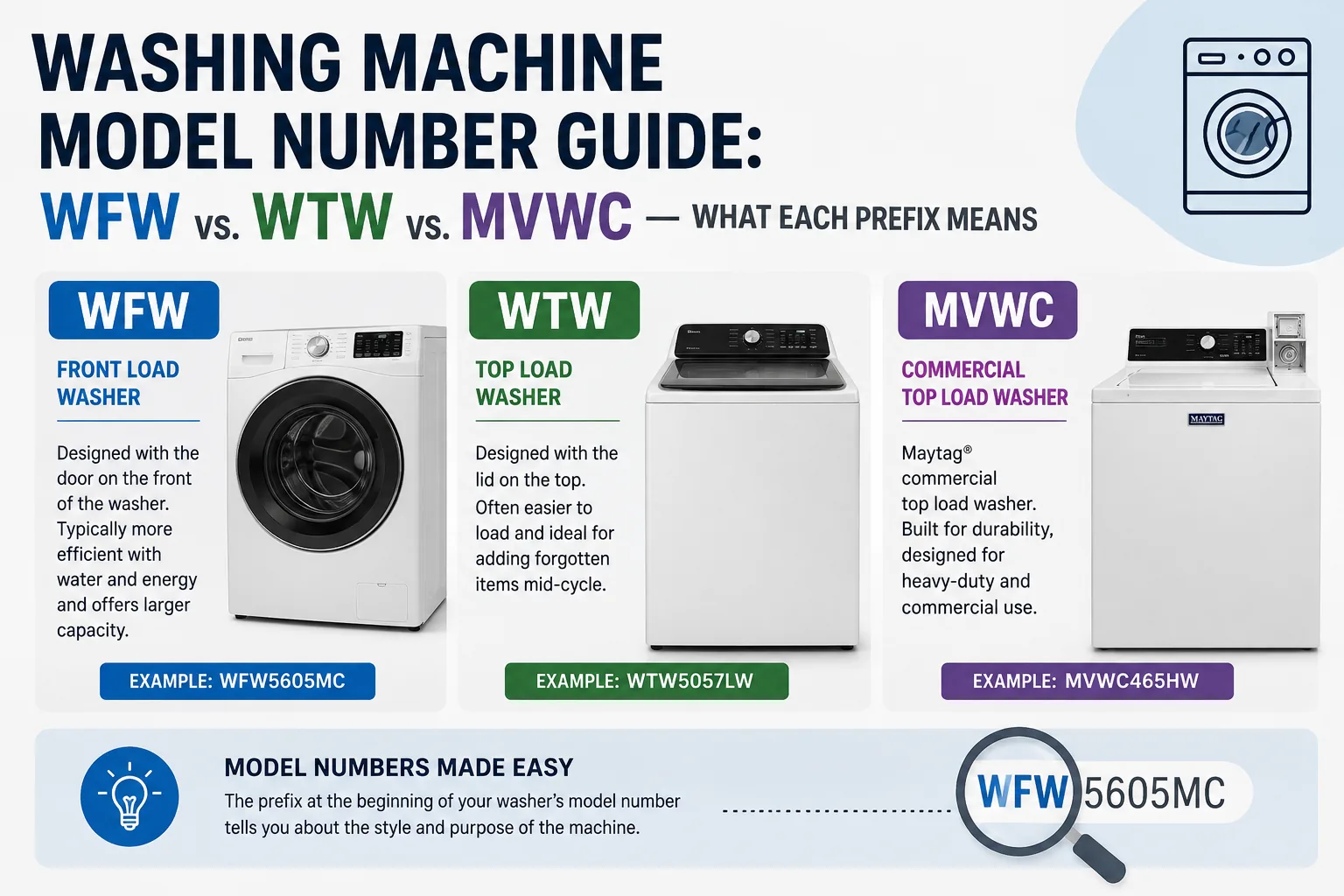
WFW, WTW, and MVWC aren’t random letters Whirlpool and Maytag slapped on a label — each prefix tells you the washer’s build style before you ever check capacity, cycle count, or which parts fit it. If you’re standing in front of a washer trying to order a lid switch or a door boot and the part doesn’t match, the prefix is usually why.
This short video walks through where to physically find that model number tag and what the letters and numbers around the prefix actually mean.
Once you know what the tag is telling you, the rest of the label makes a lot more sense — and this is the kind of thing worth getting right the first time. I’ve pulled tags on washers that looked nearly identical side by side but had completely different drain systems and control boards underneath, and the prefix was the only clue that separated them.

What WFW Means (Front-Load Washers)
WFW is Whirlpool’s front-load prefix. If the model number on the tag starts with those three letters, you’re looking at a horizontal-axis washer with a door boot gasket, a drain pump instead of a simple drain valve, and a control board that talks to the door lock, the water level pressure sensor, and the motor drive separately. That’s also why front-load washers throw a different set of fault codes than top-loaders — codes like the ones covered in the F8 E3 error or the fuller rundown of HE Duet front-load error codes only apply to WFW-prefixed machines, not their top-load cousins.
What WTW Means (Top-Load Washers)
WTW is the Whirlpool top-load prefix — vertical-axis, lid on top, either an agitator or an impeller plate depending on the specific model year. These use a completely different water fill and spin system than a WFW, and if the machine is a Cabrio-style WTW, it’s also the platform where the E01 F06 error code shows up most often, tied to the motor’s rotor position sensor rather than anything in the drain system.
What MVWC Means (Maytag Commercial-Style Top-Loaders)
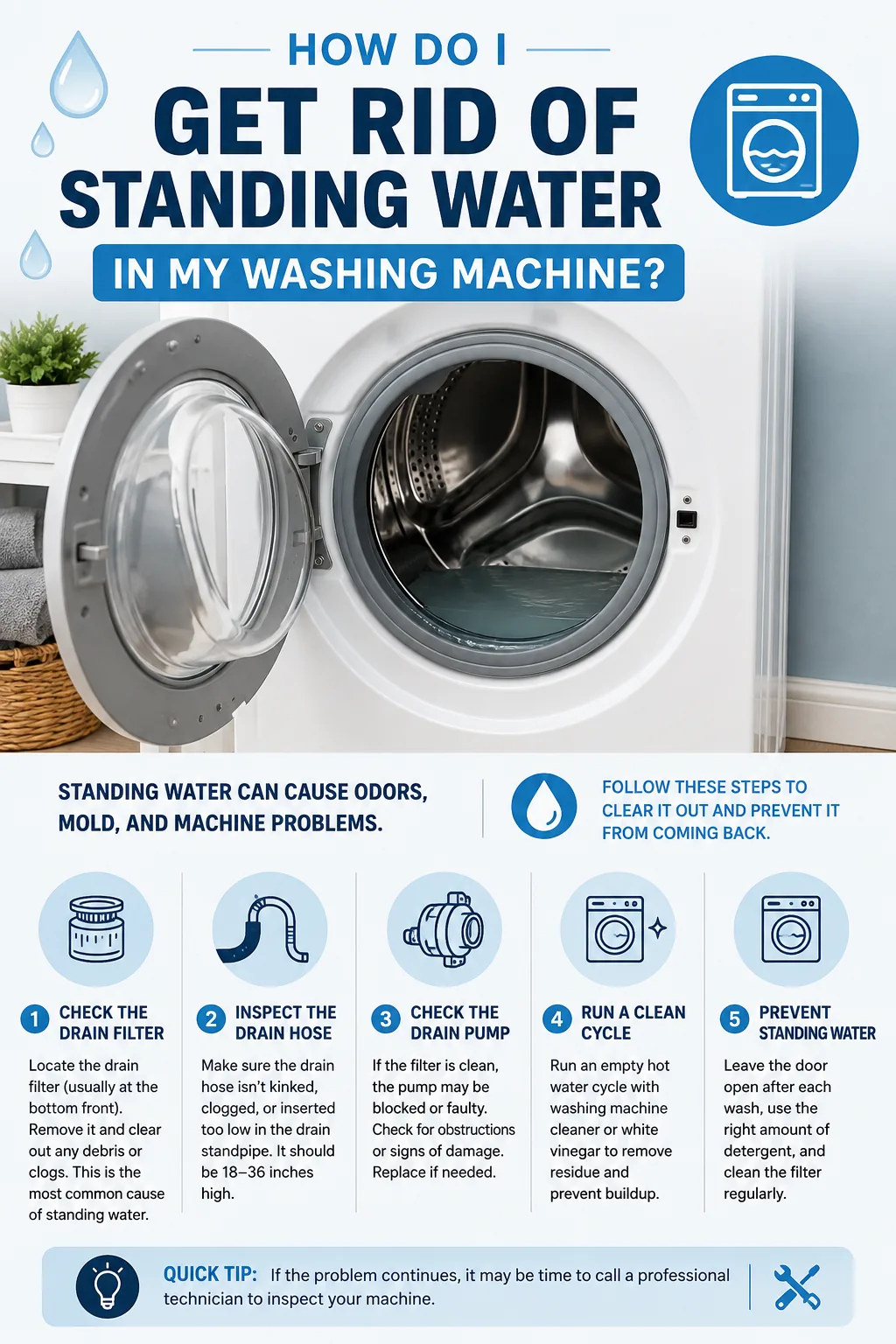
MVWC is Maytag’s badge for its commercial-style top-load washers — still a residential machine in most cases, but built on a heavier-duty drive system and stainless tub that Maytag markets toward higher-use households. Mechanically it’s closer to a WTW than a WFW: top-loading, agitator or impeller, similar drain valve setup. The prefix mainly signals the build tier, not a different washer category. Any washer, front or top load, that’s slow to drain or leaves standing water in the tub after a cycle is worth checking with the same basic steps regardless of prefix — the fix for standing water in a washing machine usually starts at the drain hose and pump before you assume it’s the control board.
Why the Prefix Actually Matters
Parts counters and manufacturer support sites both index everything by the full model number, not just the letters, but the prefix is what narrows the search fast. A door boot gasket, drain pump, or door lock assembly on a WFW washer will not fit a WTW or MVWC, even if the two machines are the same brand and roughly the same size. When you’re pulling up a wiring diagram or ordering a part, matching the prefix first saves you from ordering the wrong thing and having to send it back.
How to Find Your Exact Model Number
The tag itself is usually behind the door on a front-load washer, or under the lid or on the back panel of a top-loader — it’s worth checking both spots since placement varies by model year. Repair Clinic has a clear walkthrough on how to find the model number on a top-load washer if the tag isn’t where you expect it. Once you’ve got the full number, the prefix tells you the washer family, and everything after it — the numbers and trailing letters — narrows down the exact features, capacity, and production run.
A quick washer model number guide like this one won’t replace pulling the actual tag, but knowing what WFW, WTW, and MVWC each mean before you look means you’re not guessing at what kind of machine you’re working on. That’s usually enough to get the right part ordered on the first try instead of the second.

Written by Keith Schneerer
Certified Appliance Tech · Founder, RemoveAndReplace.com
Keith has spent 30+ years repairing machines, starting as a military mechanic and later maintaining food processing equipment before moving into appliance repair. He founded RemoveAndReplace.com to share field-tested repair advice.
More about Keith →