Here’s what you need to know before you replace the shock absorbers Kenmore Washer machines rely on: front-load models use hydraulic shocks, top-load models use suspension rods or dampers, and either job runs 45–90 minutes with a full replacement set — not just the one that looks worst. Skip a matching part and the washer will still bang within a few months.

- Front-load Kenmores use hydraulic shock absorbers; most top-load Kenmores use suspension rods or dampers — they are not the same part and not interchangeable.
- Always replace shocks or rods in matching pairs (or all four on top-loaders), even if only one looks bad.
- A shock kit runs $25-45; suspension rod sets run about $15-25 a pair — both are far cheaper than the $150-250 a service call typically costs for this repair.
- Tightening suspension hardware down as far as it’ll go doesn’t quiet a washer — it usually makes the clunking worse.
- Budget 45 minutes if you’ve done it before, closer to 90 minutes the first time you’re in there.
Not sure which part actually failed? Jump to how to tell which suspension part actually failed. Already know your suspension type and just need the hardware list? Jump to tools and parts you’ll need.
| Suspicious Part | Likelihood | Fix Cost | DIY Time |
|---|---|---|---|
| Worn shocks/dampers | Most common | $25-45 | 60-90 min |
| Weak suspension springs | Less common | $10-20 each | 45-60 min |
| Worn suspension rod bushings | Less common | $15-25/pair | 45-60 min |
| Unbalanced load/unlevel feet | Occasional | Free | 5 min |
Worn Shocks Are the Most Common Reason Your Kenmore Washer Bangs and Walks
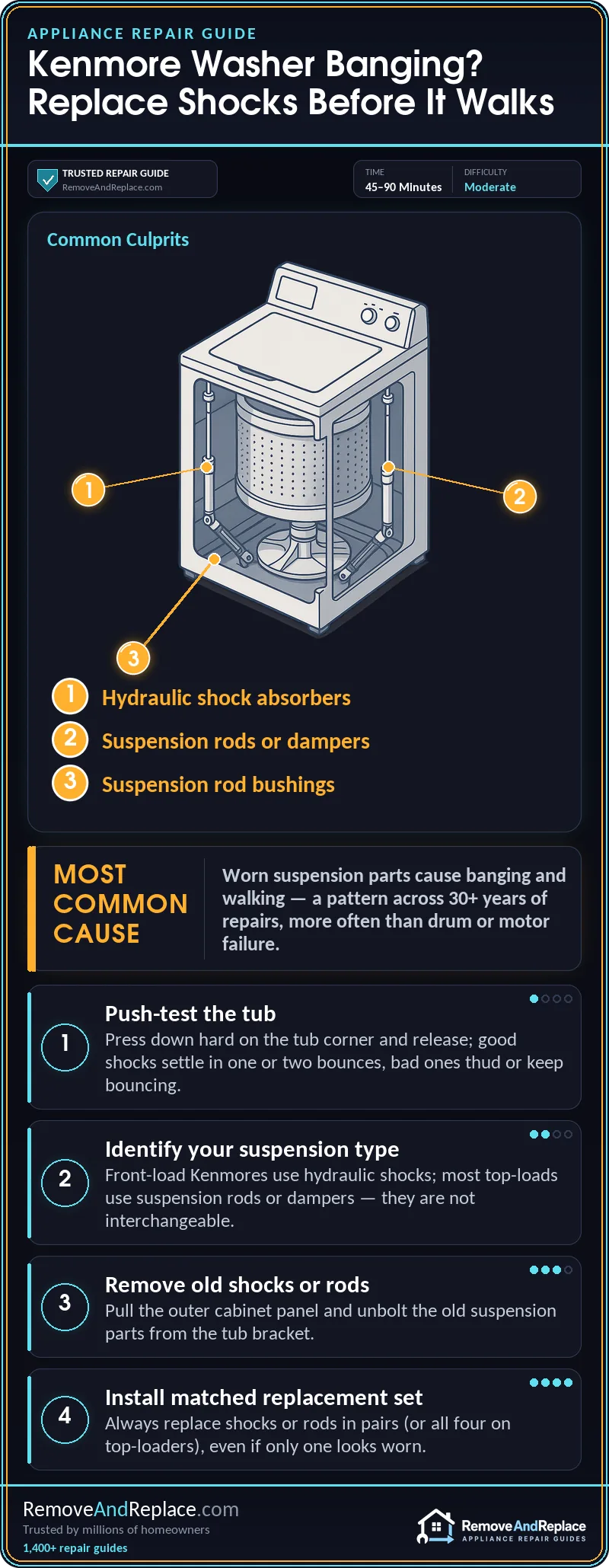
When a Kenmore washer starts banging, thumping, or walking across the laundry room during spin, worn suspension parts are the usual culprit — a pattern that shows up the same way over and over across more than 30 years of hands-on appliance and equipment repair — more often than the drum, motor, or bearings people blame first. Front-load Kenmores use a pair (sometimes two pairs) of hydraulic shock absorbers bolted between the tub and the cabinet base. Most top-load Kenmores use suspension rods or dampers that look more like a spring wrapped in a rubber sleeve. Either part loses its resistance over years of use, and once that happens the tub swings freely during spin instead of staying controlled. The fix is to replace the shock absorbers a Kenmore Washer uses as a full matched set, not swap out a single part. Most people with basic hand tools finish the job in under two hours, and diagnosing which part actually failed matters more here than the wrench work itself.
Get the wrong part off the shelf because you didn’t check which suspension design your model actually uses, and you’ll be making a second trip.
How to Tell Which Suspension Part Actually Failed
Before you replace the shock absorbers Kenmore Washer parts stores sell you, run this simple push test first:
- Push down hard on one corner of the top of the tub (front-loaders) or the outer tub through the top-load lid opening, then let go fast.
- Watch how the tub settles. A good shock or damper absorbs the motion, and the tub settles in one or two soft bounces.
- Compare against a bad part’s behavior — it either bottoms out with a thud, keeps bouncing for several seconds, or barely resists at all.
- Note the direction of any looseness. If the tub feels loose and wobbly side to side rather than bouncy up and down, that points more toward a spring or a suspension rod bushing than the shock itself — a distinction most parts-store pages skip over.
Run that push test before you order any part number (I do this every time, even on models I’ve already worked on). For more background on this part specifically, this guide to troubleshooting and replacing a washing machine shock absorber covers the general diagnosis steps across brands.
This video walks through pulling the outer cabinet panel, unbolting the old shocks from the tub bracket, and getting the new ones seated and torqued down correctly. It’s a good visual reference for the bracket angle, which is the part people usually fumble on their first attempt. Watch it once before you start pulling bolts.
Front-Load vs. Top-Load Kenmore: You’re Not Replacing the Same Part
This is where most generic parts-page articles fall apart. They treat “shock absorber replacement” as one universal job, but Kenmore sells two different suspension systems depending on the washer style. Kenmore Elite front-load washers built by LG (many carry a 417-prefix model number and were sold roughly 2010-2016) use a dual-stage hydraulic shock — a piston inside a sleeve. It’s bolted at both ends with a bracket that has to come off in a specific order, or you’ll strip the mounting ear. Unbolt the tub-side bracket first instead of the base bracket and the shock twists sideways while it’s still under spring tension, which is how that mounting ear gets stripped. Standard 110-prefix top-load direct-drive Kenmores use suspension rods (some call them dampers) that thread onto pivot pins near the tub’s base. No hydraulic fluid is involved — just a spring-loaded rod that wears out mechanically instead of losing hydraulic resistance.
If you’ve got a top-loader and the machine sounds like loose change in the motor housing during agitation, that’s usually the rod bushings drying out and rattling against the pivot pin, not the rod itself failing.
The Wrong Fix Almost Everyone Tries First
The first thing most people do when a washer starts thumping is crank down every suspension bolt they can find, figuring tighter means quieter. It doesn’t. Suspension rods and shocks are built to flex and absorb motion. Cinching them down solid just transfers the vibration straight into the cabinet frame, and the clunking usually gets louder, not quieter. If you catch yourself reaching for a wrench to “just tighten it up,” stop. That’s not a fix — it’s a way to strip the mounting threads and turn a $25 part into a cracked tub bracket.
Tools and Parts You’ll Need
Before you replace the shock absorbers Kenmore Washer models use, gather these tools first: a 3/8-inch socket set, needle-nose pliers, a flat prybar for popping the tub clamp ring on some front-load models, and a small tray or magnetic dish to keep track of hardware. You’ll pull more small bolts than you expect, and losing one mid-job is annoying (don’t ask how I know). A Torx T20 bit shows up on some newer Kenmore cabinet screws too, so have one handy. On the parts side, PartSelect’s Kenmore suspension parts listing will show you exactly which shock or rod set matches your model number. RepairClinic’s shock absorber parts page is a good second place to cross-check the part number. Double-check either against your washer’s actual model tag before ordering — front-load and top-load parts aren’t interchangeable and look similar enough in a thumbnail photo to fool you. If you’re new to appliance repair in general, this guide to repairing a broken washer covers the basics of working safely inside a washer cabinet.
How Do You Replace Front-Load Kenmore Shock Absorbers?
- Unplug the washer and pull it away from the wall enough to access the back panel comfortably.
- Remove the rear or lower access panel — on most front-load Kenmores this is a few Torx or Phillips screws along the bottom edge.
- Locate the shock absorbers — they run diagonally or vertically between the outer tub and the cabinet base, usually two or four of them depending on the model.
- Unbolt the cabinet-side end first, then the tub-side bracket — doing it in this order keeps the shock from twisting under spring tension while you’re removing it.
- Compare the old shock to the new one before installing — confirm the bracket ends match and the length is identical.
- Bolt in the new shock, tub-side first this time, then the cabinet-side end, torquing snug but not overtightened.
- Repeat for every shock in the set — replace them all together even if only one tested bad.
- Reinstall the access panel and run an empty spin cycle to confirm the banging is gone.
How Do You Replace Top-Load Kenmore Suspension Rods?
- Unplug the washer and remove the top panel or cabinet screws per your model’s service points, usually along the back edge under the control panel.
- Tilt the cabinet top back or remove it to expose the tub and suspension rod mounts.
- Locate the suspension rods — there are usually two or four, running from the tub base down to the cabinet frame at an angle.
- Detach the lower pivot pin first using needle-nose pliers to pop the retaining clip, then the upper mount.
- Install the new rod upper mount first, then snap the lower pivot pin clip back into place.
- Replace all suspension rods in the set, not just the worn one — mismatched resistance between old and new rods causes the tub to rock unevenly.
- Reinstall the cabinet top and run a spin cycle empty to check for remaining noise or movement.
Disconnect power before opening either cabinet. Front-load washers especially can have residual water weight in the tub that shifts unexpectedly once a shock is removed. Support the tub with a strap, or have a second person hold it steady while you work on the last shock or rod in a set, since nothing else is holding the tub centered at that point.
When to Call a Pro Instead
A shock absorber kit for most Kenmore front-load models runs $25-45 on RepairClinic, and top-load suspension rod sets run about $15-25 a pair. A service call for this same repair typically runs $150-250 once labor is added. Doing it yourself saves real money if you’re comfortable working inside a cabinet panel with hand tools.
- Call a pro if the outer tub itself is cracked or leaking around the shock mounting bracket.
- Call a pro if you can’t get the tub-side bracket bolt to break loose without excessive force — stripped brackets aren’t a DIY-friendly fix.
- Call a pro if this is a front-load Kenmore Elite under warranty — a DIY teardown can void coverage on a machine that’s often still worth repairing under the manufacturer’s terms.
How to Keep This From Happening Again
Overloading the tub is the single biggest thing that shortens suspension life. Jamming in one more towel than the drum comfortably holds puts uneven stress on the shocks or rods every cycle. Check that all four leveling feet are actually touching the floor and locked with their jam nuts every six months or so. An unlevel washer works the suspension harder than it’s designed for, and that’s a five-minute check with zero cost. If the machine sits on an upper floor or over a finished ceiling, a rubber anti-vibration pad under each foot takes real strain off the suspension parts long-term. For more general noise-prevention habits, see these steps for quieting a washing machine.
My first instinct used to be to just replace whichever shock looked the worst and call it done. I don’t do that anymore. Mismatched resistance between an old and new shock puts the tub off-balance in a way that’s honestly worse than leaving both old ones in — so now it’s always the full set or nothing.
If your washer’s noise problem turns out to be something other than the suspension entirely, this guide to washer noise during the spin cycle walks through the other usual suspects.
FAQ
Can I replace just one shock absorber instead of the whole set?
Technically you can, but I wouldn’t. Mismatched resistance between an old shock and a new one throws the tub off-balance, and you’ll likely be back in there within a few months replacing the second one anyway.
How do I know if my Kenmore washer uses shocks or suspension rods?
Front-load models use hydraulic shock absorbers. Most top-load direct-drive models (110-prefix) use suspension rods or dampers instead. Check your model number against the parts diagram before you replace the shock absorbers Kenmore Washer parts stores list — the two aren’t interchangeable.
Is a washer walking across the floor always a suspension problem?
Not always, but it’s the more common cause once you rule out a couple of quick things first:
- Redistribute the load and rerun the spin cycle to rule out an unbalanced load.
- Check that all four feet are level and locked with their jam nuts.
- If both check out fine, suspect worn shocks, springs, or suspension rods next.
I always check leveling first since it’s free. If the feet are solid and the load’s fine, the suspension parts are next on the list.
How long does this repair actually take?
Budget about 90 minutes the first time through a full set, closer to 45 minutes once you’ve done it before and know exactly which panel comes off. Front-load models generally take a bit longer than top-load rod replacements.
Will a bad shock absorber damage other parts of the washer if I wait?
Eventually, yes. A tub that’s swinging freely during spin puts extra stress on the drive belt, bearings, and cabinet frame. A small delay on a $30 shock can turn into a cracked tub bracket that costs a lot more to fix.

Written by Keith Schneerer
Certified Appliance Tech · Founder, RemoveAndReplace.com
Keith has spent 30+ years repairing machines, starting as a military mechanic and later maintaining food processing equipment before moving into appliance repair. He founded RemoveAndReplace.com to share field-tested repair advice.
More about Keith →