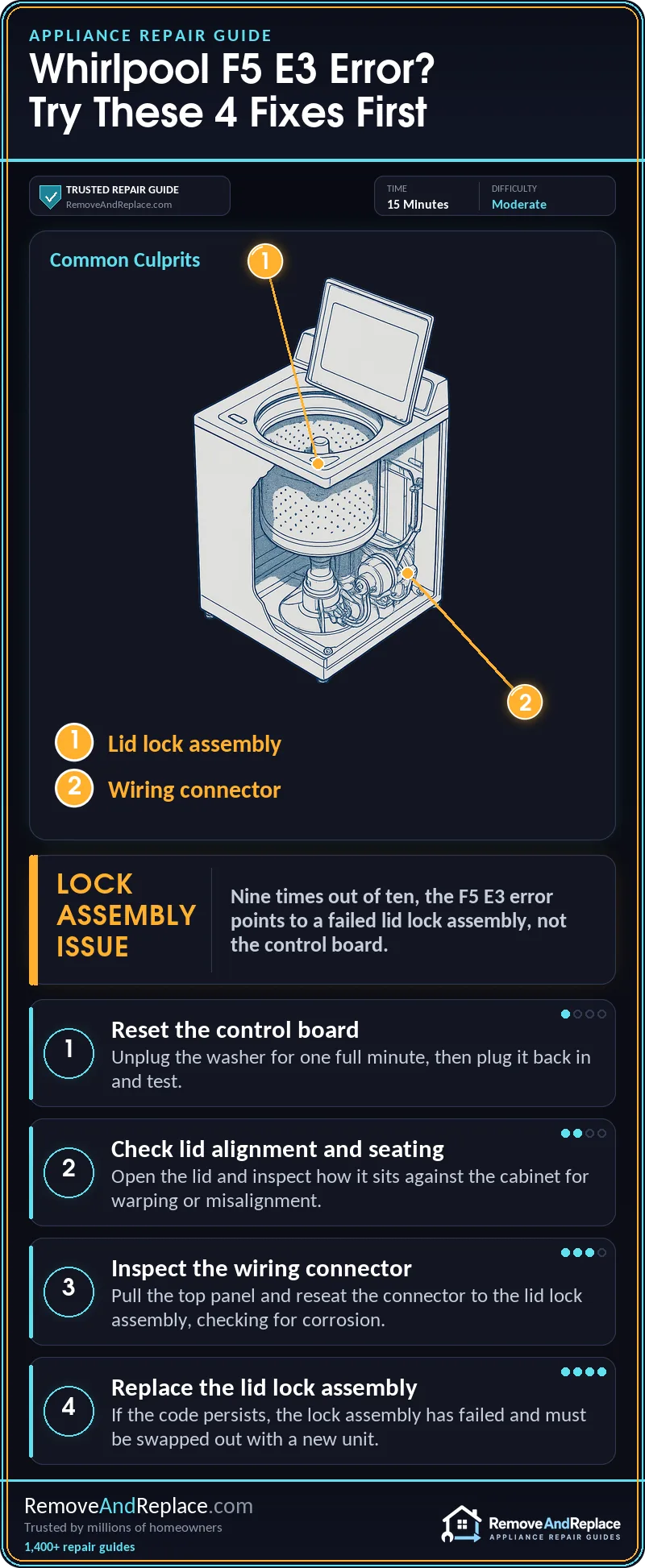
F5 E3 on a Whirlpool top-load washer means the control board sent a signal to latch the lid lock and never got confirmation the latch actually engaged. It’s not a random glitch — the machine is telling you the lock circuit failed a specific test, and nine times out of ten that points straight at the lid lock assembly itself, not the main control board.

This short clip from Whirlpool walks through the same F5 E3 code on a top-load washer and shows roughly where the lock assembly sits under the lid, which helps if you’ve never had this panel open before.
I’ve spent enough time chasing electrical faults on aircraft systems in the Air Force to know that a “signal not confirmed” error almost always means the sensor or switch failed to close, not that the brain telling it to close is bad. Same logic applies here. The washer’s control board asks the lock to engage, waits for a return signal from a switch inside the lid lock assembly, and if that switch doesn’t report back within the expected window, it throws the Whirlpool F5 E3 Lid Lock Error and stops the cycle.
What Actually Causes F5 E3
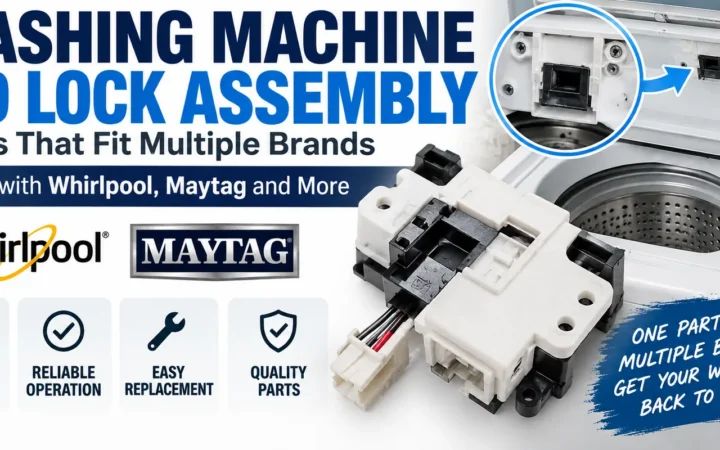
The lid lock assembly on most Whirlpool top-loaders is a sealed unit — it’s not something you open up and clean or adjust. Inside it there’s a small motor or solenoid that pulls the latch closed, plus a switch that confirms the latch is seated. When that switch wears out, gets stuck, or the wiring connector corrodes, the confirmation signal never makes it back to the board, and you get the Whirlpool F5 E3 Lid Lock Error instead of a completed cycle.
A few things can cause the same code without the lock assembly being bad:
- A wiring harness connector that’s loose or backed out at the lid lock or the control board
- A bent or misaligned lid that isn’t seating the strike properly, so the lock never fully engages
- A control board that’s lost calibration after a power surge (less common, but it happens)
If you’re seeing other codes crop up on the same machine, it’s worth checking a full washer error code reference for front and top load machines so you’re not chasing two problems as if they were one.
How I’d Troubleshoot It
Start simple before assuming the worst. Unplug the washer for a full minute to force a hard reset of the control board — that alone clears a fair number of these codes if it was a one-time communication hiccup rather than a failed part. Plug it back in, close the lid firmly, and start a cycle.
If F5 E3 comes right back, open the lid and look at how it sits against the cabinet. A lid that’s slightly warped or a strike that’s not lining up with the lock mechanism will keep the switch from ever confirming a full latch, and the washer has no way to know the difference between “lid open” and “lid closed but not sensed.” I’d also pull the top panel and check the wiring connector running to the lid lock assembly — reseat it, look for corrosion or a pin that’s backed out of the housing.
None of this requires special tools, and it’s the same first pass I’d run through on any electrical fault before condemning a part outright — confirm the signal path is intact before you replace anything.
When the Lid Lock Assembly Needs Replacing
If the connector’s good, the lid sits flush, and the code still comes back every cycle, the lock assembly itself has failed and needs to be swapped. Whirlpool’s own support page on this exact fault, the F5 E3 error code video for top-load washers, walks through the same confirmation before pointing at the lock assembly, which matches what I’ve found working on these.
Replacement isn’t a bad DIY job if you’re comfortable with basic hand tools — it’s usually a matter of removing a few screws under the top panel, unplugging the old harness, and swapping in the new assembly. Repair Clinic has a solid step-by-step for the Whirlpool top-load lid lock assembly replacement (W11394572), and PartSelect lists the correct OEM part for many of these models as the WPW10619844 lid lock assembly — worth checking your model number against either listing before you order, since Whirlpool has used a few different lock assembly designs across its top-load lineup.
One thing I’d flag: don’t try to force the lid closed or jam something into the lock mechanism to trick the switch. It won’t fool the control board, and it’s a good way to crack the plastic housing on a part you’re about to replace anyway.
If Water Is Left Sitting in the Tub
Because F5 E3 usually stops the cycle before it drains, you may open the lid to a tub full of water once you finally get it unlocked. If that happens, this guide on clearing standing water out of a washing machine covers the safe way to drain it manually before you start troubleshooting the lock itself.
And if you’re dealing with more than one appliance throwing codes around the house, the same troubleshooting mindset applies elsewhere — the dishwasher error code guide covers a similar logic of confirmation-based faults versus true component failures.
Bottom line on the Whirlpool F5 E3 Lid Lock Error: rule out the connector and lid alignment first, and if the lock still won’t confirm closed after a reset, replace the lid lock assembly rather than the control board — that’s where this fault lives almost every time.

Written by Keith Schneerer
Certified Appliance Tech · Founder, RemoveAndReplace.com
Keith has spent 30+ years repairing machines, starting as a military mechanic and later maintaining food processing equipment before moving into appliance repair. He founded RemoveAndReplace.com to share field-tested repair advice.
More about Keith →