Nearly everyone I talk to about this assumes the tank is worn out and needs replacing. Most of the time the tank is fine, and one cheap part or one dial setting is doing the damage. The trick is reading how the hot water fades, because the pattern points at the cause.
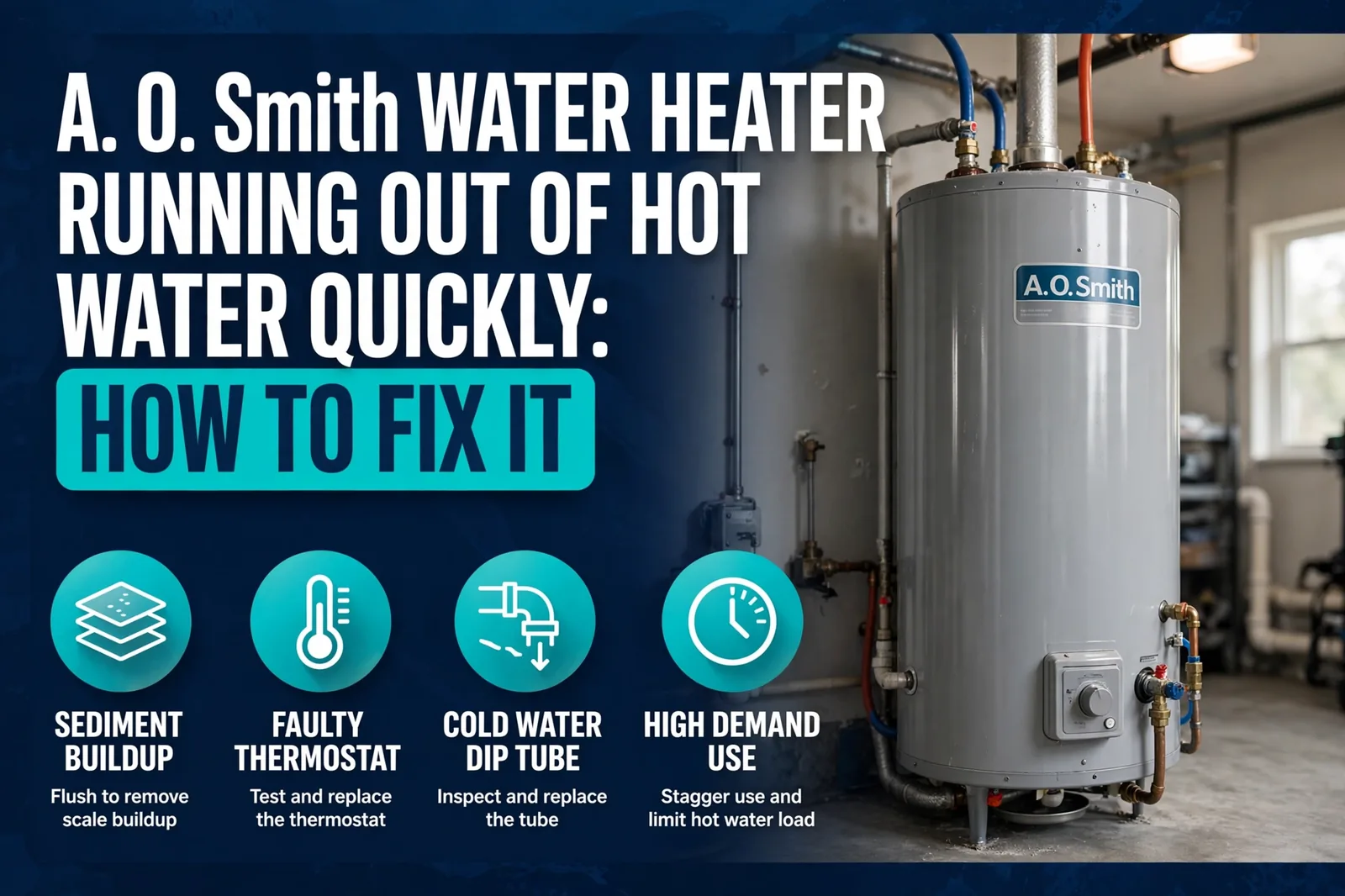
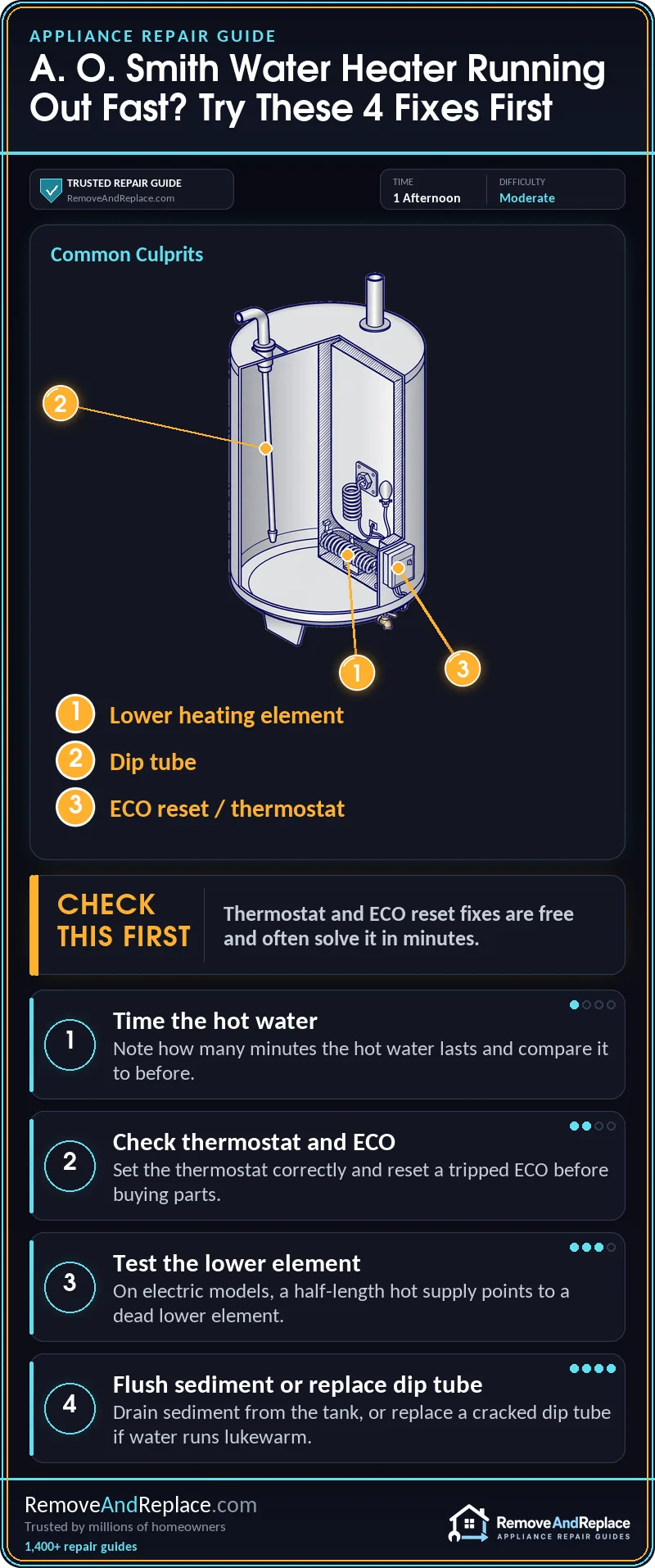
An A. O. Smith water heater running out of hot water fast usually has a dead lower element (electric) or a low thermostat setting (gas). Time how long the hot lasts: about half as long as before points to the element, while lukewarm that never recovers points to a broken dip tube.
Why an A. O. Smith Heater Runs Cold Early
A tank heater only has so much hot water stored, and anything that shrinks that usable volume makes you feel it in the shower. The usual culprits are a heat source that has stopped doing half its job, a thermostat set too low, sediment taking up space inside the tank, or a dip tube that has cracked and is sending cold water to the wrong place. I worked on commercial dishwashers for 11 years, and water heating there follows the same logic: heat source, thermostat, and whatever is sitting in the bottom of the tank. Start with the free checks, because they solve more of these than a new part does. Then match your symptom to the table below before you buy anything.
| Cause | Likelihood | Fix Cost | DIY Time |
|---|---|---|---|
| Thermostat set too low or tripped ECO reset | Common | Free | Minutes |
| Dead lower heating element (electric) | Most common on electrics | Low | An afternoon the first time |
| Sediment buildup | Common | Free to low | An afternoon |
| Broken dip tube | Less common | Low | An afternoon |
| Tank too small for the household | Less common | High | Pro job |
The Wrong Assumption, and the Wrong Fix
The wrong assumption is that a heater that runs out fast is “dying.” Tanks usually fail by leaking, not by gradually losing capacity. A short supply is almost always something fixable inside or on the heater.
The wrong fix is cranking the thermostat to the maximum. That doesn’t add a single gallon, and it raises the scald risk while shortening the life of the tank. If you want to see where the dial belongs, I walked through it in water heater temperature settings for gas and electric.
Time It First: A Free Diagnostic
Fill a tub with hot water or run a shower, and note how many minutes it stays hot. Then write that number down. Compare it with what you remember from when the heater was working well. Don’t guess the numbers; your own before-and-after is the useful part.
- Hot lasts about half as long as it used to: on an electric unit, suspect the lower element.
- Water turns lukewarm and stays that way: suspect the dip tube, since cold water is mixing in near the top.
- No hot water at all: that’s a different problem, usually a tripped reset or a dead upper element on an electric, or a pilot or ignition problem on a gas model.
- Hot water gets worse in winter: incoming water is colder, so the heater has more work to do. That’s normal and not a failure.
Video: What This Repair Looks Like
The video below shows a water heater that runs out of hot water too quickly and walks through the common causes. Watch it before you open any panels, because seeing how the element and thermostat sit behind the access covers makes the steps further down easier to follow.
Read this before any step below. Unplug the appliance or switch off its breaker before you touch anything. Shut off the water supply to the appliance before you disconnect any hose or valve. Shut off the gas supply before you work on any gas component, and if you smell gas, leave and call your gas utility. Water from the tank and drain valve can scald, so use a hose run to a drain and let the tank sit a while before you open anything.
Check the Thermostat and the ECO Reset
This costs nothing, so do it first.
- On a gas model, find the temperature dial on the gas valve, since it may have been bumped down.
- Compare the setting to the label. If the valve flashes an error code, the label on the valve explains what the flashes mean.
- On an electric model, switch off the breaker and confirm the power is off.
- Open the upper access panel and look for the ECO (high-limit) reset button on the upper thermostat.
- Press the button if it has tripped. That may restore the heat, but a unit that trips again needs a closer look.
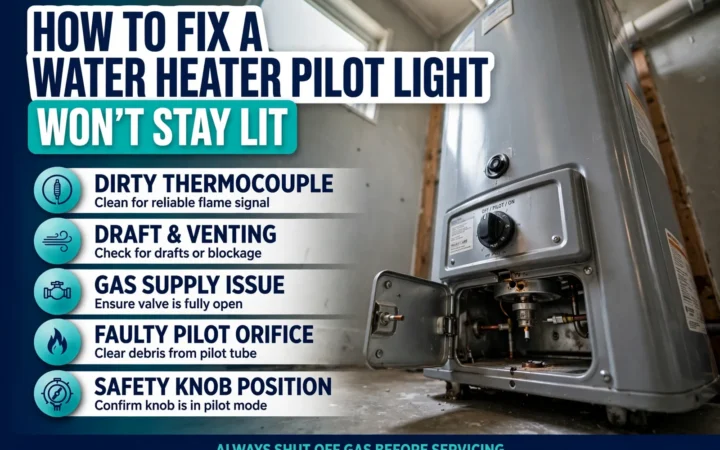
If the pilot is out, this is where I’d go next: how to fix a water heater pilot light that won’t stay lit. For a reset that keeps tripping, I covered that in electric water heater reset button keeps tripping.
Replace the Lower Heating Element (Electric)
A dead lower element is the classic reason an electric tank runs out in about half the time. The upper element still heats the top of the tank, so you get some hot water, but the bottom half stays cold. Check the element for continuity with a multimeter while power is off. If it reads open, replace it with an element that matches the wattage and type printed on your heater’s rating plate. Don’t guess the wattage.
- Switch off the breaker and confirm the power is off at the heater with a tester.
- Shut off the cold water supply to the heater, then open a hot faucet in the house to let air in.
- Drain the tank with a hose run to a floor drain or outside until it is below the element.
- Remove the lower access panel and insulation, then disconnect the wires from the element.
- Unscrew the old element with an element wrench or deep socket, and fit the new one with its gasket.
- Reconnect the wires, close the drain valve, then reopen the cold supply. Leave a hot faucet open until water runs steady, which shows the tank is full. Only then switch the breaker back on. Powering a dry element burns it out quickly.
Flush Out Sediment
Hard water leaves mineral scale in the bottom of the tank, and the Phoenix area has plenty of it. That scale takes up space where hot water should be, and on a gas unit it insulates the burner from the water. A rumbling or popping sound while it heats is the common tell. Flush it using the same shutoff sequence as the element job, and stop only when the water from the hose runs clear.
Replace a Broken Dip Tube
The dip tube carries cold water to the bottom of the tank. When it cracks, cold water pours in near the top and mixes with the hot, so the water goes lukewarm fast and doesn’t recover. Plastic flecks in aerator screens are a giveaway. Replacing it means disconnecting the cold inlet nipple, pulling the old tube, and sliding in a new one of the same length.
Before You Order Any Part
Check the rating plate on the side of the heater for the model and serial number, the wattage (electric), and the tank capacity. A pass is a plate that matches the part you’re buying. A fail is a guess. If the element tests open, it’s the part. If it tests fine, look at the thermostat, sediment or dip tube instead.
Is Your Tank Simply Too Small?
If everything checks out and the heater has always run short, it may be sized wrong for your household. The yellow EnergyGuide label lists a first-hour rating, which is how much hot water the heater can deliver in an hour starting full. ENERGY STAR’s water heater sizing guidance explains how to match that rating to your household’s peak demand.
Sediment Is Not the Same as the Rotten Egg Smell
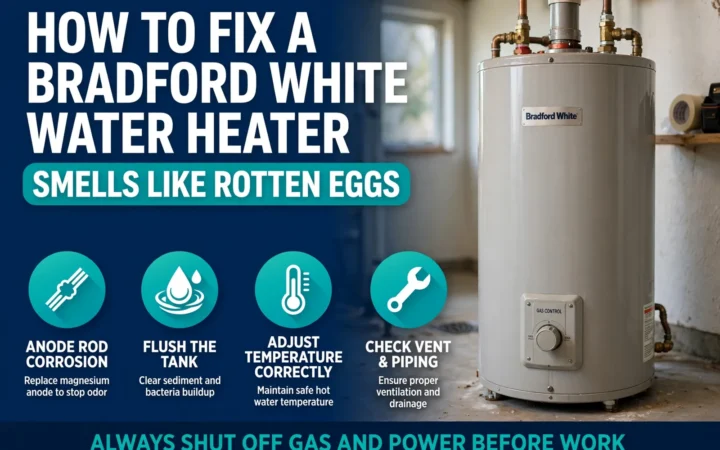
Two sentences on this: if you also notice a sulfur smell, that’s a different problem than capacity. See the Bradford White rotten egg fix, which applies to most tank heaters.
When to Call a Pro
Call a licensed plumber for anything involving the gas valve, burner assembly or a flue problem, and for replacing an undersized tank. The same goes for a heater that leaks from the tank itself. If a new element or dip tube doesn’t change the result, a pro can test the thermostat and wiring.
Keep It From Happening Again
Flush the tank once a year, and sooner if your water is hard. Keep the thermostat at a sensible setting rather than the maximum.
FAQ
Why does my water heater run out of hot water so fast?
A failed lower element on an electric model, sediment, a low thermostat setting or a broken dip tube are the usual causes. A clogged or leaky tank is rarer than any of them, so run the timing test before you replace anything.
How can I tell if the dip tube is broken?
The water goes lukewarm and stays that way even though the heater is running. I’d also look for little white plastic bits in your faucet screens.
Can I just turn the thermostat up?
No.
Does the A. O. Smith water heater running out of hot water usually mean replacement?
Not in my experience. Most of these are an element, a dip tube or built-up sediment, and a tank that’s still sound is worth fixing rather than replacing.
How often should I flush my tank?
Once a year is a good habit, and more often with hard water. I used to skip it until I started seeing how much scale comes out, and now I don’t skip it.
How do I find my heater’s tank size?
Look at the rating plate on the side of the tank, which lists the model and capacity. The model and serial number also let you look up the exact specs with A. O. Smith.

Written by Keith Schneerer
Certified Appliance Tech · Founder, RemoveAndReplace.com
Keith has spent 30+ years repairing machines, starting as a military mechanic and later maintaining food processing equipment before moving into appliance repair. He founded RemoveAndReplace.com to share field-tested repair advice.
More about Keith →