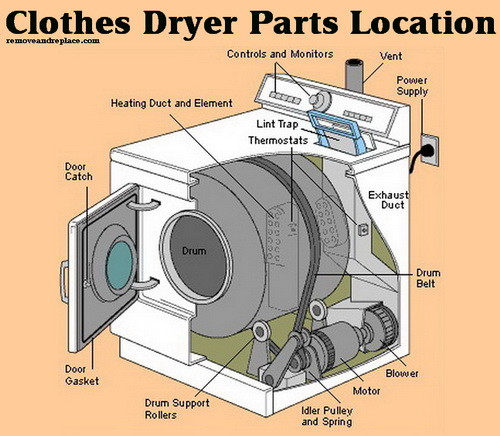
Here’s what’s actually happening inside a dryer that won’t heat: hot air only gets generated and pushed through the drum when air can move freely from the intake, past the element or burner, through the wet clothes, and out the exhaust vent. Block that path anywhere and a safety thermostat shuts the heat down before it ever reaches your clothes — long before the heating element itself would ever fail on its own. Any mechanical system built around moving air behaves this way, whether it’s an aircraft engine or a clothes dryer — a lesson from 19 years of Air Force aircraft maintenance that still applies here: when something that’s supposed to flow can’t, everything downstream stops working the way it should.

Almost every dryer that suddenly stops producing heat, or takes twice as long as it should to dry a load, is dealing with restricted airflow — not a dead part. Checking airflow before assuming a part failed is the first move worth making, and in my experience the fix, most of the time, costs nothing.

A dryer not heating is almost always an airflow problem rather than a broken part. Clean the lint filter and clear the exhaust vent hose before replacing anything. If the drum still won’t turn or heat comes back briefly then quits, a tripped thermal fuse — usually caused by that same restricted airflow — is the next likely cause, and it’s an inexpensive, straightforward swap.
- Most dryers that “won’t heat” are choking on lint somewhere, not failing internally
- Clean the lint filter, then the full vent hose, before assuming a part is bad
- A blown thermal fuse almost always means airflow was restricted first — it rarely fails on its own
- A vent packed with lint is a real fire risk, not just a slow-drying nuisance
| Cause | Likelihood | Fix Cost | DIY Time |
|---|---|---|---|
| Clogged lint filter | Most common | Free | 5 min |
| Clogged or kinked vent hose | Very common | Free–$15 | 20–30 min |
| Overheated motor (thermal shutdown) | Common | Free | ~1 hour cool-down |
| Blown thermal fuse | Less common | $10–20 | 30 min |
| Heating element burnt out | Less common | $40–70 | 45–60 min |
| Loose electrical plug/socket | Uncommon | Free | 10 min |
Most people assume a cold dryer means a dead heating element. In my experience it’s airflow blocked somewhere between the drum and the outside vent nine times out of ten — the element itself rarely fails on its own, and I don’t see a reason to order one until you’ve ruled that out.
Clean the Lint Filter First (Most Common Cause)
If your dryer suddenly stopped drying clothes in a normal amount of time, or stopped producing heat entirely, the lint filter is the first thing I check — no tools required. Lint builds up on the screen every cycle, and once it forms a solid mat, air can’t pass through it. Without airflow moving past the heating element, the dryer’s safety thermostat senses the buildup and cuts the heat before it reaches your clothes. Pull the lint screen out, peel the fuzz off by hand, and rinse it under warm water if it feels waxy from dryer sheet residue. Run a short test cycle after that. If your dryer heats normally now, that’s the whole repair, and it cost you five minutes and nothing else. If it’s still running cold, the next likely cause is right behind the dryer, not inside it.
Check the Vent Hose Next (Second Most Common Cause)
If the lint filter was clean and the dryer is still running cool, the exhaust vent hose running from the back of the dryer to the outside wall is almost always the next problem I look at. This hose collects the lint the screen doesn’t catch, and over months it packs in tight enough to block airflow completely — which trips the same safety thermostat a clogged filter does. A standard 4-inch dryer vent hose doesn’t need much buildup to go from restricted to fully blocked, which is why a filter that “looks fine” still leaves you with a dryer that won’t heat. I’ve pulled hoses that looked spotless from outside but were nearly solid inside, so I never trust a quick glance at either end. Unplug the dryer, pull it away from the wall carefully, and disconnect the hose at both ends by squeezing the metal clips and pulling outward. Run a long vent brush through the inside of the hose and clean out the wall opening behind it too — lint collects on both sides, not just one.

Once it’s clean, reattach the vent hose and slide the dryer back into place without kinking it — a kinked hose blocks airflow just as badly as a clogged one does. I’d tell anyone to clean this hose once a year, twice if you dry heavy items like towels or bedding often, and you’ll likely never deal with this again.

Why Does My Dryer Run But Not Heat?
If the drum is turning, the light’s on, and the dryer sounds normal but no heat ever kicks in, an overheated motor is a common culprit — especially after a few loads run back to back. Dryer motors have a thermal protection switch that shuts down heat production, and sometimes the whole motor, if things get too hot inside the cabinet. Give the dryer a full hour to cool down before running another test. If it heats normally after that rest, you were probably overloading it — try a smaller load next time and give the machine a few minutes between cycles. If you’re running an LG and getting an actual error code on the display instead of just cold air, I’d try running through a reset before assuming a part failed.
One more thing worth ruling out: if the motor’s running but the drum itself isn’t turning at all, that’s usually a broken drive belt, not a heating issue — clothes that never tumble won’t dry evenly no matter how much heat is present.
Common Mistake: Turning Up the Heat Instead of Checking Airflow
A lot of people bump the dial to the hottest setting when the dryer stops heating, figuring more heat will force its way through. All that does is push a system that’s already restricted even harder — and if the thermal fuse hasn’t blown yet, that’s usually what finally does it. Rule out airflow first, before touching the dial at all — that’s the order I’d follow every time, and it’s what I tell anyone who asks me the same question. If the dryer isn’t heating, the fix is airflow, not a higher setting.
Thermal Fuse, Heating Element, and Other Parts Worth Testing
If you’ve cleaned the filter, cleared the vent hose, and given the motor time to cool, and the dryer still won’t heat, it’s time to test parts with a multimeter instead of guessing. The most common failure at this stage is the thermal fuse — a one-time-use safety device that blows permanently once it senses excess heat, usually from the same airflow restriction you already fixed. It won’t reset itself; it has to be replaced. I’ve also seen the operating thermostat, the high-limit thermostat, and the heating element itself fail, roughly in that order of likelihood. All of these test with simple continuity checks on a multimeter, and none require pulling the whole dryer apart — just the back or front panel, depending on your model. I always work through them in that order rather than jumping straight to the heating element, since it’s usually the last thing actually at fault.
Always unplug the dryer before removing the vent hose or opening any access panel. If it’s a gas dryer, don’t attempt any gas line work yourself — stick to airflow and electrical checks, and call a licensed technician for anything involving the gas supply.
If you’re testing a thermal fuse for the first time, this walkthrough on replacing the thermal fuse in an electric dryer covers exactly where it sits and how to swap it. For gas dryers specifically, Repair Clinic’s gas dryer troubleshooting guide covers a few extra causes unique to those models, like a bad igniter. If it turns out to be the heating element, PartSelect’s heating element replacement guide walks through the swap step by step.

Keep This From Happening Again
Clean the lint filter every load — that one’s non-negotiable, and it’s the first thing I ask anyone about when they mention slow drying times. Beyond that, I’d pull the vent hose off and clean the inside of it once a year, or twice a year if you’re regularly drying heavy items like towels, bedding, or pet bedding. A packed vent hose is one of the more common causes of appliance-related house fires, so this isn’t only about drying time. While you’re back there, check the outside vent cap too — lint builds up on the outdoor hood just as easily and restricts airflow the same way an internal clog does.
A loose or worn electrical plug can also cause intermittent heating problems, especially on older 240-volt outlets, so it’s worth a look if everything else checks out clean. If you’re eyeing that outlet for other reasons — say, wondering whether it could double as an EV charging circuit — that’s a separate project entirely and not something I’d combine with your dryer’s dedicated circuit.
Most of what’s covered here costs nothing but time. If it does come down to a part, a thermal fuse typically runs $10–20 and takes about 30 minutes to swap. A heating element runs closer to $40–70 and takes 45 minutes to an hour depending on how the model’s built. Compare that to a service call, which commonly runs $150–250 depending on your area — this is one of the more worthwhile repairs to do yourself if you’re comfortable with a screwdriver and a multimeter. You can find a broader rundown of causes on Repair Clinic’s dryer not heating guide if you want a second opinion before ordering anything.
Frequently Asked Questions
How often should I clean my dryer vent hose?
Once a year at minimum, twice if you’re drying heavy stuff like towels or blankets several times a week. It’s the single easiest thing you can do to keep this problem from coming back, and it’s the first maintenance step I’d recommend to anyone.
Can a dryer run without heat and still be safe to use?
Technically yes, but I wouldn’t keep running it that way. A cold dryer usually means airflow is restricted somewhere, and that same restriction is what leads to lint fires. Fix the airflow before you keep drying loads in it.
Will a clogged vent hose trip my dryer’s circuit breaker?
Not usually — a clogged vent trips the thermal fuse or safety thermostat, not the breaker. If your breaker is actually tripping, I’d look toward an electrical issue instead, like a short in the heating element or a loose connection.
Is it normal for the thermal fuse to blow more than once?
It shouldn’t happen repeatedly. In cases I’ve seen where it blows twice on the same dryer, it traced back to a vent that never got fully cleared the first time. If it blows again, I’d recheck the entire vent run, not just the fuse.
Do gas dryers have the same heating problems as electric ones?
The airflow causes are identical — lint filter, vent hose, thermal fuse. I check airflow the same way on gas models before touching the burner assembly. Gas dryers add the burner assembly and igniter into the mix, so if you’ve already ruled out airflow, I’d check those before assuming it’s the same fix as an electric model.
Related Guides

Written by Keith Schneerer
Certified Appliance Tech · Founder, RemoveAndReplace.com
Keith has spent 30+ years repairing machines, starting as a military mechanic and later maintaining food processing equipment before moving into appliance repair. He founded RemoveAndReplace.com to share field-tested repair advice.
More about Keith →
Amanda,
The fan in your Kenmore dryer is either burned out and needs to be replaced, or the wiring connection is loose or damaged.
Check the wiring harnesses for damage or simply being loose.
Reconnect the wiring if needed.
If you believe the blower fan in your dryer is bad, type the model number of the Kenmore dryer into Google.
Find your Kenmore dryer on an appliance parts website and find the blower fan part number.
Order the fan and remove and replace.
This will be cheaper than hiring a technician or buying a new dryer.
Make sure you shop around to find the best price for the part you need.
Even try Amazon if possible as they have many parts for appliances and next day shipping.
Watch some YouTube videos to see how to take the dryer apart and replace the blower fan.
If you need additional assistance, please let us know.
-RR
I have a Kenmore, front load, stackable dryer. It has heat and the drum turns, but the fan seems to have stopped working. There is no airflow at all. We have cleaned the hose and trap fully. We have taken the hose off and the fan still does not blow. What could be the problem? Would it be cheaper to have it fixed or just buy new. We got them second hand but they are probably only about 5 years old.
Thanks for the quick response.
He did not check anything other than the outside vent. Once he cleared the airflow, we immediately got heat. So he collected his payment and left. He mentioned that if they dyer got heat, then the thermal fuse should be working fine and it did not get blown or need replaced.
I did find the model number for the GE Dryer – DHDVH52GF1WW – and also discovered it is gas not electric.
If it is the thermal fuse, is there an easy way to replace this myself?
I did not know the lint filter in the dryer was there!
Cleaned it and works great now!
Mitch,
Did the repair guy check the thermal fuse?
You may have a bad fuse or possible faulty thermostat, wiring, or control panel/timer assembly issue depending on the model number of your GE dryer.
The most likely issue is a bad thermal fuse.
Also, be sure you are getting the proper voltage to the dryer, you may have it on 2 breakers and one is tripped.
-RR
Had a repair guy come in and look at our dryer. Our outside vent was clogged causing us to not have heat. After it was unclogged it went back to working, paid the man and thought I learned my lesson on keeping the vents clean.
Came back 2 days later and we are back with no heat. Checked and airflow seems to be good.
Any thoughts on what the problem could be? We have a GE electric dryer – not sure of the model.
Williams,
Yes it will be okay for one load. This troubleshooting procedure will tell you if the problem is in the wall (lint build-up) or if the dryer is not drying as designed and a part needs to be replaced.
-RR