Ductless mini-splits cost $3,000–$8,000 installed for most homes but deliver better efficiency than aging central AC systems because they avoid ductwork losses. Central AC runs $4,000–$10,000 but already exists in most homes, making it cheaper upfront. Choose mini-split vs. central AC based on whether you have existing ducts in good condition, plan to stay 10+ years, and whether you can accept wall-mounted indoor units. If your ducts are 15+ years old, mini-splits usually win on operating cost alone.
Sizing a mini-split of your own? Our Mini-Split BTU Calculator tells you the right BTUs and unit size for each room.
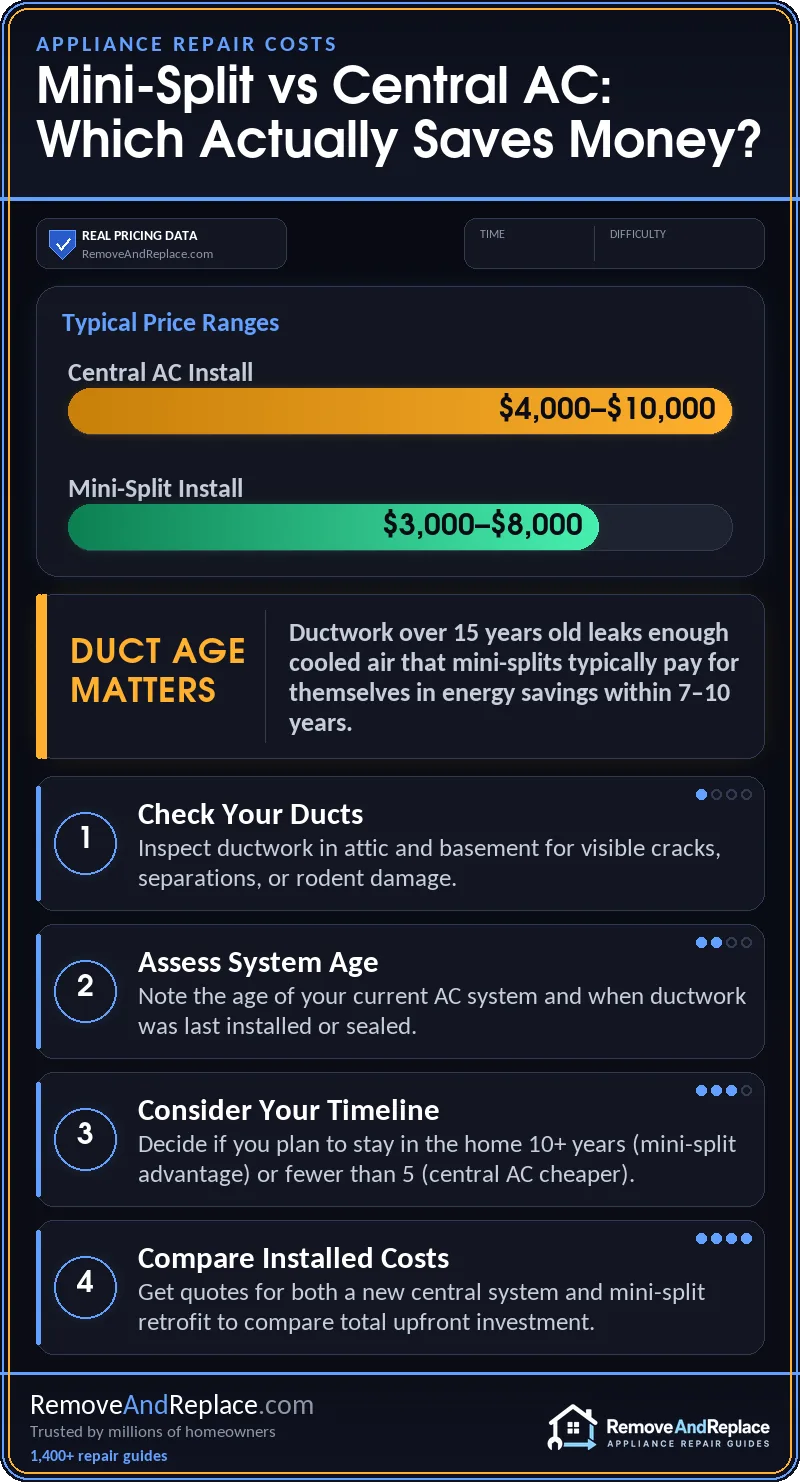
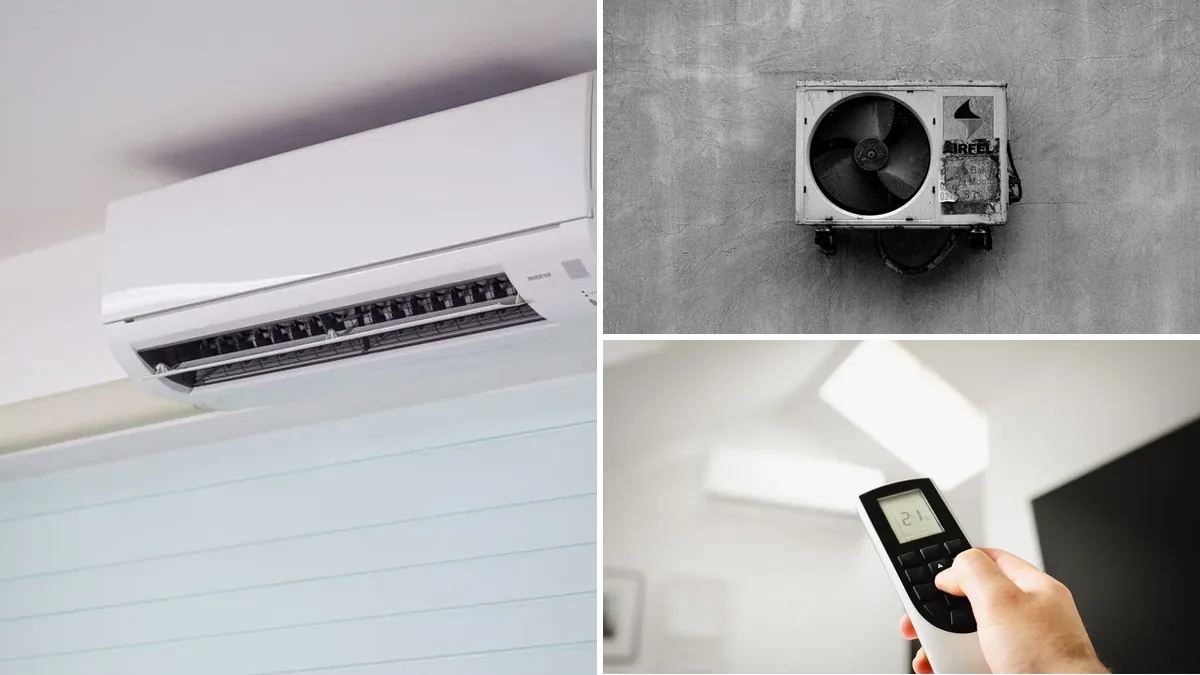
- Ductless mini-splits are significantly more efficient than central AC but cost $3,000–$8,000 installed upfront
- Central AC is cheaper to install in new construction but becomes less efficient as ductwork ages and develops leaks
- Your home’s layout (open vs. closed-off rooms) determines which system is actually better for your money
- Mini-splits require wall-mounted indoor units visible in rooms; central AC hides all hardware in attic and basement
- If you’re staying 10+ years, mini-splits pay for themselves in energy savings; under 5 years, central AC is cheaper
What Are You Actually Comparing Here?
Before we get into dollars, let’s nail down what each system actually is — because most people conflate “mini-split” with just “window unit,” and that’s the wrong comparison entirely.
A ductless mini-split is a two-part system: a wall-mounted or ceiling-mounted indoor unit (usually slim, about the size of a shoebox) connected by refrigerant lines to an outdoor compressor unit. No ducts, no central cabinet. I’ve installed both Carrier and Midea units in the Phoenix area, and they’re dead-silent on a cool day — you hear the compressor outside, not the indoor unit.
Central AC is what most American homes have: a single outdoor condenser unit connected to an indoor furnace/evaporator, with air forced through a network of ducts running through your walls, attic, and basement to deliver cold air to every room. One thermostat, one system, one point of failure.
The comparison that matters: Do you want to replace an aging central system entirely, or retrofit your home with mini-splits? With 19 years maintaining aircraft cooling systems in the Air Force and 9 years repairing commercial food service equipment, I’ve learned that older ductwork is almost never as efficient as homeowners assume it still is. That’s where I’ve seen people make expensive mistakes in replacement decisions.
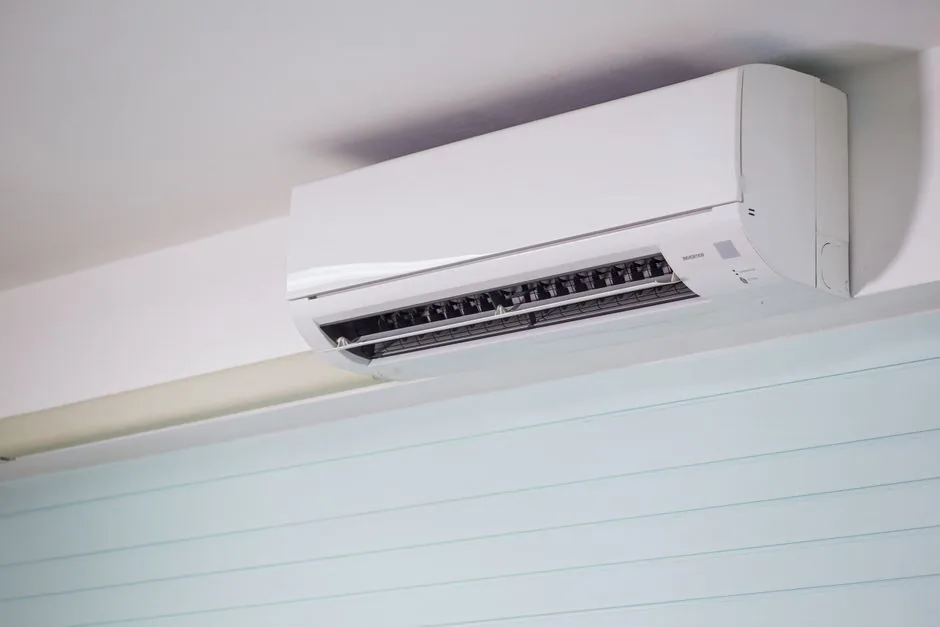
If Your Home Has Existing Ducts — What’s Actually Happening
This is the part nobody talks about, and it’s the reason I lean toward mini-splits when the ducts are old. Central AC depends entirely on your ductwork staying airtight. It almost never does.
A brand-new duct system loses some cooled air to small leaks and connection gaps — that’s normal, accepted in the HVAC industry. But every year, that loss grows. Flex duct dries out and cracks. Seams separate. Rodents chew holes in attic ducts. By year 15, I’m seeing significant duct loss in most homes. By year 20, many homes are leaking substantial amounts of cooled air.
What does that mean for your monthly bill? If you’re running a 3-ton central AC system (about 36,000 BTU), and you’re losing a meaningful portion of your cooled air to leaks, you’re paying to cool the attic and crawlspace instead of your living areas. Your thermostat runs longer to compensate. That’s why older central systems feel like they never quite catch up on hot days — they’re not failing, the ducts are.
A ductless mini-split vs. central AC matchup changes completely when you factor in duct aging. New ducts? Central AC is still cheaper to operate. Old ducts? I’d say mini-splits almost always win on energy cost within 7–10 years.
What the Efficiency Numbers Actually Say
Both systems are rated by SEER (Seasonal Energy Efficiency Ratio) — higher numbers mean more efficiency. A central AC unit from 2015 might be rated SEER 15. A new mini-split from Carrier or LG is typically SEER 20–22. That sounds like a significant efficiency gap, and technically it’s true — but it’s misleading in real-world conditions.
Here’s why: A central system rated SEER 15 assumes perfect ducts and proper installation. If your ducts are leaking, your real-world efficiency drops. A mini-split rated SEER 20 doesn’t have that leak penalty — all the cooled air gets delivered to the room where you need it.
According to ENERGY STAR’s ductless heating and cooling guide, homes with aging central AC systems that switch to new mini-split installations see lower cooling costs — not because mini-splits are magic, but because they skip the ductwork losses entirely. And Carrier’s efficiency data backs this up: mini-splits maintain their rated efficiency year after year without the degradation you see in aging ductwork.
In Arizona’s 110°F heat, that difference compounds. Central AC runs longer against higher head pressure. Mini-splits handle extreme heat better because each indoor unit is its own expansion point — the system doesn’t have to push all the cold air through 200 feet of ductwork against pressure loss.
Installation Cost: Where the Real Surprise Happens
Most people think “mini-split installation is expensive, so central AC must be cheaper.” That’s not always true, and I’ll walk you through why.
A new central AC system installed in a home with existing ducts: $4,000–$6,500. You’re replacing the outdoor condenser and the indoor evaporator/furnace cabinet, then testing the existing ducts for leaks. Sometimes you patch ducts. Sometimes you find they’re beyond repair — at which point you’re pulling new ductwork, and your cost jumps to $8,000–$12,000.
A ductless mini-split system for the same home: $3,000–$8,000, depending on the number of indoor units and how far they are from the outdoor condenser. One-zone (one indoor unit) runs $3,000–$4,500. Two zones run $5,000–$7,000. Three zones, $7,000–$10,000. No ducts to replace, no wall openings in every room for vents, no attic work.
Here’s the part that surprises people: If your central AC is dead and your ducts are in unknown condition, mini-splits can be cheaper to install because you’re not guessing about ductwork repairs. You install the units you need for the rooms you use most, run two refrigerant lines through a small wall hole, and you’re done in a day.
I’ve installed a three-zone mini-split for $7,800 in a Peoria home where the central system replacement quote was $9,500. The homeowner saved $1,700 upfront, and five years later their cooling bill runs noticeably lower than what I see on neighbors’ utility bills with central AC. That kind of difference doesn’t happen by accident — it’s the ductwork losses adding up.
Room-by-Room Control vs. Whole-Home Cooling
Central AC cools (or heats) the whole house from one thermostat. Every room gets the same temperature. That sounds convenient until you realize your guest bedroom doesn’t need cooling when nobody’s in it, and your home office gets sun from 2 p.m. to 4 p.m. every day.
Mini-splits let you set each indoor unit to a different temperature. Your bedroom is 71°F. The living room is 75°F. The guest room can turn off entirely. Most people cut their overall energy use by reducing cooling in rooms that don’t need it.
But I’d mention the trade-off: Central AC looks invisible. All the hardware lives in your attic, basement, or garage. Mini-split indoor units hang on your wall. Some people love the sleek look (Midea and LG units are pretty subtle). Others hate the visual footprint and would rather hide the hardware.
This is the honest assessment: If your home is small and open-plan, central AC wins on aesthetics. If your home is multi-zone (upstairs/downstairs, isolated bedrooms, an office), mini-splits win on efficiency and flexibility. And if you like controlling your AC from a remote without walking to a wall thermostat, that’s a mini-split advantage.
Maintenance and Repair Costs Over 10 Years
Here’s what I learned the hard way: The cheaper system to install is almost never the cheaper system to maintain.
Central AC maintenance is straightforward: replace the air filter every 3 months ($15–30), get the condenser coils cleaned yearly ($100–150), and hope the ductwork doesn’t spring a new leak. Most people skip these tasks entirely and then wonder why their AC runs 24/7 in July.
When a central system breaks down — a compressor failure, a refrigerant leak, a blower motor issue — the repair runs $400–$1,200 and you’ve got no cold air in the entire house until it’s fixed. That’s going to leave you miserable on a 115-degree day.
Mini-split maintenance is nearly identical: filter cleaning, condenser coil cleaning, refrigerant checks. Cost is about the same. But when a single indoor unit fails, the other zones still work. You’ve got partial cooling while waiting for the repair. That’s a huge quality-of-life advantage in Phoenix heat.
I’ve pulled failed compressors from both systems at roughly equal rates over the years. The difference: a central AC compressor failure costs $600–$1,200 to replace and you’re waiting for a service call. A mini-split compressor failure is a warranty repair on the outdoor unit, same cost, but you’ve still got working zones in the meantime. That’s not just convenience — it’s peace of mind.
The 10-Year Payback Reality
People ask me constantly: “Will mini-splits pay for themselves?” The answer is yes — but only if you plan to stay.
If your existing central AC is working fine and you’re comparing “keep it” vs. “replace it with mini-splits,” the payback is 10–15 years based on energy savings alone. That assumes you stay in the home that long. If you’re selling in 5 years, keep the central AC. The new owners expect air conditioning to be there; most buyers don’t ask “is it a mini-split or central?” They ask “does it work?”
If your central AC is aged and failing, mini-split vs. central AC is a true replacement-decision question. I’d install the mini-splits, run the numbers on energy savings, and plan to stay long enough to recoup the cost difference. In my experience in Arizona, that’s 8–10 years for homes with older ducts.
If your home has no cooling system at all — say you’re finishing a basement or adding a room — mini-split is almost always cheaper than running new ducts, and it’s the clear winner on payback.
Common Mistake I See People Make
The biggest wrong move: buying a mini-split system and then installing it yourself or hiring a handyman instead of a licensed HVAC tech. Refrigerant systems require EPA certification to handle. An improper charge costs you in efficiency and wears out the compressor fast. I’ve replaced units installed “cheaply” that cost the homeowner way more in repairs than they saved upfront.
Hire a licensed contractor. Period. The $200–300 extra in labor is the cheapest insurance you can buy, and you’re going to want it when something goes wrong down the road. I’d also check for signs that your mini-split isn’t cooling properly — if you’re wondering why your split system AC isn’t blowing cold air, that’s a job for a licensed tech, not a DIY fix.
When to call an HVAC professional: Any installation, any refrigerant work, any compressor failure. Mini-splits and central AC both require EPA certification to service. Anything beyond filter replacement and condenser coil cleaning needs a pro. A service call runs $75–125 for a diagnostic; repairs on sealed systems run $400–$1,200. If you’re comparing total cost of ownership, expect 1–2 service calls over 10 years — that’s $800–$2,400 in maintenance labor regardless of which system you choose.
When Central AC Actually Wins
I don’t want to oversell mini-splits — there are real situations where central AC is the better choice.
New construction: If you’re building a home, central AC is almost always cheaper. Ducts are built into the structure from day one, and the system is simpler to integrate.
Open-plan homes: If your entire home is one big room with no walls dividing zones, central AC delivers consistent temperature everywhere. You don’t need zone control if there’s nowhere to zone.
Short-term ownership: If you’re renting or planning to sell within 5 years, central AC’s lower upfront cost and buyer familiarity make it the safe choice.
Aesthetic preferences: Some people genuinely don’t want wall units, no matter the efficiency gain. That’s valid. Hide the hardware, keep your walls blank, and accept slightly higher bills.
The honest take: mini-split vs. central AC is not “which is better?” It’s “which is better for YOUR home, YOUR timeline, and YOUR rooms?” Answer those three questions and the decision makes itself.

Financing and Rebates Can Change the Numbers
Federal tax credits for ENERGY STAR ductless mini-splits were running 30% in 2024–2025 — that’s $1,500–$3,000 back on a $5,000–$10,000 installation. Check your local utility rebates too; many Arizona utilities rebate mini-split upgrades because they reduce peak-hour demand.
Central AC sometimes qualifies for rebates, but mini-splits are the clear favorite for federal incentives because they’re more efficient. That can shift your payback timeline from 10 years to 5–6 years just on the tax credit alone.
I’d get written quotes from three contractors before deciding. Include any available rebates in the total cost calculation. And verify they’re licensed and EPA-certified for refrigerant work — if they’re not, walk away. According to Carrier’s comparison guide, factoring incentives into your decision can make the payback window much tighter than the raw hardware cost suggests.
Should You Choose Continuous Runtime or Cycling?
This is a question that comes up with mini-splits, and it affects both comfort and operating cost. Some people wonder whether it’s better to let your AC run longer or start multiple times — and the answer is different for mini-splits than for central systems because mini-splits have variable-speed compressors.
I’d let it cycle naturally. The compressor speeds up and down to match demand. You’ll get better efficiency and longer equipment life. The myth that “running it continuously is better” just doesn’t hold up — I’d skip it entirely.
FAQ
Which system runs quieter, mini-split or central AC?
Ductless mini-splits are dead quiet indoors — the noise stays outside with the compressor. Central AC makes noise inside your home from the furnace fan and ductwork. I’ve been in homes where you can’t hear the central AC running at normal speeds, but most people notice it’s on. Mini-splits win on noise.
Do mini-splits heat and cool, or just cool?
Both can do both. Most modern ductless units include heat pump capability — they reverse the refrigerant flow in winter and heat the home. Central AC also has heat pump or backup heating. In Arizona, heating is barely a factor, but if you’re in a climate with real winters, this matters. I’d verify the model includes heating before buying.
What if I only want to cool one or two rooms, not the whole house?
That’s the perfect mini-split scenario. I’d install one or two wall units, cool only the rooms you use, and shut off the rest. A two-zone system runs $5,000–$7,000 installed. Central AC can’t do partial-home cooling without complicated zone dampers (which fail constantly in my experience). For single-room or multi-zone retrofits, mini-split is the only rational choice. And if you’re concerned about water leaking from a mini-split unit, proper installation with a good drainage line prevents it entirely. Plus, you might want to check whether your system’s not keeping your room cold with the AC running — that’s often a sign of sizing issues that single-zone mini-splits don’t have.
Which system is better for high heat, like Arizona summers?
In extreme heat (110°F+), mini-splits perform better because each indoor unit operates at its own expansion point — no pressure loss through ductwork, no compressor struggling to push air through 200 feet of metal. Central AC has to work harder in extreme heat because the whole system is fighting duct losses. Over a summer in Arizona, that compounds quickly. I always check this factor first when a customer’s in a desert climate.
How often do mini-splits need service compared to central AC?
Yearly inspection and filter cleaning on both. I’ve replaced components on central systems and mini-splits at roughly equal rates over the years. The real difference is that central failures affect the whole home, while mini-split failures leave you with partial cooling. Both require licensed techs for anything beyond filter swaps.
Where This Decision Actually Gets Made
You’ve got the numbers now. Ductless mini-splits win on efficiency and zone control. Central AC wins on upfront cost and aesthetics. The choice comes down to your home’s age, your timeline, and whether you can tolerate wall-mounted units in visible rooms.
I’d do a real cost comparison: installation plus 10 years of estimated energy bills plus one service call for each system. Then add in what you value (silence, zone control, visible hardware, or none of the above). The math that wins usually tells you which system actually fits your life. I always look closely at ductwork condition first — that’s going to be your biggest cost driver if you’re staying with central AC.
I’ve installed both systems over the years. Neither is wrong. Your home’s ductwork condition, your timeline, and whether you’re staying or selling — that’s what makes the decision for you. Get multiple contractor quotes, ask about rebates, and don’t skip the EPA-certified technician doing the installation. That’s where the real savings happen.

Written by Keith Schneerer
Certified Appliance Tech · Founder, RemoveAndReplace.com
Keith has spent 30+ years repairing machines, starting as a military mechanic and later maintaining food processing equipment before moving into appliance repair. He founded RemoveAndReplace.com to share field-tested repair advice.
More about Keith →