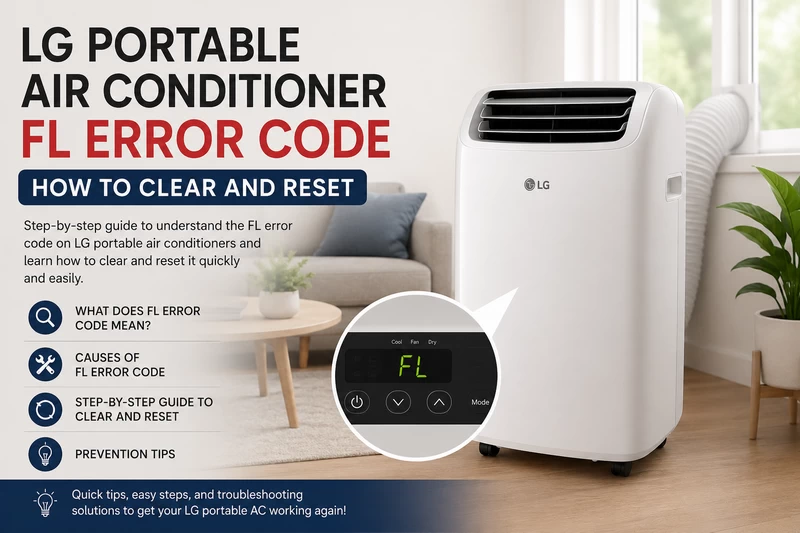
The LG portable air conditioner FL error code means the internal condensate tank is full and the unit has shut off cooling so the pan doesn’t overflow. Unplug it, pull the lower drain plug on the back panel over a shallow pan, let it run all the way out, reseat the plug, and plug it back in. The code clears on restart.
Before You Pull The Drain Plug
- FL and CH04 are the same fault on LG portable units — full condensate tank.
- If almost no water comes out, the tank was never full. Suspect a stuck float or an unlevel unit.
- Never tip or tilt the unit to dump the water out.
What Does FL Mean On An LG Portable Air Conditioner?
FL means the internal condensate tank on an LG portable air conditioner has filled and the control board has cut cooling so the base pan doesn’t overflow — and after 30+ years of hands-on repair work, I can tell you a full-tank code almost never comes from a sensor reading the water itself. The code comes from a plastic float riding on top of the water in that pan, and when it rises far enough it trips a switch that tells the board to stop cooling. But that same float can hang up on scale or slime and report “full” when the pan is bone dry.
Start with the symptom you’ve actually got:
| Cause | Likelihood | Fix Cost | DIY Time |
|---|---|---|---|
| Condensate tank genuinely full | Most common | Free | 10 min |
| Unit not sitting level | Common | Free | 5 min |
| Float stuck on scale or slime | Less common | Free | 30–45 min |
| Failed float switch | Uncommon | $20–$40 | 45 min |
| Airlocked or uphill drain hose | Common on drain setups | Free | 15 min |
Drain The Tank The Right Way
If water pours out when you pull the plug, congratulations — this is the easy version, and I’ve had plenty of these wrapped up in ten minutes. LG portables collect condensate in a shallow pan at the bottom of the cabinet, and in a humid room they’ll fill that pan faster than the evaporator can flash it back out through the exhaust. Drain it fully, restart, and the code is gone.
- Unplug the unit. Not the power button — pull the cord. I do it at the cord every time, because you’re about to have standing water near a compressor and a fan motor.
- Slide it somewhere you can get a pan under it. The lower drain port sits an inch or two off the floor on most LG models, so a cookie sheet or a boot tray works better than a bucket.
- Twist off the cap, then pull the rubber plug behind it. There are two pieces on most units. People pull the cap, see no water, and assume the tank’s empty — the plug is still in there.
- Let it run until it stops dripping. I give it another full minute after that, because the pan has internal baffles and it drains in stages.
- Reseat the plug and cap firmly, plug in, and power up.
If you ever do tilt one — moving it, hauling it up stairs — let it stand upright a full 12 hours before you plug it in. Laying a portable AC over on its side or its back drops compressor oil into places it doesn’t belong, and firing it up before that oil settles can take out the compressor entirely. That’s why you never tip a unit to dump water out faster, and it’s the one rule I’d never bend on portables.
The Unit Isn’t Level
My first instinct on an FL code was always the drain plug. I did that for years. Now I put a torpedo level on top of the cabinet before I touch anything, because a portable sitting on a bowed floor, a slanted patio slab, or a thick shag rug pushes all the condensate to one corner of the pan — right where the float lives. The pan is maybe a third full and the switch is already tripped. I level the unit, drain it, restart. If the code stays gone for a week, that was it.
The Float Switch Is Stuck Or Failed
The float is a small plastic bobber on a hinge or a vertical stem, and it trips a magnetic reed switch when it rises. Mineral scale, pink biofilm, and lint from the room all build up on the stem over a season or two, and eventually the float sticks in the “up” position and never comes back down. That’s your permanent FL code. You can confirm it in about two minutes once you’re inside, and most of the time I’ve found the fix is a rag and some vinegar — no parts at all.
Unplug the unit and leave it unplugged for the entire job. You’re reaching into a wet pan next to line-voltage wiring and a capacitor. Don’t work on it plugged in, and don’t work on it “just switched off.”
- Pull the rear service panel. Usually six to eight Phillips screws around the perimeter. On single-hose LG models like the LP1017WSR the pan is right there behind the panel. On dual-hose models like the LP1419IVSM you’ll have more ducting in the way — I budget an extra 15 minutes and take a photo before unclipping anything.
- Find the float. Look for a small white or black plastic float in the corner of the base pan, with two thin wires running off a body on the stem.
- Lift the float by hand and let go. I always do this before chasing anything electrical. It should drop back down freely and with a faint click. If it hangs, drags, or stays up — that’s your fault, right there.
- Clean the stem and pan. Fifty-fifty white vinegar and water on a rag, wipe the stem, wipe the pan, work the float up and down a dozen times until it moves loose. Rinse and dry.
- Reassemble, plug in, and run it for an hour. If FL comes back with a clean, freely moving float, the switch itself has failed.
One more thing I always check while I’m in there: the short internal drain hose that carries water from the evaporator tray down to the base pan. If it’s kinked or gummed up, water backs up and pools in exactly the wrong spot. I usually hear that one before I see it — a gurgle or a steady drip inside the cabinet that doesn’t sound like normal condensate running.
A replacement float switch assembly for most LG portable units runs somewhere around $20 to $40 from a parts supplier once you’ve matched it to your model number. A service call just to diagnose it starts at $90 to $150 before any labor, so I’d rather gamble $30 on the part. It’s two wires and one mounting clip — if you got the rear panel off without cussing, you can do this one. Where I’d stop is oily residue in the base pan or frost on the coil, because now you’re looking at a sealed system issue and the FL code is a symptom, not the problem.
Continuous Drain Setups Have Their Own Trap
This is the part I end up explaining most often. If you’ve got a hose on the lower drain port running to a floor drain or a bucket so you never have to empty the tank, the float switch is still live. It doesn’t get disabled just because the cap is off. So anything that stops water from leaving through that hose still trips FL.
Three things do it, and they’re all free to fix:
- The hose rises somewhere along its run. Gravity drain means gravity — every inch of that hose has gotta run downhill from the port. One loop up over a threshold and water sits in it.
- The end of the hose is submerged. If it’s sitting in an inch of water in the bucket, you’ve made a trap and the pan can’t vent. Cut it shorter or raise the end.
- The hose is too long. Ten feet of skinny hose on a gravity feed with almost no head pressure just doesn’t move water fast enough. I keep the run as short as I can.
Model note: On dual-hose LG units in the LP series, the base pan holds a bit more water than the single-hose units, so you get a longer runway before FL trips and a bigger mess if you pull the plug without a pan under it. On the inverter models the compressor ramps rather than cycling, so they pull more moisture out of a humid room — if I were running one in a basement, I’d plumb a continuous drain from day one.
How To Reset The Unit After Clearing FL
There’s no secret code and no button combination, which surprises people. LG portables clear the LG portable air conditioner FL error code on a power-up cycle once the float drops. Unplug it, and I’d wait a full 60 seconds so the control board discharges, then plug it back in and press power. If it comes up in cooling mode with no code, you’re done.
If FL returns instantly — within seconds of powering up, before the unit could possibly have made any condensate — I treat that as a stuck float or a dead switch, full stop. It’s the same logic I use on an LG refrigerator throwing Er FF, and it works the same way on a Whirlpool dryer after an error code — if the fault returns before the machine has had time to actually create the condition, the machine is misreading, not malfunctioning.
I’d also check your specific model against LG’s own room AC error code list, since a handful of units use CH04 for this and a couple use it for something else entirely. And if the display is fine but the handset walked off, a universal AC remote will get you back into the menu.
Keeping FL From Coming Back
Twice a season, I pull the drain plug and flush the pan with a cup of half-vinegar, half-water. That’s it. That single habit is what keeps scale off the float stem, and a clean stem is a float that drops when it should. I’d also get in the habit of running the unit in fan-only mode for 20 minutes at the end of a hot day before you shut it off — it dries the coil and the pan out instead of leaving standing water in there overnight to grow the slime that gums up the switch.
And check level once a month if the unit lives on carpet. Carpet compresses under the weight, and a portable that was dead level in June is leaning a quarter inch by August. I used to try to explain the whole physics of why a quarter inch matters across a shallow pan and — nah, forget it. You just gotta put a level on it.
My Take On This Code
Honestly? I’ll take the LG portable air conditioner FL error code over most of the others. It’s the unit protecting itself instead of quietly dumping a gallon of water onto your floor, and most of the time you’re gonna fix it with a pan and ten minutes. What frustrates me is how much of the advice online stops at “drain the tank” — the people still searching after that already drained it and got nothing. And if you’ve got codes stacking up across your other LG appliances, it’s worth learning the pattern — the E6 code on their top load washers follows the same “sensor says so, reality disagrees” logic.
Frequently Asked Questions About The FL Code
Why does my LG portable AC say FL when the tank is empty?
A float stuck up on mineral scale, or a unit on a slope that shoves what little water there is into the float corner, both read as “full.” I’d level it first, then clean the float stem.
Where is the drain plug on an LG portable air conditioner?
Lower rear panel, usually within a couple inches of the floor. There’s a screw-off cap and a rubber plug behind it — you have to remove both. Some LG models also have an upper drain port for continuous drainage in heat-pump mode; that’s not the one you want for clearing FL.
Can I run the unit with the drain plug left out?
Yes, if you’ve got a hose on it running downhill to a drain. Don’t just pull the plug and let it dribble onto the floor — the pan is designed to feed a hose, not to weep, and you’ll end up with water under the unit instead of in it.
Does a reset clear the LG portable air conditioner FL error code permanently?
Only if you actually fixed what caused it. Drain it, level it, or clean the float — then reset.
Is FL the same as CH04?
On most LG portable units, yes — full condensate tank, two different labels depending on model year and board revision. Owners in the LG community forum thread on portable AC FL codes report both on similar units. The fix is identical either way.

Written by Keith Schneerer
Certified Appliance Tech · Founder, RemoveAndReplace.com
Keith has spent 30+ years repairing machines, starting as a military mechanic and later maintaining food processing equipment before moving into appliance repair. He founded RemoveAndReplace.com to share field-tested repair advice.
More about Keith →