Here’s what’s actually going on inside your range hood: the fan motor and the light bulbs run on two separate branches off the same power feed. They usually split at a switch plate or a small terminal block behind the control panel. That’s why I always ask what’s still working before anything else. A hood that’s completely dark and silent points somewhere different than one where the lights work but the fan won’t spin. Whether you call it a range hood, a vent hood, or a kitchen exhaust fan, the diagnostic order stays the same. Most people jump straight to “the motor’s dead.” Most of the time, they’re wrong.

If a range hood stopped working all at once — no fan, no lights — a tripped GFCI outlet or breaker is one of the most common causes, and it costs nothing to check. If only the fan or only the lights quit, the fault is isolated to that one branch — usually a switch or the fan’s capacitor, not the whole unit.
The Short Version
- When a range hood stopped working completely (no fan, no lights), it’s most often the outlet or breaker, not the motor
- Fan-only or lights-only failure narrows the problem down to a single wiring branch
- A clogged grease filter can trip a thermal safety cutoff and shut the fan down on its own
- A blown thermal fuse or a worn-out switch causes more of these failures than an actual dead motor
- Duct configuration and blocked exterior vents cause failures almost nobody thinks to check
| Cause | Likelihood | Fix Cost | DIY Time |
|---|---|---|---|
| Tripped GFCI outlet or breaker | Most common | Free | 2 min |
| Clogged filter / thermal cutoff | Common | Free-$15 | 15 min |
| Blown fuse or bad switch | Somewhat common | $8-25 | 20-30 min |
| Failed capacitor or motor | Occasional | $25-150 | 45-60 min |
| Wiring, board, or duct issue | Rare | $50-150+ | Pro recommended |
No Power at All? Check the Breaker and GFCI First
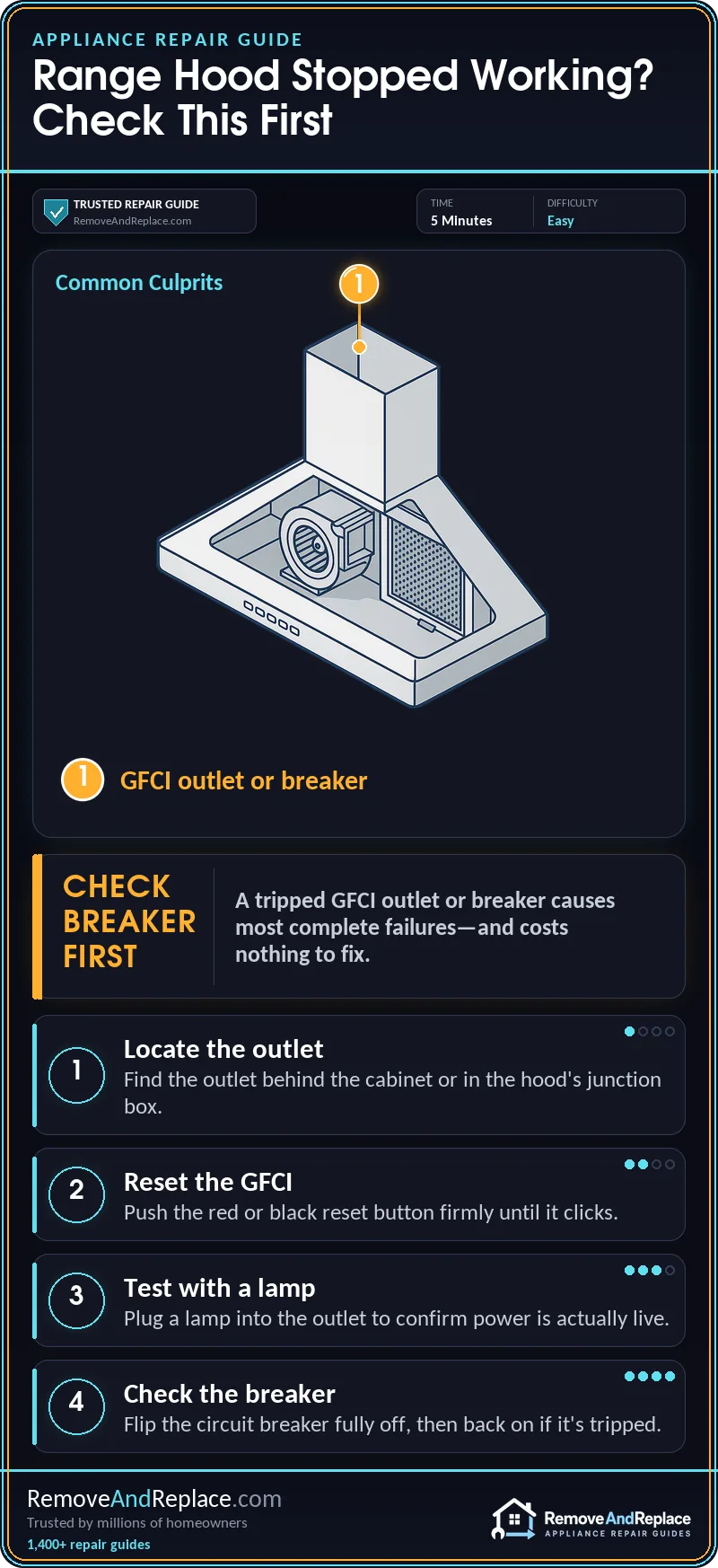
Most of the time a range hood stops working completely — no fan, no lights, nothing — the real problem is a tripped GFCI outlet or a tripped breaker, not a dead motor. The outlet is still the first thing I check, every time, a habit that carried over from 19 years fixing aircraft electrical systems in the Air Force. Since 2014, most kitchen code updates require range hood outlets to sit on GFCI-protected circuits. And if your hood is actually a combination microwave-vent unit, the same outlet issue is the top cause when a microwave suddenly stops working too.
Check it in this order:
- Find the outlet — it’s often tucked behind the cabinet above the hood, or built into the hood’s own junction box.
- Look for a small reset button with a red or black indicator, and push it firmly until it clicks.
- Plug a lamp or phone charger into that same outlet to confirm it’s actually live before you touch anything inside the hood.
- If the outlet checks out fine, head to the breaker panel and check for a tripped breaker on that circuit — flip it fully to off, then back to on.
Why Does Only the Fan or Only the Lights Stop Working?
If the lights are still on but the fan won’t spin, you can rule out the outlet, the breaker, and usually the main power cord — power is clearly getting to the unit. That narrows it down to the fan’s own switch, the motor’s start capacitor, or a thermal cutoff sitting right behind the grease filter. Flip it around — fan runs fine but the lights are dark — and you’re almost always looking at a burned-out bulb, a bad light switch, or a loose wire at the socket, not anything electrical upstream. That lines up with what Repair Clinic’s own troubleshooting notes on hood fans and lights say too.
This is the piece nobody talks about: manufacturers wire the fan and the lights as separate branches specifically so one failing doesn’t take down the other. Use that. Before you pull anything apart, just note what’s still working — it’ll save you from replacing a $90 motor when the actual problem was a $4 bulb.
The wrong move I see constantly is people pulling the whole switch panel off the front of the hood to test wiring with a multimeter before they’ve even swapped the bulb. Ninety seconds with a new bulb beats twenty minutes with a meter (trust me on this one).
This video walks through checking the switch, the capacitor, and the wiring behind the control panel on a typical under-cabinet range hood — the same order I just walked through above. It’s a good visual reference if you’ve never had the control panel apart before and want to see where the switch and capacitor actually sit.
Clogged Grease Filter Tripping the Thermal Cutoff
One of the more common causes of a fan that shuts off while the lights still work is grease buildup on the filter. When grease coats the filter, heat can’t escape properly, and it trips a thermal safety cutoff mounted right behind the filter frame. This is a safety feature doing its job, not a malfunction. The fan is protected from overheating, and it’ll usually reset itself after 15-20 minutes once it cools down.
Here’s how to clear it:
- Pull the mesh filter out of the hood.
- Wash it in hot water with degreaser, or run it through the dishwasher.
- Dry it completely before reinstalling.
- If the fan still won’t restart after it’s cooled, the thermal cutoff itself may have failed. Replace it — that part usually runs $10-20 depending on the brand.
The common mistake I see is people cleaning the mesh filter and completely ignoring the thermal cutoff switch mounted behind it. That switch collects the same grease film and can start sticking or failing to reset even after the filter’s spotless. Wipe that switch housing down every time you clean the filter, not just the mesh — it’s a 30-second step people skip constantly.
Here’s one almost nobody mentions: on Broan and NuTone inline blower units — the kind mounted in the attic or wall with just ductwork running to the hood — a pressure-sensitive cutoff can trip if the exterior wall cap gets blocked by a bird nest or wasp nest. That blockage backs up pressure in the duct run. I’ve pulled apart a few of these expecting a bad blower and found a blocked exterior vent instead. If you’ve got a remote inline blower and the fan clicks like it’s trying to start but won’t, check the outside cap before you touch the blower.
Blown Thermal Fuse or Line Fuse
A blown fuse is also a fairly common cause — either the small thermal fuse near the motor housing or an inline fuse on the wiring on some GE and Whirlpool models. You’ll usually find it behind a small access panel near the blower housing, held by two Phillips screws. Test it with a multimeter set to continuity — no beep means it’s dead. These run $6-15 depending on the brand, and swapping one takes about 20 minutes once you’ve got the access panel off. First time through, budget closer to 40 minutes; you’ll spend most of it just finding the panel.
A Bad Rocker or Slide Switch
Switches on cheaper range hoods are rated for a certain number of on-off cycles, and after a few years of daily use they wear out internally even though they still click fine. You’ll sometimes feel it before you diagnose it — the switch feels kinda mushy, the click just doesn’t feel as solid as it used to. A replacement rocker or slide switch runs $10-25 and needs a Phillips screwdriver and maybe a small flathead to pop it out of its housing. Budget 30 minutes; most of that is getting the control panel off without cracking the plastic mounting tabs — they’re brittle on older units. If you want a broader rundown beyond these causes, this rundown of the ten most common range hood issues covers noise and airflow problems that don’t stop the fan outright.
Failed Capacitor or Motor
If the fan hums but won’t spin, or spins slowly and never reaches full speed, a failed start capacitor is often the cause — it’s a $15-30 part and a straightforward swap once you’re inside the housing. If the motor is completely seized or you catch a faint burnt-electrical smell near the blower, the motor itself has likely failed. That’s an $80-150 part plus about an hour of your time pulling the old one and rewiring the new one to match. For a deeper walkthrough on testing the motor itself, Repair Clinic’s blower diagnostic guide shows how to check winding resistance before you order a new motor.
Whoever decided to run the wiring underneath the motor mount instead of beside it never had to replace one of these in a cabinet with six inches of clearance. It’s a knuckle-buster every single time.
Wiring, Circuit Board, or Duct Configuration Problems
The rarest cause comes down to actual wiring damage or a failed control board, usually on hoods with digital touch controls or multiple fan speeds. This is where I’d call a pro unless you’re comfortable reading a wiring diagram, because a board swap on some models runs $80-150 and ordering the wrong one means starting over.
Duct configuration is the piece almost nobody checks. It’s not really a “stopped working” problem — it’s more of a “never worked right” problem that gets blamed on the hood. A Lawrence Berkeley National Lab study on range hood performance found capture efficiency ranging from under 15% to over 98% between units, and a higher price tag didn’t guarantee better results. If someone converts a recirculating hood to ducted (or the reverse) without swapping the correct damper kit, the fan will run fine while doing almost nothing to clear smoke or grease from the air. If that’s your actual complaint, rather than the fan simply not running, here’s a full breakdown of six fixes for smoke that won’t clear.
Always unplug the range hood or shut off its breaker before opening any access panel — don’t just flip the wall switch. Range hood motors and control boards can hold a charge, and reaching into a “switched off” unit that’s still hooked to line power is how a twenty-minute job turns into a trip to urgent care.
A thermal fuse or switch runs $8-25 in parts and takes under 30 minutes once you’ve done it before — a service call for the same fix runs $120-200, so this is one of the rare repairs where doing it yourself actually makes a real dent in the bill. You’ll need the exact model number to order the right switch, fuse, or board — here’s where to find it, usually stamped inside the frame behind the grease filter. If the breaker trips again right after you reset it, that’s not random — something’s shorting downstream, and that’s not a DIY afternoon.
- Call a pro if: you smell burning insulation or see scorch marks near the wiring
- Call a pro if: the breaker trips again immediately after resetting
- Call a pro if: you can’t find your hood’s model number to order the correct board or motor
Keep This From Happening Again
Clean the grease filter every 3-4 weeks if you cook often, more like every 8 weeks if you don’t — grease buildup is what trips the thermal cutoff and shortens the switch and motor’s life over time. Test the GFCI outlet’s reset button every few months the same way you’d test one in a bathroom; they wear out and stop resetting reliably after several years. If your hood vents outside, take a look at the exterior wall cap once a year — that’s the check almost nobody does, and it’s the one that would’ve caught the blocked-damper failure I mentioned earlier before it ever became a “fan won’t start” service call.
Frequently Asked Questions
A few quick answers to the questions I get asked most about this exact problem:
Why did my range hood stop working with no warning at all?
Steam and cooking humidity are hard on GFCI outlets over time — the moisture causes nuisance trips even when nothing’s actually wrong electrically, which is why the same outlet can trip again a few weeks later for no obvious reason.
Can I bypass the thermal fuse if the fan won’t reset?
No. Don’t do it. That fuse exists so the motor doesn’t catch fire when it overheats, and jumping it defeats the one safety feature actually protecting your kitchen.
Why do the lights work but the fan doesn’t?
Power is clearly reaching the unit, so check the fan switch or the capacitor first. I’ve replaced far more $18 capacitors than motors over the years — it’s rarely the motor itself.
How long should a range hood motor actually last?
Most decent range hood motors last 10-15 years with regular filter cleaning. I’ve seen cheap builder-grade units fail in under 5 because the filter was never cleaned and the motor ran hot constantly.
Is it ever worth just replacing the whole range hood instead of repairing it?
If your range hood already has a decade or more of hard use behind it and you’re already facing a $150+ board or motor repair, a new hood usually wins on the math. But if the fix is just a $10 fuse or a GFCI reset, repairing it takes minutes and costs almost nothing.
A range hood stopped working doesn’t have to turn into a big ordeal. Start at the outlet, work outward from there, and you’ll usually have this solved before the takeout order even shows up.

Written by Keith Schneerer
Certified Appliance Tech · Founder, RemoveAndReplace.com
Keith has spent 30+ years repairing machines, starting as a military mechanic and later maintaining food processing equipment before moving into appliance repair. He founded RemoveAndReplace.com to share field-tested repair advice.
More about Keith →

