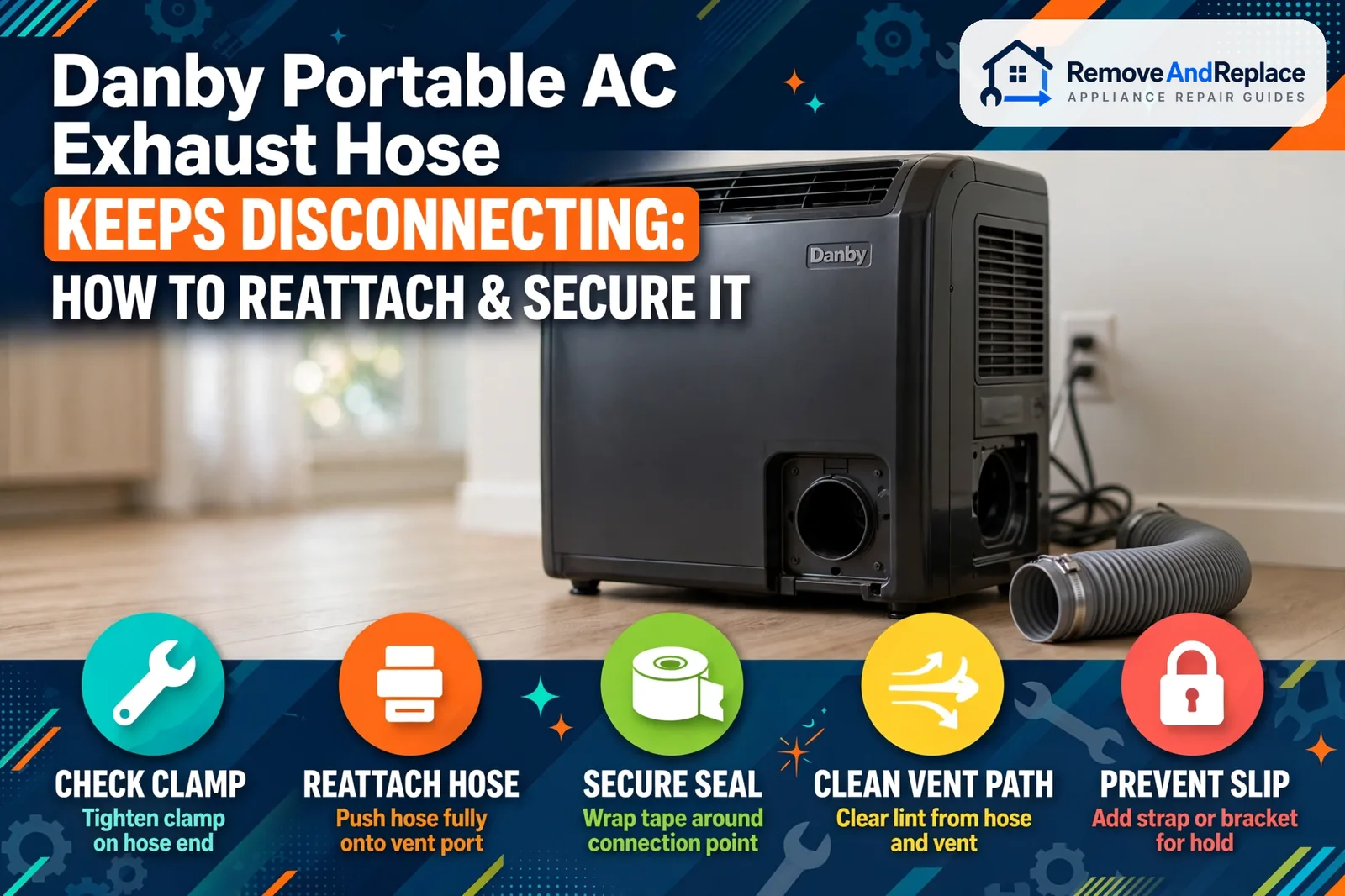
When a portable AC exhaust hose keeps disconnecting, a hose that never fully locked onto the unit’s collar is a common culprit, as is one strained by the window kit. Test it with the unit off: grip the hose end and tug. If it slides or twists freely, reseat and lock it; if it holds, check the window-side angle.
Before You Grab the Tape
- A hose that only looks attached is the usual culprit, so test it with a tug before changing anything.
- Unsupported hose weight and strain on the connections pull most hoses loose, especially when the hose is stretched or bent. Vibration and worn or mismatched fittings add to it.
- Foil HVAC tape is a backup, never the main fix.
- Check your Danby manual for the connector style before buying a replacement hose.
Why Does the Exhaust Hose Keep Popping Off a Danby Portable AC?
Inside that ribbed hose, the unit is pushing hot, slightly pressurized air out of your room, and the hose is only held at two joints: the collar on the back of the unit and the adapter at the window kit. Heat can make the plastic brittle, the compressor vibrates, and any sideways pull or sag puts a constant load on those joints. A joint that was only pushed on, not locked, slowly walks off. That’s why the portable AC exhaust hose keeps disconnecting hours after you “fixed” it. The hose usually isn’t defective. It’s being asked to hold a connection it was never fully seated into. I spent 19 years around aircraft pneumatic systems, and the rule carries over: a duct joint that’s merely sitting in place won’t stay sealed once it’s under load.
What the Hose Is Actually Fighting
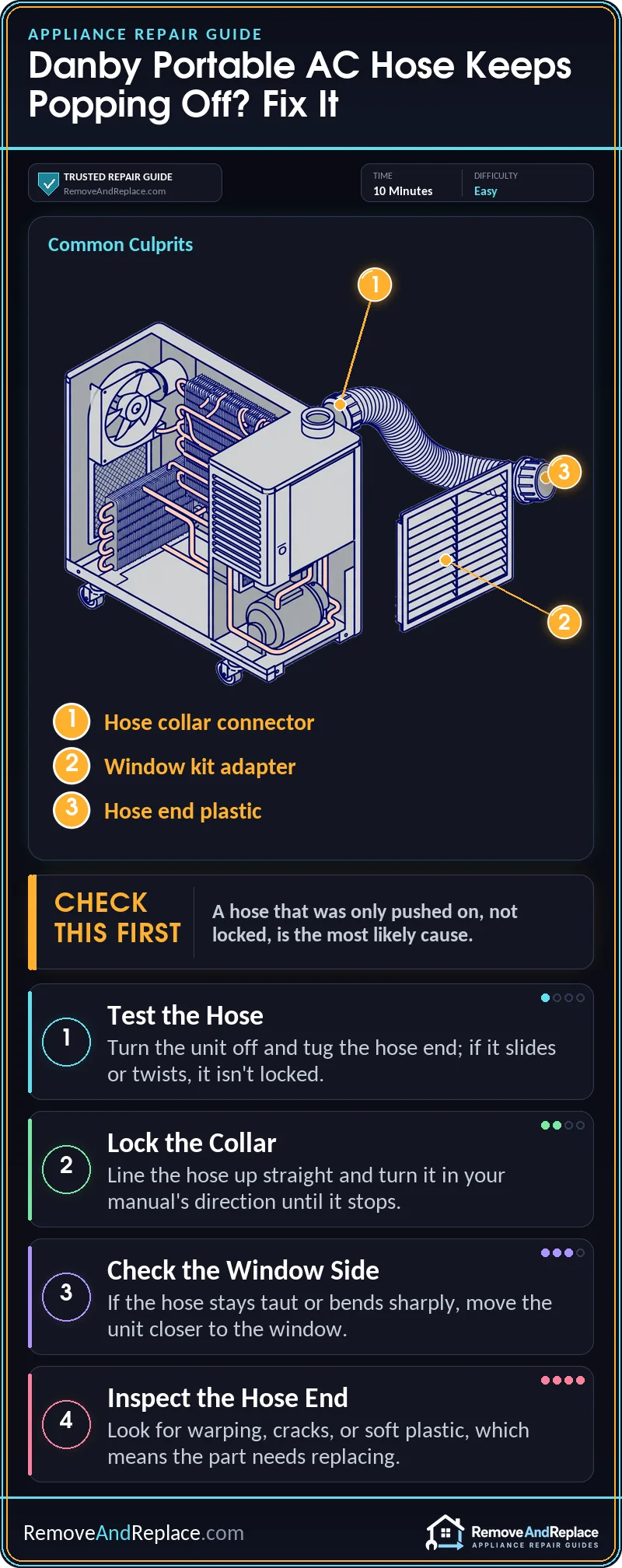
Most people assume the hose is worn out or the wrong size. Usually neither is true. Before replacing anything, work out which of these three you have. Danby’s owner’s manual hose installation page is worth having open for your exact model, since connector details differ.
The collar was never fully locked
What you’ll see: the hose end spins or slides when you tug it, and it may sit slightly crooked on the unit. What’s happening: the hose end is resting on the collar rather than engaged with it. Some portable units thread the hose on counter-clockwise, so people twist the wrong way and think it’s tight when it isn’t. What to do: back it off, line it up straight, and turn it the direction your manual shows until it stops. Don’t crank it past that.
Window-kit tension is pulling it off
What you’ll see: the hose holds fine in the morning and pops off later in the afternoon, usually on the window side, or it leans hard toward one direction. What’s happening: if the unit sits too far from the window, the hose is stretched taut, and warm plastic gives up its grip. A tight bend right at the connector does the same thing. What to do: move the unit closer so the hose runs in a gentle, relaxed curve. My guide to venting a Midea Duo through a sliding glass door shows the same layout thinking for awkward windows.
The hose end has warped or cracked
This one is less common, and it’s the one that fools people. If the connector end looks slightly warped, the ribs are crushed, or the plastic feels pliable and has lost its shape, no amount of reseating will hold. In a sunny window, especially in hot climates where the window kit bakes all afternoon, heat can make the plastic brittle and prone to cracking, so the grip fails. Hot air leaking at the joint is the other clue. A worn collar on the unit itself, with a cracked lip or stripped threads, behaves the same way, and that usually means a replacement part rather than tape.
How Do the Causes Compare?
| Cause | Likelihood | Fix Cost | DIY Time |
|---|---|---|---|
| Collar not fully locked | Most common | Free | A few minutes |
| Tension or sharp bend at window kit | Common | Free | Short; mostly repositioning |
| Softened or cracked hose end | Less common | Low to moderate (new hose) | Short once the part arrives |
| Damaged collar on the unit | Rare | Varies; may need service | Depends on the part |
This video walks through attaching and securing a portable AC exhaust hose. Watch how the hose end seats at the unit and how the run to the window is set up. That’s the same checkpoint list you’re working through here.
How to Reattach and Secure the Hose
Unplug the appliance or switch off its breaker before you touch anything. The hose is hot after a long run, so let it cool before you handle the ends.
- Unplug the unit and let the hose cool down.
- Inspect both ends. Look for cracks, crushed ribs, warping, or stripped threads on the hose and on the collar.
- Take the hose fully off and then re-seat it straight, not at an angle. Follow your manual for the turn direction; if it feels like it’s fighting you, you’re probably going the wrong way.
- Lock it in. It should stop with a firm, snug feel and not spin freely.
- Do the same at the window adapter, making sure it’s fully engaged in the kit.
- Relieve the tension. Slide the unit closer to the window so the hose runs in a smooth curve with no kinks and no stretch.
- Tug test. Give each end a firm pull. If either one moves, start over at that joint.
Run it and check again after it’s warmed up.
Common Mistake: Taping It and Stretching It to Reach
I used to think a few wraps of whatever tape was in the drawer would fix this. It doesn’t. Ordinary tape’s adhesive gives out under heat, and it hides the real problem, which is usually tension. The other habit is stretching the hose to make a window fit. A stretched hose pulls on its own ends all day.
If the joint is seated and relaxed and you still want insurance, wrap a single layer of foil HVAC tape around the seam. Think of it as a backup. If tape is what’s keeping the hose on, something else is still wrong.
Before You Order a Replacement Hose
Do the tug test first. If a properly seated, relaxed hose still slips, the end is warped or the threads are worn, and a replacement makes sense. Work through it in this order:
- Find the model number on the nameplate at the back or side of the unit.
- Check the manual for the correct connector style, because hoses that look alike can differ in thread direction, diameter and connector type.
- Compare the old hose end to the replacement’s photos for thread or latch type.
- Confirm the turn direction matches your unit. A hose that fits but turns the wrong way is a mismatch, not a fix.
For general background, Danby’s install FAQ and this hose-falling-off rundown cover the basics.
A hose that keeps slipping loose lets hot air back into the room, and that load can cause other symptoms. If water starts showing up afterward, see my guide on fixing a portable air conditioner that’s leaking water. A drain-related code is a different problem, but the Haier version, covered in the P1 error code article, shows the same kind of check.
When to Call a Pro
A cracked collar on the unit itself, or any sign of a refrigerant problem, is no longer a hose job. Sealed-system work needs a licensed, EPA-certified technician. If the housing is damaged where the hose connects, a service call is usually smarter than improvising a bracket.
Frequently Asked Questions
Can I use duct tape to hold my portable AC hose on?
I wouldn’t. The adhesive breaks down in heat and leaves a gummy mess. If you need a backup, use foil HVAC tape over a hose that’s already properly seated.
Why does the hose only come off when the unit is hot?
Warm plastic can lose its grip, and any tension in the hose pulls harder on a weakened joint. Relax the hose run first. If the end has visibly warped, replace the hose.
Is it a problem if my portable AC exhaust hose keeps disconnecting?
Yes, because hot air leaks back into the room, which cuts cooling and can make the unit run longer. I’d fix it the same day rather than living with it, since it’s usually a free fix.
Seat it, relax it, tug it. If it still wants to leave, the part is worn and it’s time to replace it.
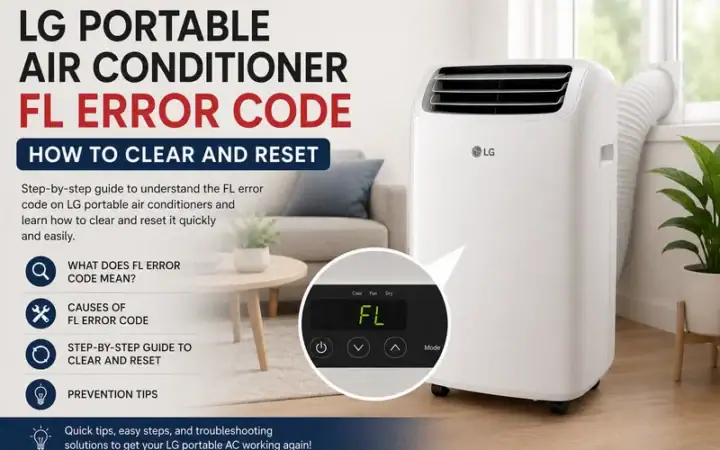
If an error code popped up while the hot air was backing up, my LG FL error code reset guide shows how that process typically goes on a portable unit.

Written by Keith Schneerer
Certified Appliance Tech · Founder, RemoveAndReplace.com
Keith has spent 30+ years repairing machines, starting as a military mechanic and later maintaining food processing equipment before moving into appliance repair. He founded RemoveAndReplace.com to share field-tested repair advice.
More about Keith →