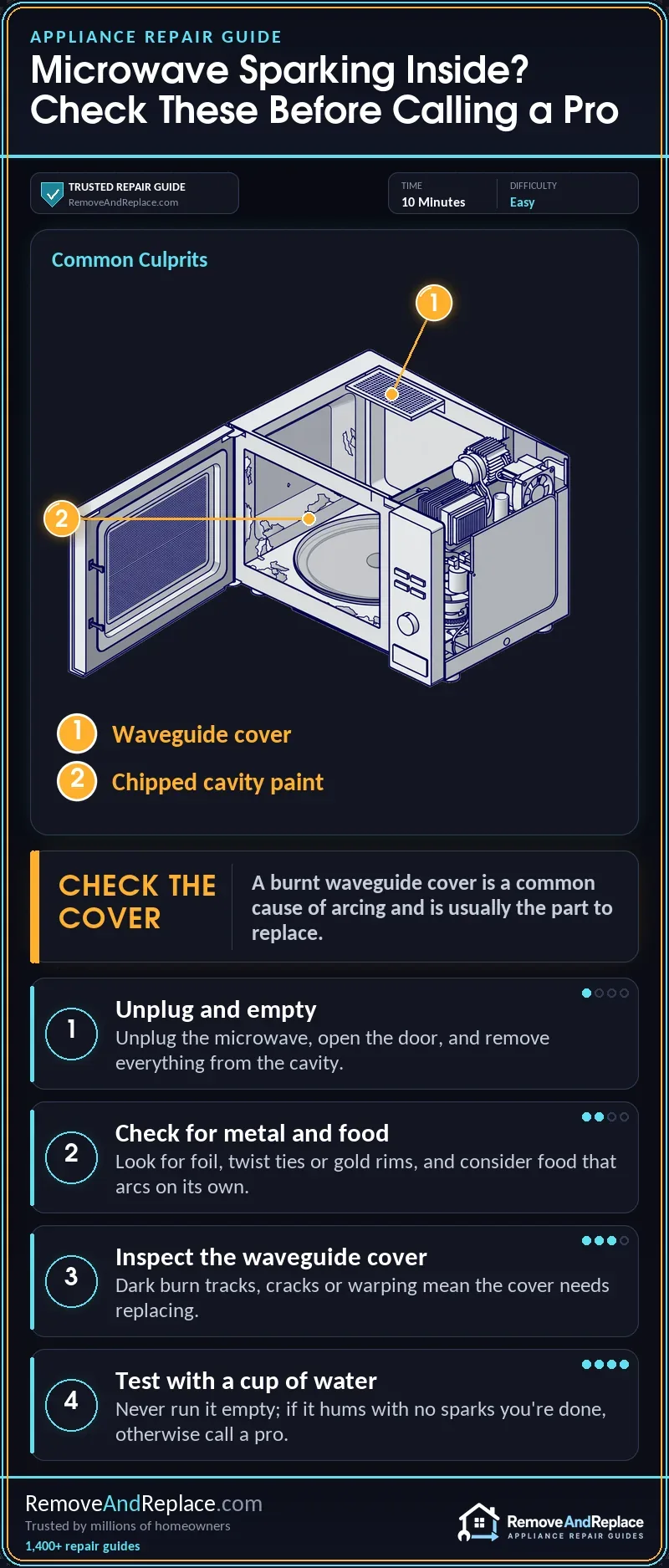
Unplug the microwave, empty the cavity, and look for a burnt waveguide cover, chipped paint or stray metal. Those are the usual causes of sparking inside, and a burnt cover is the part you replace. If everything looks clean, stop using the microwave and call a pro.
Before You Start
- Unplug it first. Never run the microwave to “see if it still sparks.”
- Check the waveguide cover and cavity paint before you suspect any electrical part.
- Grapes, hot dogs, carrots and mineral-heavy foods can arc with no metal present.
- The diode, capacitor and magnetron are pro territory because of the high voltage.
- On an older, cheap unit, a replacement often beats a repair quote.
Why Is Your Microwave Sparking Inside?
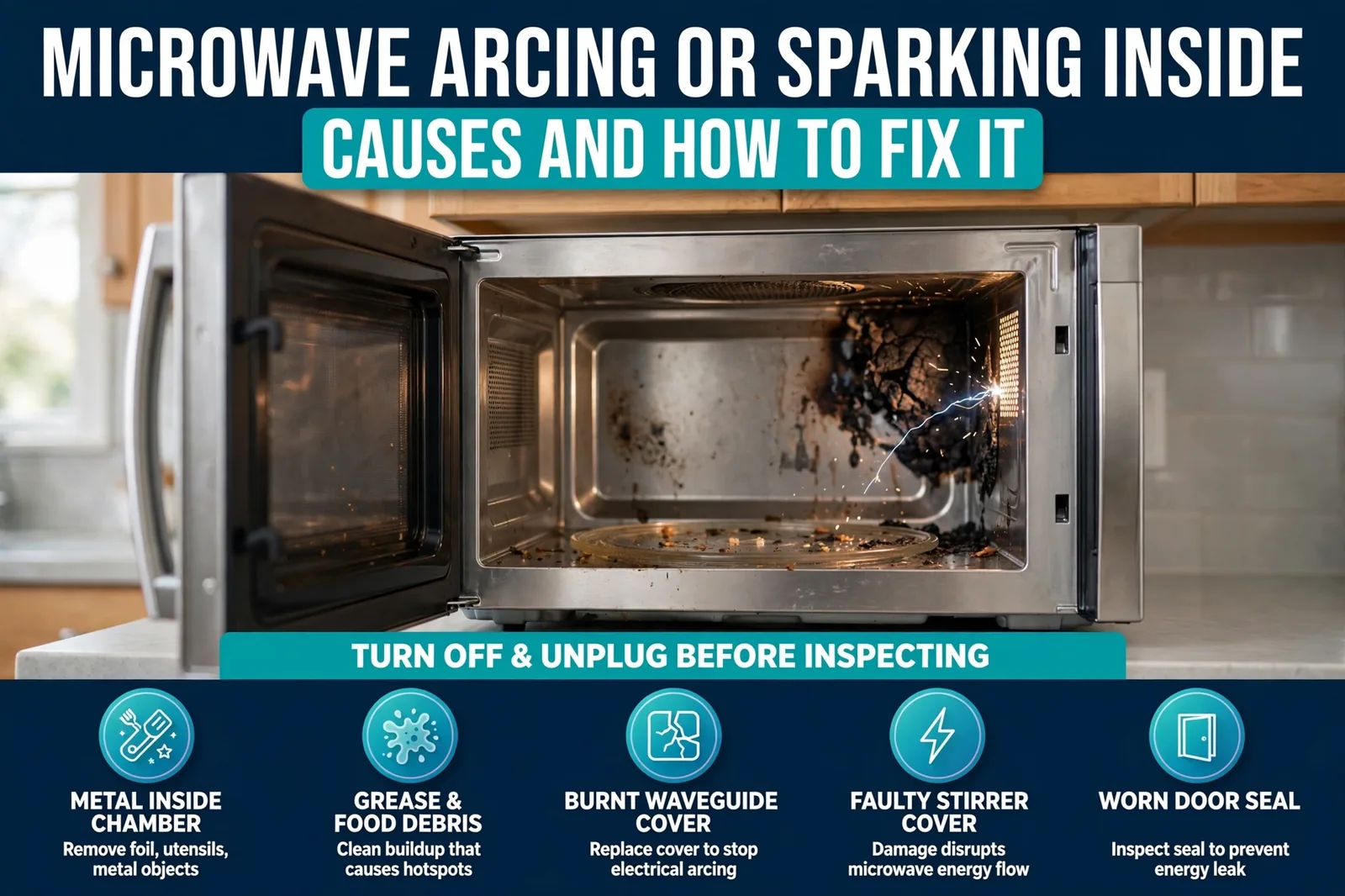
Sparks in a microwave look scary, but the cause is usually something you can see with the door open and the plug pulled. Arcing happens when microwave energy jumps between two close points of metal or other conductive material: a fork tine, a foil edge, a bare patch on the cavity wall, a burnt spot on the waveguide cover. That’s why microwave arcing sparking inside the cabinet tends to leave a mark you can find. I came up through 19 years of aircraft electrical work, and the habit stuck: find the burn mark first, then decide what part to blame. Look over the cavity walls, the ceiling and the small cover that usually sits on the cavity wall or ceiling, depending on the model. Burnt, dark or flaking? That’s your lead. Nothing visible, and it still sparks with a plain microwave-safe dish? That points deeper, and it’s a pro call.
Most people assume sparks mean the magnetron is dying. Usually not. The magnetron makes the energy, and arcing is that energy landing on the wrong thing. If your unit runs but doesn’t heat and there are no sparks at all, that’s a different problem, and demo mode is worth ruling out first.
The common wrong move is running it empty to see whether the sparking continues. Don’t. With nothing to absorb the energy, you can damage the magnetron and turn a cheap cover replacement into an expensive one. PartSelect’s sparking microwave guide covers the same usual suspects if you want a second opinion.
| Cause | Likelihood | Fix Cost | DIY Time |
|---|---|---|---|
| Metal, foil or gold-rim dish | Common | Free | Minutes |
| Food that arcs on its own | Common | Free | Minutes |
| Burnt waveguide cover | Common | Low | Short job |
| Chipped paint in the cavity | Common | Low | Short job |
| Diode, capacitor or magnetron | Less common | High | Pro job |
What Does the Video Show?
This video walks through how to track down what’s causing sparks inside a microwave and what to do about it. Watch it before you open anything up, so you know what a damaged cover or cavity looks like.
Check the Metal and the Food First
Work through it in this order. It’s free, so it comes first.
- Unplug the microwave and open the door.
- Pull everything out of the cavity, including the turntable and any rack.
- Look for metal: foil, twist ties, a gold or silver rim on a plate, a travel mug, or a metal rack that doesn’t belong.
- Think about the food that was inside when it sparked (see below).
- Plug it back in and test with a cup of water, never empty.
Can Food Alone Cause Sparks?
Yes. Grapes cut almost in half, hot dogs, carrots and spinach are well known for it. Mineral-rich foods can do it too. Dense, watery food with a thin bridge of skin or a lot of minerals can act like a tiny antenna. If the sparks only show up with that food, the microwave is fine. Cut it differently or heat it another way.
Burnt Waveguide Cover: The Part That Usually Needs Replacing
The waveguide cover is a thin sheet, often mica-like, that shields the opening where microwave energy enters the cavity. Grease and food splatter soak into it, and eventually it scorches. A cover with a dark, burnt or cracked patch is a likely cause of arcing and should be replaced. It won’t necessarily spark on every run, and the sparking can stop mid-cycle as the burnt material wears off, but the damage is still there. The stuff cooked onto it conducts, and it keeps burning deeper.
One thing people get wrong about cleaning: a cover that’s only slightly soiled can be wiped clean, but one with charred edges or holes has to be replaced. RepairClinic and Axis Repair both make that distinction. A scorched cover is damaged, not dirty, and wiping it may make it look better without restoring it. Replace it, and wipe away any carbon deposits left behind in the area.
Where the cover sits and how it’s held on varies. Over-the-range models often tuck it up high in the cavity, while countertop and built-in units can put it on a side wall, so check your manual or the service diagram for your model. RepairClinic has a page for microwaves that are sparking or arcing that’s worth a look. The steps below are the general job.
- Unplug the unit. Switching it off at the control panel isn’t enough. On an over-the-range model, unplugging means reaching the outlet in the cabinet above.
- Look at the cover closely. Dark burn tracks, cracks or warping mean it has to go.
- Remove the cover. Depending on the model it’s held by a screw or clip. Don’t pry with a metal tool.
- Fit the exact replacement for your model. Don’t cut one from sheet stock.
- Test with a cup of water. Never run it empty. If it hums quietly with no sparks, you’re done.
Before You Order
The one check: burn marks right at the cover. If you see them, order the cover. If the cover looks clean but the walls don’t, it isn’t the cover. The model number on the rating plate (usually inside the door frame or on the back) tells you which cover to buy.
Chipped Paint or Rust in the Cavity
Bare metal showing through the cavity paint can arc, and I’ve seen it start at a single small chip. If the metal underneath is smooth and intact, a touch-up paint made for microwave oven interiors is the right fix. Don’t use general hardware-store paint, because it isn’t made for that heat and food contact. If the metal is pitted, flaking or has rusted through to a hole, touch-up won’t hold. At that point, I’d stop repairing and consider the unit done.
Diode, Capacitor or Magnetron: When It Isn’t the Easy Stuff
If the cover and cavity are clean and it still sparks, a high-voltage part may be failing. The diode, capacitor and magnetron all work at dangerously high voltage, and the capacitor can hold a charge even after the plug is pulled. This is where I stop being a DIY guy. The symptoms overlap with other failures too, so if it’s dead, see what can cause a microwave no power issue, and if it runs but won’t heat, this Panasonic not-heating walkthrough shows the usual suspects. Cutting out after a couple of seconds is a different story; that’s covered in microwave shuts off after 2 or 3 seconds.
Safety first. Unplug the appliance or switch off its breaker before you touch anything. A microwave’s high-voltage capacitor can stay charged after unplugging, so leave anything behind the control panel to a pro. Never run the microwave empty or with sparks visible.
When to call a pro: If the cavity and cover are clean and it still sparks, or you see burn marks near the magnetron or high-voltage wiring, stop. Those parts aren’t worth the risk. Compare the repair quote against the price of a new unit before you commit, because on an older or inexpensive microwave, replacement often makes more sense than repair.
Keeping It From Coming Back
Wipe splatter off the cavity walls and cover area after messy heating, and put a properly fitted microwave-safe cover over the dish to trap splatter so it doesn’t bake onto the walls and ceiling. A clean cavity rarely arcs.
FAQ
Is it safe to keep using a microwave that sparks occasionally?
No. Occasional sparking is how a small burn becomes a damaged cover or a burned-out magnetron. Stop using it until you’ve found the cause.
Why does my microwave spark when there’s no metal in it?
The food itself, most likely. Grapes, hot dogs and carrots are the classic ones. If it’s still microwave arcing sparking inside with a plain microwave-safe dish, I’d check the cover and the paint next.
Can I just paint over a chip inside the microwave?
Only if the metal under the chip is smooth and intact, and only with a paint made for microwave interiors. I used to think any touch-up would do, but I’d now skip anything not rated for microwave cavities. If there’s rust-through, the paint isn’t the problem anymore.
Should I repair or replace a sparking microwave?
If it’s a cover or paint issue, repair it. If it’s a high-voltage part, weigh the pro quote against the cost of a new unit. In my experience, older budget models usually lose that comparison.
Find the burn mark, fix what’s actually burned, and don’t run it empty. That alone handles most of these.

Written by Keith Schneerer
Certified Appliance Tech · Founder, RemoveAndReplace.com
Keith has spent 30+ years repairing machines, starting as a military mechanic and later maintaining food processing equipment before moving into appliance repair. He founded RemoveAndReplace.com to share field-tested repair advice.
More about Keith →