Ice locking the blade, or a failed run capacitor that can’t get the motor spinning — one of those two is behind most stuck Fujitsu outdoor fans. Check the blade by hand with the breaker off first: if it spins freely, ice isn’t the problem and the capacitor or motor is next.
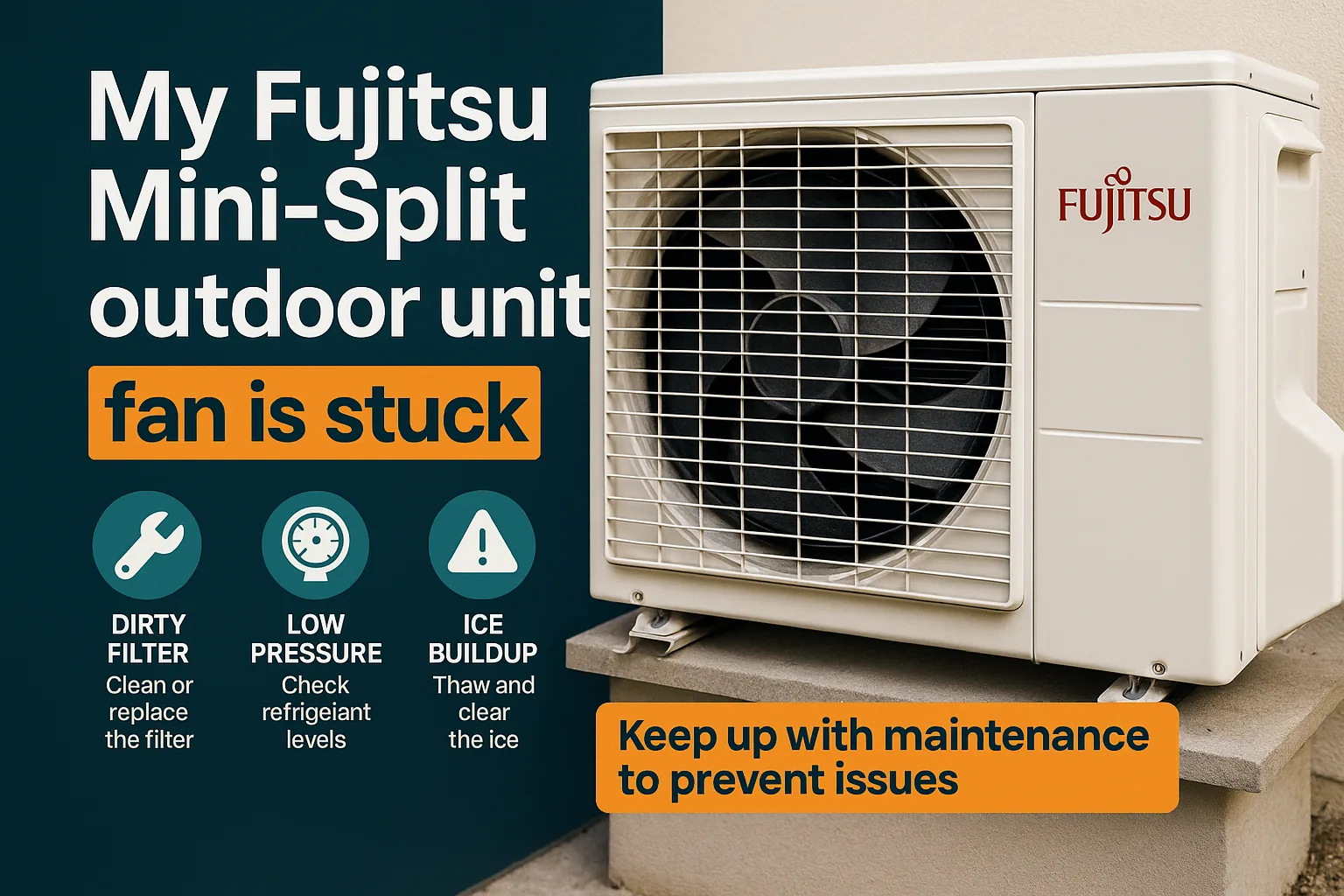
- Ice and frost buildup is the most common reason a Fujitsu outdoor fan locks up — and it costs nothing to fix.
- Most stuck-fan cases turn out to be the cheap fixes — ice or a bad capacitor — not a new outdoor unit.
- Leave the blade alone while the unit’s powered — more on why in the test-spin section below.
- If you searched “My Fujitsu Mini-Split fan stuck,” the blade spin test below rules ice and bearings in or out in under five minutes.
| Cause | Likelihood | Fix Cost | DIY Time |
|---|---|---|---|
| Ice/frost locking the blade | Most common | Free | 15-45 min |
| Bad fan run capacitor | Common | $20-35 | 20-45 min |
| Fan motor bearing seizure | Less common | $90-160 | Pro recommended |
| Stuck control board relay | Rare | $150-300 | Pro required |
Ice and Frost Buildup Causes Most Stuck Fujitsu Fans
Ice is the first thing worth checking on a stuck Fujitsu outdoor fan — it’s the most common cause, and one I’ve chased plenty of times over 11 years fixing commercial food service equipment on similar condensing units. Frost builds up around the fan shaft and blade tips during a hard freeze or a defrost cycle that didn’t drain properly, and it locks the blade solid against the housing. The compressor still hums along fine because it doesn’t care that the fan isn’t spinning — you’ll hear the unit running, just with dead air coming off the coil. If your unit isn’t blowing cold air because of this, that’s the airflow side of the same problem. The fix costs nothing: cut power, let the ice melt on its own or help it along with warm — not hot — water, and don’t touch the blade until it’s confirmed loose. This is the most common version of the My Fujitsu Mini-Split fan stuck complaint, and it’s the cheapest one to fix.
On Halcyon and AIRSTAGE units, refrozen meltwater can weld the blade to the fan guard overnight, especially without a base pan heater kit.
Could It Be a Bad Fan Capacitor Instead?
The second most common cause is a failed run capacitor. The capacitor gives the fan motor its initial kick to start spinning — without it, the motor just sits there and hums, or tries to turn and stalls out. You’ll hear a faint buzz from the outdoor unit with the blade dead still, sometimes with a slight vibration you can feel with a hand near the housing (unit off, never running). Fujitsu’s own troubleshooting resources list a bad capacitor as a standard check whenever the fan won’t run — see the AIRSTAGE Mini-Splits Troubleshooting FAQ.
Fujitsu Halcyon and AIRSTAGE outdoor units built roughly between 2014 and 2020 use a small dual-run capacitor tucked right behind the service panel, and on units that live somewhere hot, it’s common to find the case bulging or slightly swollen on top before it fully dies. That bulge is your answer before you even pull a meter out.
I used to grab the whole fan motor assembly as my first instinct whenever a Fujitsu outdoor fan wouldn’t turn — cheaper insurance, I figured. That was a $150 habit for what was usually a $25 capacitor. These days I test-spin the blade and check the cap before I order anything.
How Do You Test-Spin the Blade to Know What’s Wrong?
Kill power at the breaker — not just the thermostat — and confirm the compressor hum has actually stopped, not just the fan. Wait five minutes for the capacitor to bleed off its charge. Then reach in from the side of the fan guard, never through the top, and try to rotate the blade by hand.
If it spins freely with no resistance, ice and bearings are both off the table — you’re looking at the capacitor or a wiring problem, which is more good news than bad, since that’s usually the cheaper fix. If the blade won’t budge and there’s no visible ice anywhere on it, that’s a seized bearing. And if it turns but feels gritty or catches partway around, the bearing’s on its way out even though it hasn’t fully locked up yet. This is exactly the kind of hands-on check that separates a real “My Fujitsu Mini-Split fan stuck” diagnosis from a guess.
The number one wrong move I see: people grab a screwdriver or a stick and pry the blade loose while the unit is still plugged in and powered, trying to “break it free.” Don’t — even a partially seized motor can suddenly kick on while your hand or a tool is in the blade path, and it’s exactly the kind of “trust me on this one” moment where a bruised knuckle is the good outcome.
The Hidden Drain-Related Ice Problem
There’s a rarer version of the ice problem that catches people even in mild climates — it starts with drainage, not the weather:
- The base pan drain gets blocked, or the unit isn’t sitting level.
- Meltwater from a normal defrost cycle pools instead of draining away.
- The pooled water refreezes against the blade the next time the compressor cycles into defrost.
- The fan runs fine for days, then locks up again after one cold night — easy to mistake for a dying motor since it seems to come and go.
- The real fix is clearing the base pan drain path and, in genuinely cold climates, adding a base pan heater kit — not replacing anything electrical.
This video walks through the same test-spin check and capacitor inspection covered above on a real Fujitsu outdoor unit, so you can see what a swollen capacitor and a free-spinning versus locked blade actually look like in person. It’s a good gut-check before you start pulling panels off your own unit.
Fan Motor Bearing Seizure (Less Common)
After ice and the capacitor, the next thing worth suspecting is the motor bearing itself. Fujitsu outdoor fan motors run sealed sleeve bearings, and after 8-12 years, especially on units that sit in dusty or humid spots, they can wear enough that the shaft just locks up cold. You’ll test-spin it and get nothing — no give, no grinding, just solid resistance. This one isn’t a DIY part swap for most people; the fan motor is wired into the board and mounted in a way that makes replacement fiddly even for someone comfortable with a multimeter.
Stuck Control Board Relay (Rare)
The least common cause, but the one that throws people off the most, is a control board relay that’s stuck closed or open. Instead of a mechanical problem, the board simply isn’t sending power to the fan motor at all — the motor and capacitor can both test out perfectly fine. This usually shows up alongside an error code on the indoor unit display. If you’re seeing a code, RemoveAndReplace’s Fujitsu AC Error Codes and Troubleshooting guide is worth checking before you assume the fan itself is the problem, and resetting the unit is a legitimate first step that sometimes clears a relay that’s just hung up rather than actually failed.

How to Safely Thaw an Ice-Locked Fujitsu Fan
- Shut off power at the breaker that feeds the outdoor unit — not just the thermostat inside.
- Check for visible ice around the blade tips, the fan guard, and the shaft. It usually looks like a rough white coating, sometimes a solid bridge between the blade and the housing.
- Let it thaw naturally if it’s not urgent — an hour or two in above-freezing air usually does it.
- Or speed it up with warm water, poured gently over the iced area — never hot water, and never a heat gun or hair dryer close enough to melt plastic housing components.
- Test-spin the blade by hand once the ice is visibly gone, before restoring power, to confirm it moves freely.
- Clear the base pan drain while you’re in there — this is usually the actual root cause, not just the ice itself.
Budget 15 minutes if it’s a light coating you’re just waiting out, closer to 45 minutes the first time if you’re also tracing down and clearing a clogged drain path.
Replacing the Fan Motor Capacitor
A capacitor holds a charge even with the unit unplugged and the breaker off — sometimes for hours. Discharge it across its terminals with an insulated screwdriver, or better, a resistor-tipped discharge tool, before you touch the leads. This isn’t optional.
- Cut power at the breaker and wait at least five minutes.
- Remove the service panel — usually 2-4 screws on Fujitsu Halcyon and AIRSTAGE outdoor units.
- Discharge the capacitor per the warning above before touching anything else.
- Photograph the wiring on the old capacitor before disconnecting — the terminal layout matters and isn’t always obvious.
- Match the microfarad (µF) rating exactly on the replacement — this isn’t a “close enough” part.
- Reconnect, replace the panel, and test-spin the blade by hand one more time before restoring power.
The capacitor itself runs $20-35 through most parts suppliers. Budget 45 minutes the first time you do this, closer to 20 minutes once you’ve done it once and know where the screws hide.
A bearing seizure or a control board relay isn’t a great candidate for a first-timer. A service call for either usually runs $150-300 for the capacitor-adjacent stuff, climbing to $350-650 if the fan motor or the board itself needs replacing. Compare that to a $20-35 capacitor you can swap yourself in under an hour, and the math on when to call someone gets pretty obvious.
- Call a pro if the motor is confirmed seized (no spin at all, no ice present) — these motors are wired into the board in a way that’s fiddly even with experience.
- Call a pro if you’re seeing an error code alongside the stuck fan and a reset doesn’t clear it.
- Call a pro if the unit is still under warranty — opening the panel yourself can void it.
If you want to look up your exact model’s service documentation before deciding, RemoveAndReplace’s AC Split System Service Repair Manuals page is a good place to start, and Fujitsu’s own High-SEER Mini-Splits Troubleshooting Guide goes deeper into relay and board behavior if you’re the type who wants to understand it before someone else touches your unit.
Keep This From Happening Again
If you’re in a climate that freezes overnight, checking that the base pan drains freely — no leaves, no debris, unit level — is the single biggest thing you can do. That’s honestly it for ice. For the capacitor, there’s not much preventive maintenance beyond keeping the unit’s service panel area clear so heat doesn’t build up around it in summer, since heat is what shortens a capacitor’s life faster than anything else. RemoveAndReplace’s 10 Tips to Keep Your Mini Split Running covers the rest of the seasonal stuff worth doing once or twice a year.
Fujitsu Mini-Split Fan FAQ
Can I just force-spin the fan blade to get it moving again?
You can test-spin it once, by hand, with the breaker off — that’s diagnostic, not a fix. See the warning above about why forcing it while it’s powered is a different matter entirely.
How can I tell if it’s ice or a broken motor?
Look first. If there’s visible frost or ice on the blade or housing, that’s your answer. No ice, and the blade won’t turn by hand with the breaker off — that’s mechanical, likely a bearing. No ice, and it spins freely — that’s electrical, likely the capacitor.
Is a stuck outdoor fan covered under warranty?
Depends on the age of the unit and whether it’s the original owner. Fujitsu Halcyon and AIRSTAGE units typically carry a 10-year parts warranty if registered within 90 days of install, but opening the service panel yourself before calling can complicate a warranty claim — worth a phone call to Fujitsu or your installer first if the unit’s still young.
How Much Does It Cost to Fix a Stuck Fujitsu Fan?
The cheap fixes — ice and the capacitor — cover most cases; see the cost table near the top for what the less common bearing and control board failures run, since those are pro jobs that climb into real money.
Can a stuck outdoor fan damage the compressor?
Not immediately, but running the system for extended periods with the fan dead does push head pressure higher than the compressor is designed for, and I wouldn’t let it run like that for more than a day or two before cutting power at the breaker and dealing with it. Short-term, it’s an inconvenience. Left alone for a week in summer heat, it’s a compressor problem waiting to happen.
A stuck fan looks scarier than it usually is. Kill the breaker, do the five-minute test-spin, and you’ll know within a few minutes whether you’re dealing with ice, a $25 part, or something that actually needs a phone call. Nine times out of ten, a My Fujitsu Mini-Split fan stuck search ends with one of the two cheap fixes above.

Written by Keith Schneerer
Certified Appliance Tech · Founder, RemoveAndReplace.com
Keith has spent 30+ years repairing machines, starting as a military mechanic and later maintaining food processing equipment before moving into appliance repair. He founded RemoveAndReplace.com to share field-tested repair advice.
More about Keith →