Nothing makes a homeowner feel like they’re losing their mind quite like an outlet that’s stone dead while every breaker in the panel sits there in the “on” position, completely unbothered. It looks like it should be a simple problem, and it almost never is. The good news is that a breaker that hasn’t tripped actually narrows things down fast — it just points somewhere different than most people guess.
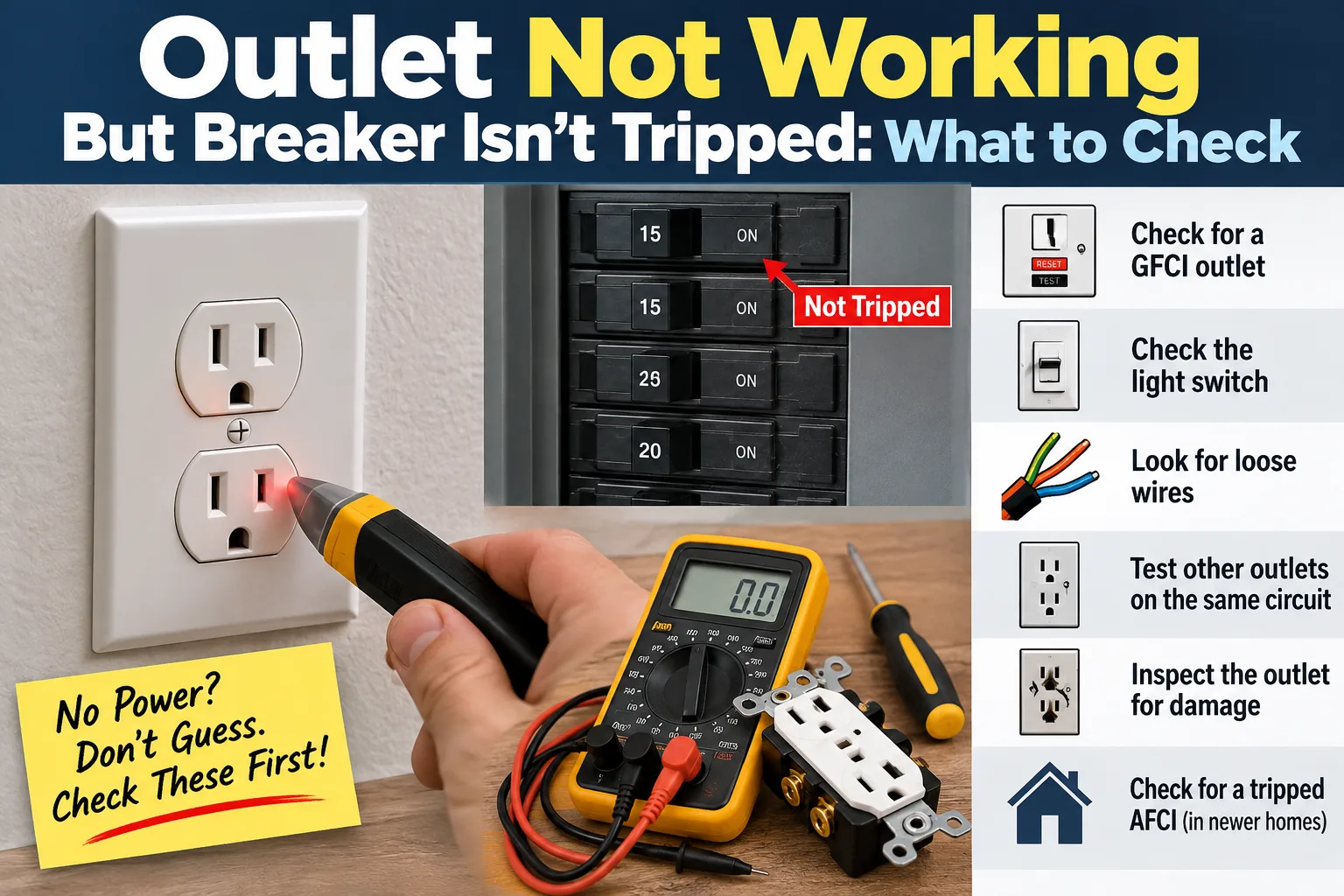
An outlet not working but breaker isn’t tripped almost always means a GFCI outlet somewhere on the same circuit has tripped and is cutting power to it — often in a bathroom, garage, or exterior wall, protecting several other outlets with no obvious connection between them. This is one of the more common causes of a dead outlet, and fixing it takes about two minutes and costs nothing.
- Check every GFCI outlet in the house, not just ones in the same room — one GFCI can protect several outlets in different rooms.
- A wall switch controlling a “half-hot” outlet is worth a 10-second check before grabbing any tools.
- Backstabbed (push-in) wire connections work loose over time, especially in homes wired before the 1990s — the fix is moving the wire to the screw terminal.
- Warm plastic, a burning smell, or scorch marks anywhere near the outlet mean stop immediately and call an electrician.
| Cause | Likelihood | Fix Cost | DIY Time |
|---|---|---|---|
| Tripped GFCI (local or upstream) | Most common | Free | 2 min |
| Half-hot outlet, wall switch off | Common | Free | 1 min |
| Worn-out or failed receptacle | Occasional | $3-15 | 15 min |
| Loose or backstabbed wire connection | Occasional | $0-8 | 20-30 min |
| Open neutral or aluminum wiring fault | Rare | $150-300 | Pro only |
Check for a Tripped GFCI Outlet First
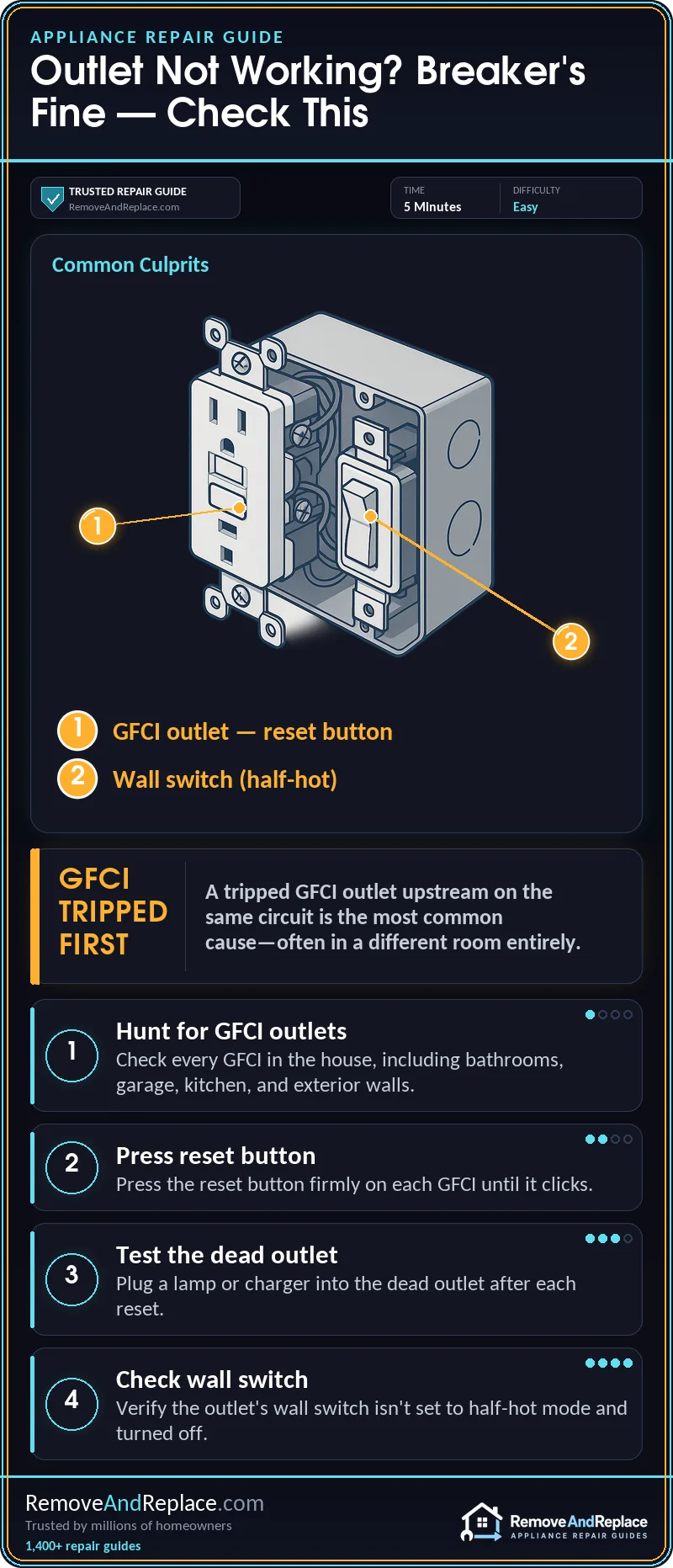
An outlet not working but breaker isn’t tripped almost always points to a GFCI outlet that tripped somewhere else on the same circuit, not a fault in the breaker panel. A breaker only trips from too much current, and nothing behind a dead outlet — a tripped GFCI, a switch left off, a loose wire, a worn receptacle — pulls enough current to trip it, which is why the panel looks normal while one outlet sits dead. One GFCI outlet can protect several regular outlets in other rooms with no visible connection between them, so the fix starts with finding every GFCI in the house and pressing reset on each one before touching a screwdriver or buying a replacement part. I’ve chased this exact pattern through 19 years of Air Force aircraft maintenance, and the part that looks broken almost never turns out to be the actual fault.
A dishwasher or an appliance like a microwave that suddenly stops working can pull just enough of a small ground fault to trip a GFCI two rooms away, and nobody thinks to check it because it seems unrelated. According to This Old House, this exact upstream-GFCI pattern is one of the first things any electrician checks before assuming a wiring fault. If the reset button clicks back in and the outlet powers up, you’re done — no parts, no tools, two minutes.
Work through GFCI outlets in this order so none get missed:
- Walk through every room, including the garage, bathrooms, kitchen, and any exterior walls, and note each GFCI outlet you find.
- Press the small reset button firmly on each one until it clicks.
- Plug in a lamp or phone charger at the dead outlet after each reset to check for power.
- If one GFCI resets and restores power, write down which outlets it protects so you know for next time.
- If none of the GFCI outlets reset the dead outlet, move on to the wall switch check below.
Older Leviton and Pass & Seymour GFCI outlets from the late 1990s and 2000s are notorious for tripping on their own (trust me on this one) — their internal contacts are touchy enough that a small voltage sag from an AC compressor kicking on can trip them with nothing actually wrong. The common wrong move here is skipping straight to replacing the dead-looking outlet. I used to reach for a new outlet as my first move on these calls too. I don’t do that anymore, not since I started checking GFCIs and switches first, because that outlet is usually fine.
Is the Outlet Wired to a Wall Switch?
Plenty of outlets, especially in living rooms, bedrooms, and older homes, are half-hot, meaning a wall switch controls power to the top half, the bottom half, or the whole receptacle. If a lamp plugged into a “dead” outlet suddenly works after you flip a nearby switch, that’s your answer. It costs nothing to check and takes about a minute.
This is easy to miss because most people don’t expect a wall switch to control an outlet at all. Builders wire it this way so a lamp can be turned on and off from the doorway instead of by reaching down to unplug it. If flipping every switch in the room doesn’t bring the outlet back to life, it’s not a switch problem, and it’s time to look at the outlet itself. A dead outlet caused by something like a range hood that stopped working on the same circuit can feel similar, so it helps to rule out switches before assuming a bigger wiring issue.
Test the Outlet Itself for a Loose or Failed Connection
If the GFCI and switch checks both come up empty, the outlet not working but breaker isn’t tripped situation may point to something upstream in the wiring, but more often it’s still something simple sitting right at the receptacle. A loose backstabbed connection or a worn-out receptacle is common in homes with original wiring, and both are cheap, simple fixes for anyone comfortable working with a screwdriver and a non-contact voltage tester.
- Turn off the breaker feeding that outlet and confirm it’s dead with a non-contact voltage tester.
- Remove the cover plate and the two screws holding the outlet in the box.
- Pull the outlet out and look at the wire connections — check for scorch marks, loose screws, or wires stabbed into the back instead of wrapped around a screw.
- Move any backstabbed wires to the screw terminals and tighten them firmly.
- If the outlet itself looks worn, cracked, or the internal contacts feel loose when a plug goes in, replace it with a new receptacle rated for the circuit.
- Restore power at the breaker and test the outlet with a lamp or plug-in tester.
Our full guide on removing and replacing a faulty electrical outlet walks through this with photos if you want a second reference while you’re standing at the box. Most standard outlets cost between three and fifteen dollars, and the whole swap takes about fifteen minutes once the power is confirmed off.
When It’s Something Bigger: Open Neutral or Wiring Faults
If a GFCI reset, a switch check, and a visual inspection of the outlet all come up empty, something upstream in the wiring is the likely cause — an open neutral connection, a failing connection in the panel, or aluminum wiring that’s loosened over the years. These aren’t DIY repairs. Aluminum wiring in particular needs specific connectors and technique to be done safely, and an open neutral can cause voltage to show up in unexpected places even with the breaker off.
High-draw circuits are more likely to show this kind of wear over time. Something like an EV charger running off a dryer outlet puts more repeated stress on connections than a lamp ever will, and that stress adds up. If you smell burning plastic, see scorch marks, or the outlet cover feels warm, stop testing and call a licensed electrician. This is one spot where guessing wrong costs a lot more than the fifteen minutes it would have taken to just call someone.
Watch: Quick Outlet Troubleshooting Walkthrough
This video walks through the same order of checks covered above — GFCI first, then switches, then the outlet itself — which makes it a good visual companion if you’d rather watch the steps than read them.
Frequently Asked Questions
Why is my outlet not working but breaker isn’t tripped?
This almost always means power is being cut off somewhere before the breaker level, most often by a tripped GFCI outlet elsewhere on the same circuit. A breaker only trips from overcurrent, and a dead outlet by itself usually isn’t drawing enough power to cause that.
Can one GFCI outlet affect outlets in other rooms?
Yes. A single GFCI outlet can protect every regular outlet wired downstream of it, even in rooms that seem unrelated. A bathroom or garage GFCI is a common culprit behind a dead outlet somewhere else in the house.
How do I know if an outlet is half-hot and controlled by a switch?
Plug in a lamp and flip every switch in the room. If the lamp turns on with one of them, the outlet (or half of it) is switch-controlled, and there’s no fault to fix.
Is it safe to replace an outlet myself?
Yes, as long as you turn off the breaker and confirm it’s dead with a voltage tester before touching any wires. If you find scorch marks, aluminum wiring, or a warm outlet cover, stop and call an electrician instead.
When should I call an electrician instead of fixing it myself?
Call one if you smell burning, see scorch marks, feel warm plastic, or if you’ve checked every GFCI, switch, and connection and the outlet is still dead. That combination usually points to an open neutral or a wiring fault further back in the circuit, which isn’t a safe DIY repair.

Written by Keith Schneerer
Certified Appliance Tech · Founder, RemoveAndReplace.com
Keith has spent 30+ years repairing machines, starting as a military mechanic and later maintaining food processing equipment before moving into appliance repair. He founded RemoveAndReplace.com to share field-tested repair advice.
More about Keith →