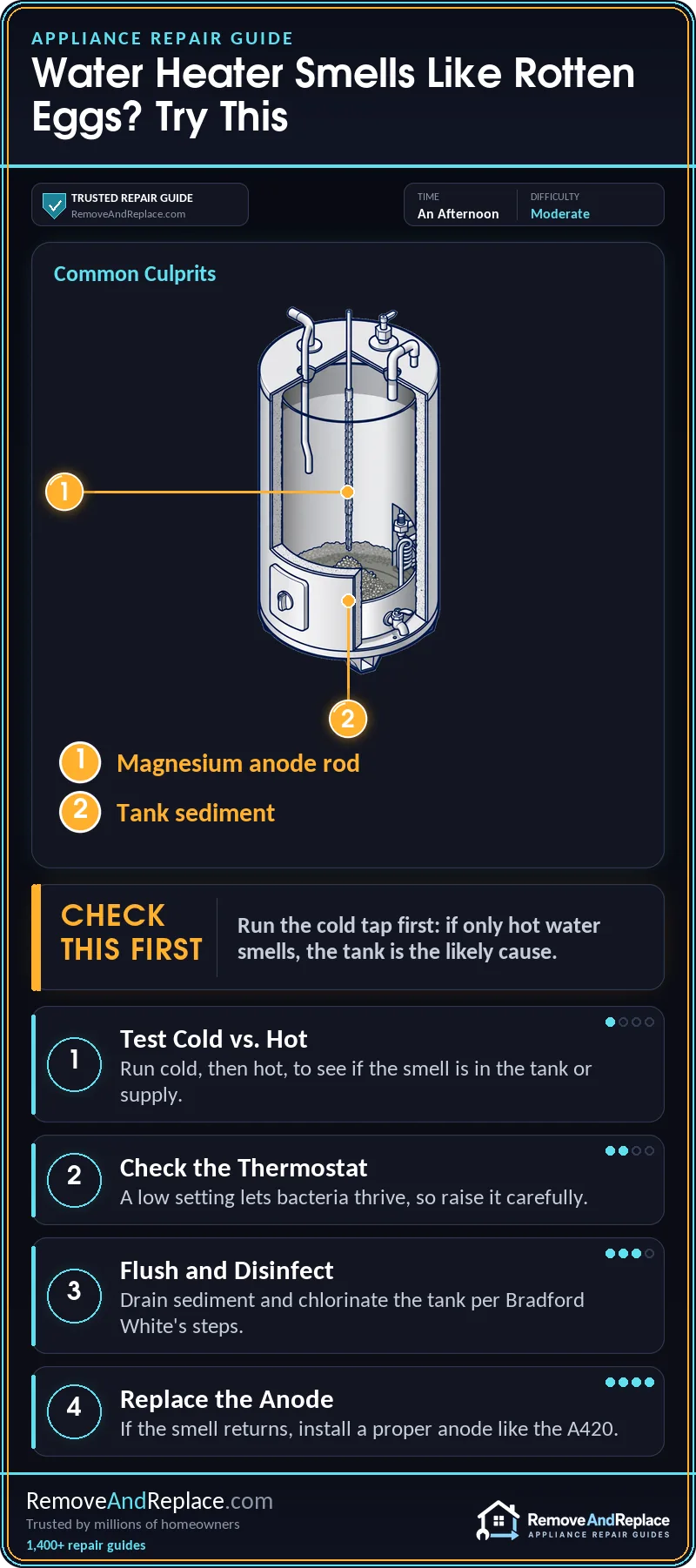
Before you drain anything or buy an anode rod, walk to the sink and run the cold tap. That ten-second test decides whether you’re fixing a water heater or chasing a problem that starts at your water supply. Then run the hot side and compare the smell. A boiled-egg stink that only shows up with hot water points at the tank. If both taps smell, the heater is probably innocent.
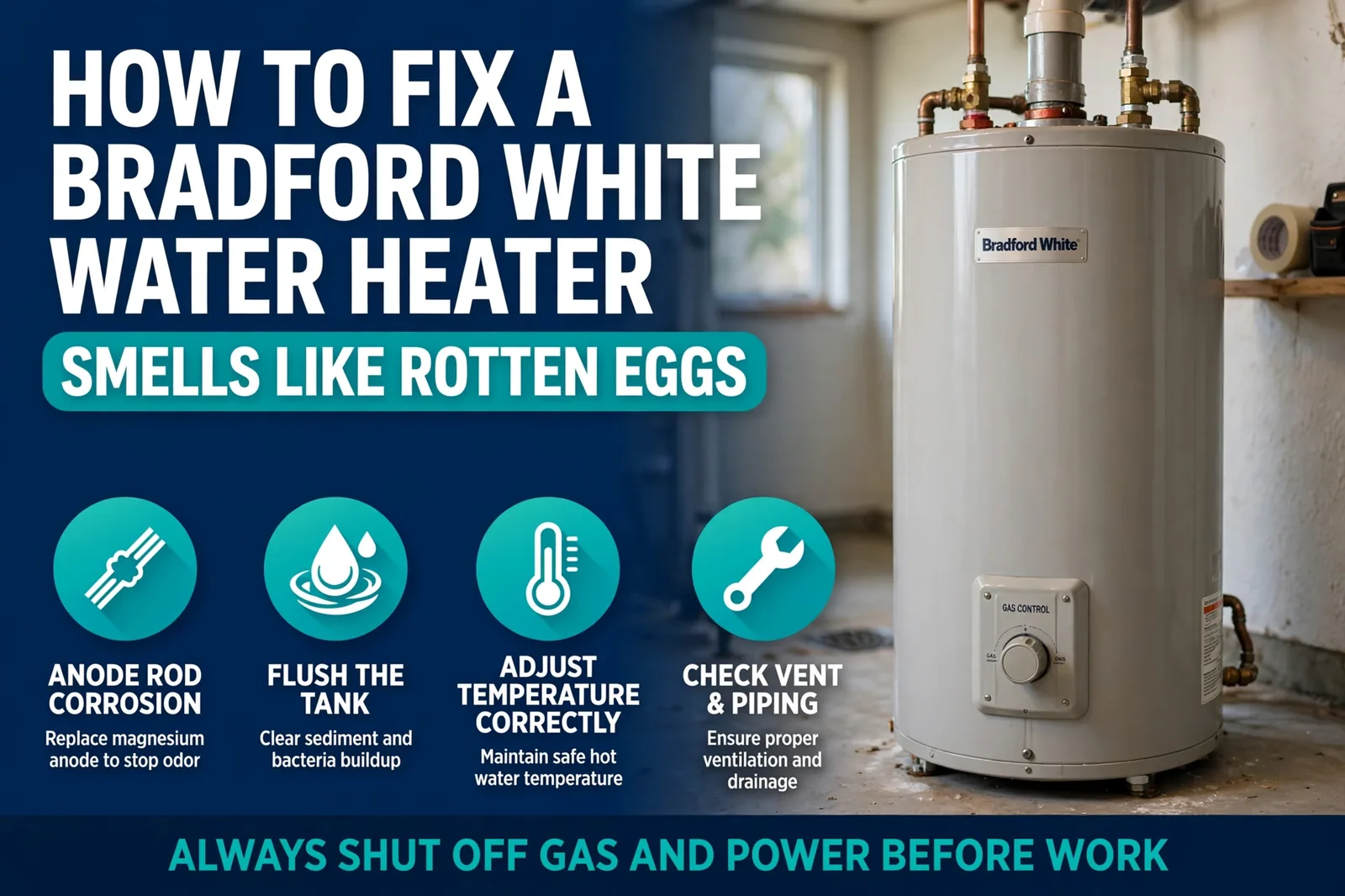
A Bradford White water heater rotten egg smell that shows up only on hot water usually means sulfur bacteria are reacting with the tank’s magnesium anode rod. Flush the tank, disinfect it following Bradford White’s chlorination steps, and swap the anode if the smell returns.
Why Does My Bradford White Smell Like Rotten Eggs?
The smell is hydrogen sulfide gas. Inside the tank, bacteria that live on sulfate in the water produce it, and the magnesium anode rod gives that reaction something to feed on. The anode is there to corrode instead of your tank, so it’s doing its job, but the byproduct is the stink. That’s why a Bradford White water heater rotten egg smell is strongest the moment hot water starts running, especially in the shower. Warm, low-temperature, stagnant water is what the bacteria like, so a heater that sat unused or runs on a low thermostat setting is the classic setup. The fix in most cases is to flush the tank, disinfect it, and, if the smell keeps coming back, change the anode material. Before you touch any valve or fitting on the water lines, shut off the cold water supply to the heater. I’ve watched this work across 30+ years of hands-on repair, but only when the steps get done in the right order. Bradford White’s own hydrogen sulfide and chlorination page for pros is the reference I’d follow for the actual procedure.
Which Cause Fits Your Smell?
| Cause | Likelihood | Fix Cost | DIY Time |
|---|---|---|---|
| Sulfur bacteria in the tank | Most common | Low (flush plus disinfectant) | An afternoon |
| Low thermostat setting | Common | Free | A few minutes |
| Anode rod reaction | Common | Moderate (new anode) | An afternoon |
| Smell in the supply water | Less common | Varies (water treatment) | Not a heater fix |
Symptom: Only the Hot Tap Smells
OK, cold water is clean and hot water stinks. That narrows it down to the tank, and bacteria plus the anode rod are the first suspects. Check the thermostat setting before anything else, because it’s free. If someone turned the heater down to save energy, the tank may never get hot enough to discourage the bacteria. Don’t crank it up blindly, though. Hotter water scalds, so keep the setting where your manual says and keep people away from the taps during any treatment.
Two wrong ideas show up constantly here. The first is that the smell means a gas leak. Hydrogen sulfide smells like eggs, but a gas leak is a separate problem, and if you smell gas around the burner area or the gas line, leave and call your gas utility. The second is the common wrong fix: pouring household bleach into the tank at random, or pulling the anode out and leaving the hole empty. Bradford White warns that removing the anode voids the warranty, and an unprotected tank rusts. If you want a different anode, replace it with a proper one made for your model, and check your manual or ask Bradford White support which replacement is right.
Symptom: Cold Water Smells Too
Then it isn’t the heater. The smell is in your supply, which is common with well water and sometimes shows up in city water after a change at the source. The Minnesota Department of Health explains hydrogen sulfide in well water clearly, including why a plumber or water-treatment specialist is the right call for a supply problem. Treating the heater won’t help.
Watch the Flush and Disinfect Before You Start
This video covers the same fix on a Bradford White tank: draining and flushing sediment, then treating the tank so the bacteria die off. It’s worth watching once before you touch a valve, because seeing the drain and refill order saves you from the most common mistake, opening the hot tap too late and letting the tank fill unevenly.
Cut the energy source first. On an electric model, switch off the breaker before draining; the elements can burn out if they’re exposed with the power on. On a gas model, turn the gas control to the off or pilot setting per your manual. Hot water scalds fast, so let the tank cool before you open the drain, and aim the hose somewhere safe.
The Flush and Disinfect Steps
- Turn off the power or gas. Electric: breaker off. Gas: control to off or pilot.
- Shut the cold water supply to the heater. It’s the same shutoff-first routine I use in the LG washer water inlet valve replacement, and it saves a lot of soaked floors.
- Open a hot tap upstairs so air can enter, then connect a hose to the drain valve and run it to a floor drain or outdoors.
- Drain the tank completely. Sediment often comes out with the first few gallons. Briefly opening the cold supply to stir the bottom can help flush it.
- Follow Bradford White’s chlorination procedure for the disinfectant amount and contact time. I won’t guess at quantities for your tank size; use the numbers on their page or in your manual.
- Refill, run each hot tap until the disinfectant smell shows up, and let it sit for the contact time the procedure gives.
- Flush again until the chlorine smell is gone from every hot tap, then restore power or gas.
Models with a power-vent or blower setup follow the same tank-side logic, but check your manual for any vent or electrical notes before you work around the unit. I haven’t worked on every variation, so the manual wins over my general advice.
What If the Smell Comes Back After a Flush or Anode Swap?
It happens a lot, and most articles stop at “replace the anode.” Work through it in this order:
- Confirm the disinfection was complete. Every hot tap flushed, contact time honored. A tank with leftover sediment hides bacteria.
- Check the thermostat again.
- Swap the anode material if the smell returns within weeks. Ask Bradford White support or a plumber which alternative anode, such as an aluminum/zinc or powered type, is approved for your model.
- Look at the water itself if none of that holds and the cold tap is clean. The water chemistry may need treatment.
RepairClinic’s Bradford White smell guide covers the same escalation from a parts angle.
How Long Until the Smell Clears?
It varies. Expect a few days of running hot water before the last traces fade. If you still smell eggs after a week of normal use, repeat the treatment once, then move on to the anode swap.
Call a plumber or water-treatment pro if the smell returns after a second treatment and an anode change, the cold tap smells too, or the tank drain is clogged solid with sediment. A gas smell near the heater is always a call to your gas utility, not a DIY job. Costs depend on your area, so ask for a quote before agreeing to a tank replacement.
FAQ
Is the rotten egg smell from my water heater dangerous?
At the levels you smell in a shower, it’s an annoyance rather than a hazard, but treat any gas-like smell near the burner as a separate emergency.
Do I have to replace the anode rod?
Not always. A flush and disinfection fixes many cases. I’d only swap it when the smell returns, and I’d use the right anode for the Bradford White water heater rotten egg smell issue rather than pulling it out.
Can I just turn the thermostat up?
Low settings help bacteria, but turning it up only for good is a scald risk. Do it as part of the treatment, then set a safe temperature.
Why does it only smell when I haven’t used hot water for a while?
Because water sitting in the tank gives the bacteria time to produce gas. I’ve seen vacation homes do this every time.
If you’re working through the utility area anyway, other noisy or odd appliance problems can wait their turn. The compressor mounting grommet fix handles a fridge that rattles, and this page on a smart fridge with no WiFi explains what still runs offline. For the heater, rinse the tank out once a year and keep the thermostat where the manual recommends.

Written by Keith Schneerer
Certified Appliance Tech · Founder, RemoveAndReplace.com
Keith has spent 30+ years repairing machines, starting as a military mechanic and later maintaining food processing equipment before moving into appliance repair. He founded RemoveAndReplace.com to share field-tested repair advice.
More about Keith →