Refrigerator compressor not starting often traces to the start relay or overload protector, not the compressor itself. Unplug the fridge, pull the relay, and test it with a multimeter; a reading matching the manual means keep looking. Sealed-system work belongs to a licensed, EPA-certified technician.
Why a Fridge Compressor Won’t Start: The Relay and Overload Come First
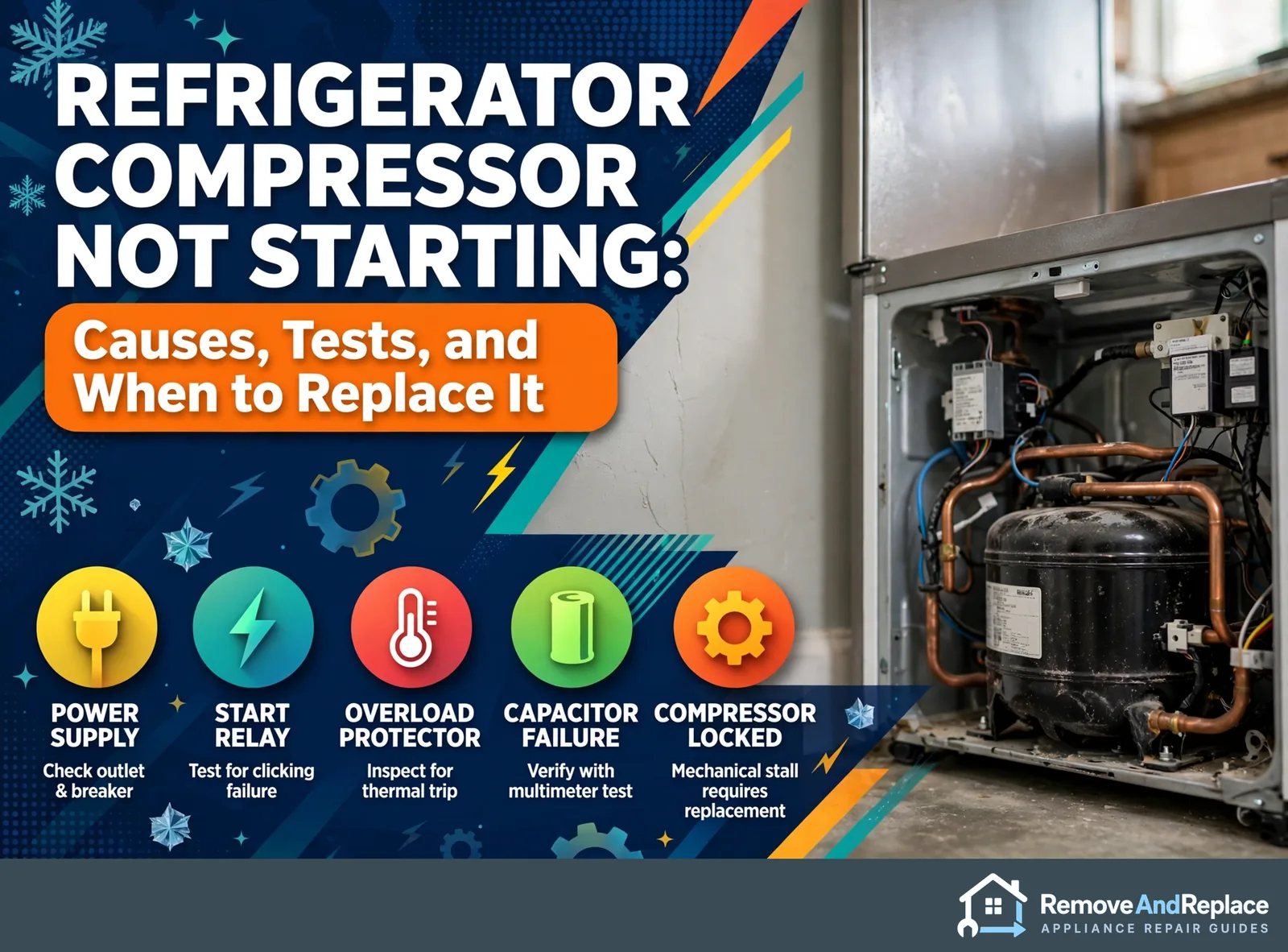
Before you blame the compressor, blame the little plug-on device bolted to its side. On most conventional fridges, the start relay and the overload protector (often sold as one assembly) get the compressor moving and cut power if it overheats. When one of them fails, you end up with a refrigerator compressor not starting even though the compressor is perfectly healthy.
The 19 years I spent in aircraft maintenance left me with a habit that applies here: test the cheap switch before you condemn the big motor. So the plan is simple. Confirm the fridge has power, listen to what the compressor does, then test the relay and overload with the unit unplugged.
If those pass, move on to the windings. And if the compressor is running but the fridge is just loud, that’s a different problem, covered in our Whirlpool refrigerator loud noise guide.
Read the Symptom Before You Grab a Meter
Most people arrive with the wrong assumption: no cold air means a dead compressor. It doesn’t. The sound at the back of the fridge tells you far more than the temperature does, and it points at different parts.
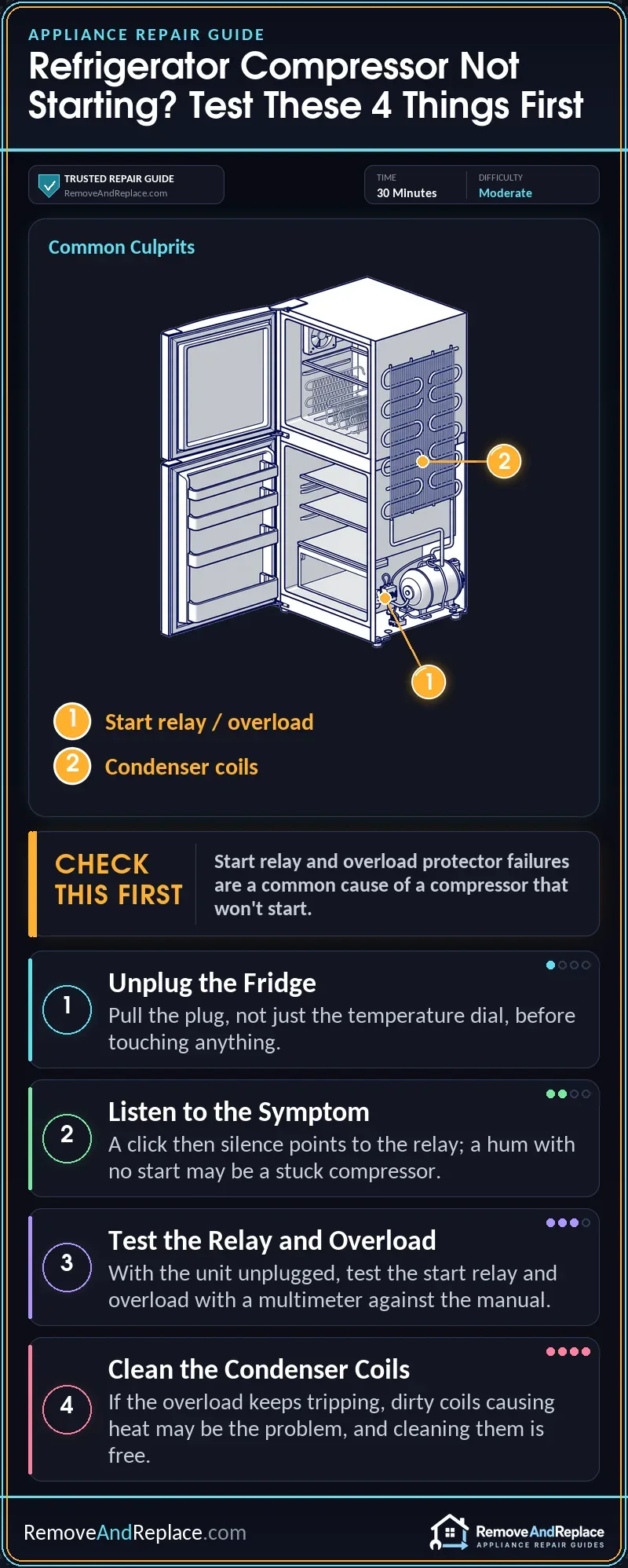
- A click, then silence: the relay or overload is likely the one clicking. The compressor never got its start signal, or it tripped right away.
- A hum, but no start: the compressor is getting power and trying to turn. That points to a weak relay, but it can also mean a seized or mechanically stuck compressor.
- Starts, runs a few seconds, then clicks off: the overload is tripping. That can be a worn overload, but also heat, dirty condenser coils, or a compressor drawing too much current.
- Totally dead, no click, no hum, no lights: check the outlet and cord, then the cold control, then the control board.
If the compressor runs fine and the freezer is just warm, you’re looking at something else, like the airflow and temperature issues in our LG freezer temperature article.
| Cause | Likelihood | What to do |
|---|---|---|
| Start relay / overload protector | Most common | Test and replace the assembly |
| Dirty condenser coils (overload tripping) | Common | Clean the coils, free |
| Cold control or thermostat | Less common | Test continuity, replace if open |
| Control or inverter board | Less common | Check the manual, usually a pro call |
| Open, shorted or seized compressor | Common | Get a pro quote, then weigh against a new fridge |
A clicking compressor that stays silent is usually asking for a new relay or overload, not a new compressor, so test the cheap part before you price the expensive one. That said, a failed compressor is not rare: Sears service data has attributed most Frigidaire compressor-not-running cases to the compressor itself, and appliancepartspros lists an open or shorted winding among the most common causes.
For a second opinion on the symptom list, the iFixit compressor troubleshooting page walks through similar ground.
This video is a visual companion to the diagnosis above. It shows the compressor area at the back of a refrigerator and the kind of checks covered here, so you can match what you’re seeing on your own unit before you start pulling parts.
Unplug the appliance or switch off its breaker before you touch anything. Pull the plug itself; turning the temperature dial to off isn’t enough. This part needs a licensed, EPA-certified technician: never cut, pierce or braze into the sealed refrigerant lines. Every test below is done with the fridge unplugged. Anything that needs the compressor powered, like a running amp reading, is tech territory.
Free Checks First: Power, Cold Control and Coils
- Check the outlet. Plug in a lamp or phone charger. A tripped GFCI or a loose plug mimics a dead compressor.
- Inspect the cord for crushed or scorched spots, especially where it runs behind the fridge.
- Turn the cold control well past its normal setting and listen for the compressor. A control stuck open never calls for cooling. If you suspect it, see our guide on replacing the thermostat on a Whirlpool refrigerator.
- Clean the condenser coils. Unplug the fridge, then vacuum the coils and the dust around them. Packed coils run the compressor hot and can trip the overload over and over.
- Wait a few minutes before plugging back in. The wrong action I see people take is flipping the plug on and off repeatedly. That forces a restart against pressure that hasn’t equalized and can make a weak compressor look dead.
The SearsPartsDirect not-running guide covers the same basic checks if you’d like another reference.
How Do You Test a Start Relay and Overload Protector?
This is the test that matters. A multimeter and a nut driver are usually all you need, and it takes an afternoon the first time and much less after that.
- Unplug the fridge and pull it from the wall. Remove the rear access cover over the compressor.
- Take a photo of how everything is connected. Then pull the relay straight off the compressor pins without twisting or levering. A flathead screwdriver may be needed to release the retaining clip or cover, and a stuck relay can be wiggled gently, but levering it off can bend the pins.
- Look at it. Burn marks, a melted case or a rattle when you shake it all point to a bad part.
- Meter the overload and relay using the continuity or resistance values in your model’s manual. Because designs differ, I won’t give a single number. A reading that doesn’t match the manual, or an open circuit where there should be continuity, means replace it.
- Test the compressor windings at the pins with the relay removed (see the next section).
Don’t be tempted to jump the overload or bypass it to “see if it runs.” Bypassing it is unsafe: the overload protects the compressor from overcurrent and overheating, which can burn out the windings.
Before You Order
Run the meter check first. A pass looks like readings that match the manual. A fail is an open reading, a burned case or a reading far off spec. The exact part number is on the fridge’s rating plate (inside the door frame or cabinet wall) and in the manual. Match the relay to that model number, not to how the old one looks, since near-identical relays aren’t always interchangeable.
Winding and Ground Checks (What Confirms a Bad Compressor)
None of the top how-to pages mention this, but it’s what separates “bad relay” from “bad compressor.” With the relay off and the fridge unplugged, measure resistance between the compressor’s terminal pins, then from each pin to the compressor’s bare metal shell or a copper line.
- Winding readings should match the manual. An open winding reads no continuity. A shorted one reads far lower than spec.
- Pin to shell should read open. Any continuity to ground means a grounded winding, and that compressor is finished.
The locked-rotor amp-draw check is what a technician uses on a hum-and-click compressor. It needs the compressor powered with a clamp meter, so I’m not telling you to do it. A seized compressor pulls very high current for a moment and then the overload trips. If your windings read fine and the relay checks out, that’s the next question to hand to a pro.
Inverter and Variable-Speed Compressors Work Differently
Newer fridges often use an inverter compressor driven by a control board rather than a plug-on relay. There’s no relay to swap. Starting problems on these usually come back to the board, its wiring or an error code, not a click-and-hum pattern.
Some brands display codes for this; if you own a Samsung, our page on Samsung 88 and 8E error codes is worth reading before you assume the worst. Don’t spend money on a board or compressor for a refrigerator compressor not starting until the manual for your model confirms how that system is diagnosed.
Call a pro when:
- The relay and overload test good but the compressor still won’t start.
- A winding is open, shorted or grounded.
- Your fridge uses an inverter board and the manual calls for specialized diagnosis.
- Anything requires opening the sealed refrigerant system.
A compressor swap involves recovering refrigerant, brazing and replacing the drier, so it’s labor-heavy. Ask for a written quote before you agree.
Repair or Replace the Whole Fridge?
A relay or overload is a small, inexpensive part and worth fixing on almost any fridge. A compressor replacement is a different decision. If the fridge is older and the quote lands close to the price of a comparable new unit, I’d put the money toward a new one.
A newer, well-built fridge with a bad compressor, or one still under a sealed-system warranty, can justify the repair. Check your warranty paperwork before anything else.
Garage and hot-room fridges, common around Phoenix, run harder in summer, and that heat shortens compressor life. Keep the coils clean and leave breathing room behind the fridge to protect whatever you end up with.
Last Step: Plug In and Confirm
Reattach the relay straight onto the pins, refit the rear cover, slide the fridge back and plug it in. Then listen. You’ll know the job worked when the compressor hums on and stays on without clicking off, and the freezer feels noticeably colder within several hours.
FAQ
How long should I wait before plugging the fridge back in?
A few minutes. I always give it that long so the pressures in the system can equalize. Restarting too fast is a good way to make a marginal compressor trip the overload.
Can I bypass the overload to test the compressor?
No. Bypassing or jumpering the overload is unsafe, because the overload protects the compressor from overcurrent and overheating, which can burn out the windings. Test it with a meter instead.
Does a humming compressor that won’t start mean it’s bad?
Not necessarily. A hum means the compressor is getting power and trying to turn, which fits a weak relay as well as a seized compressor. That’s why I test the relay first: it’s cheap, it’s easy, and it rules out the more common cause.
If the relay passes and the windings read normal, the hum could still be a mechanical lock-up, and at that point I’d want a technician’s amp reading before spending anything on a new compressor or fridge.
Can a bad thermostat cause a refrigerator compressor not starting?
Yes. If the cold control never closes, the compressor never gets the call to run, and it looks exactly like a dead compressor. It’s one of the free checks I do early for that reason.
Is it worth replacing the compressor on an old fridge?
Usually not. In my experience, once a compressor itself has failed on an older fridge, the repair bill gets too close to the cost of new. A relay, overload or thermostat is a different story and almost always worth it.

Written by Keith Schneerer
Certified Appliance Tech · Founder, RemoveAndReplace.com
Keith has spent 30+ years repairing machines, starting as a military mechanic and later maintaining food processing equipment before moving into appliance repair. He founded RemoveAndReplace.com to share field-tested repair advice.
More about Keith →