A Primo water dispenser not dispensing is often caused by an air lock or a bottle that isn’t seated properly, though a frozen cold tank or a pump that has lost its prime can also be the cause. Don’t order a part yet. Lift the bottle off and reseat it firmly, then press the dispense button: if water flows, the bottle was likely the issue, and if the pump hums but nothing comes out, work through the checks below, including the probe, tubing and filter, before you suspect the pump motor.
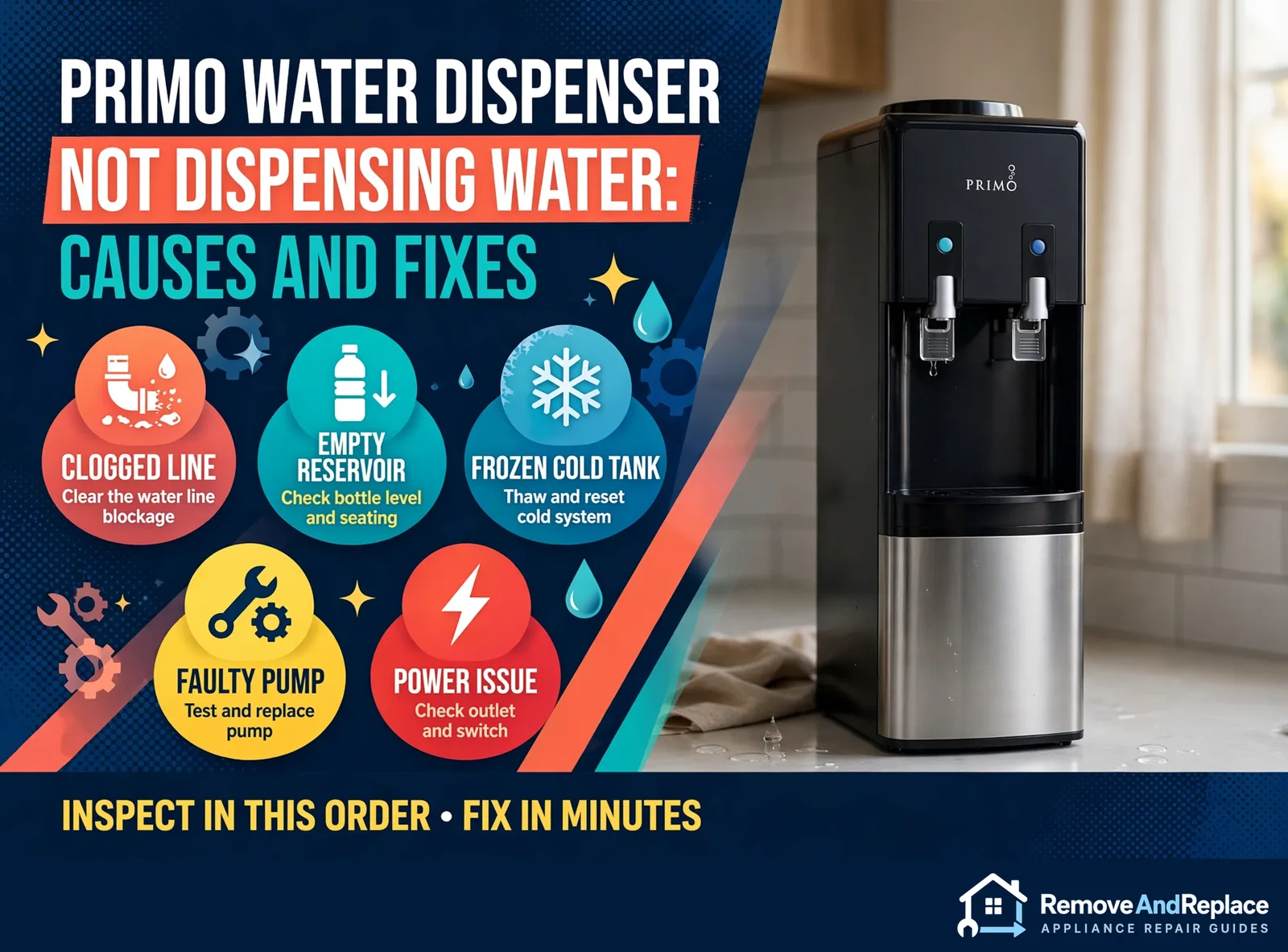
- Work out whether yours loads from the top or the bottom before you try any pump fix.
- If hot water pours while cold stays dry, check the cold side first, and check your model’s manual for what to do.
- Your model’s manual and rating plate settle anything that varies by unit, such as reset steps and thermostat settings.
What Is Actually Happening Inside a Dispenser That Stops Pouring
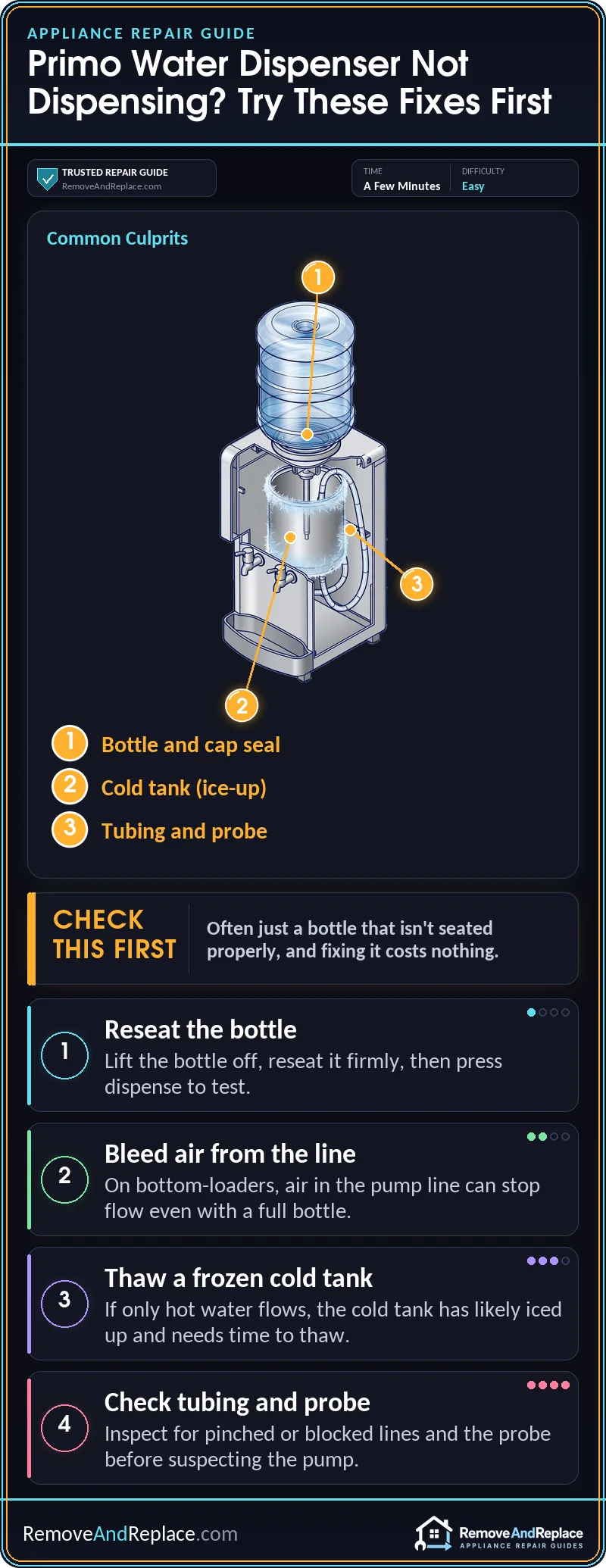
Water leaves a Primo through a tap that is open to a reservoir that holds water. The bottle refills that reservoir. Top-loaders rely mostly on gravity and air venting back into the bottle. Bottom-loaders use a pump to draw water from the bottle in the cabinet, so air in that line can stop the flow even when the bottle is full. That’s why a Primo water dispenser not dispensing can have several causes that look the same from the front. Cold water adds another path: if the cold tank ices up, the cold tap goes dead while hot may keep working. Ice-up is a problem I’ve chased across 30+ years of hands-on repair work, and the same reasoning carries over to these small tanks. My rule is to start with the free checks (bottle, air, ice) before anyone talks about a new pump. There’s a broader list of fixes in this guide to fixing a bottled water dispenser.
The wrong assumption most people arrive with is “the pump died.” A dead pump is possible, but it’s well down the list. A pump that hums and moves no water is usually pulling air or fighting a blocked line, and that’s fixable without buying anything.
Which Symptom Are You Seeing?
What you’ll see: nothing comes out of either tap, the bottle is full, and the unit is silent. What’s happening: on a bottom-loader the pump may not be getting water to prime, or the bottle isn’t seated so the probe never opened the cap. On a top-loader the bottle isn’t venting or the cap isn’t pierced. What to do: unplug, reseat the bottle, and test again.
What you’ll see: you hear the pump hum or buzz, but only air or a weak trickle comes out. What’s happening: air is in the suction line, or the line is pinched or blocked. What to do: follow the airlock steps below. If the sound itself is what worries you, our piece on noisy hot and cold water coolers covers what different sounds mean.
What you’ll see: hot water pours, cold doesn’t, or cold comes out as a thin dribble. What’s happening: hot water pouring while cold doesn’t is the classic sign the cold tank has frozen, which blocks the cold path while the hot side stays clear. What to do: thaw it, then find out why it froze. Your model’s manual is the best reference for what the cold side should do.
| Cause | Fix Cost | DIY Time |
|---|---|---|
| Bottle not seated or cap not opened | Free | A few minutes |
| Air in the pump line (bottom-loaders) | Free | A few minutes |
| Frozen cold tank | Free, plus waiting | Usually a day or more, longer after a heavy freeze |
| Clogged spigot or pinched line | Low | Under an hour |
| Faulty temperature sensor | Often low (sensors can be inexpensive) | Varies by model |
| Failed pump (bottom-loaders) | Higher; sometimes close to a new unit’s price | Varies by model |
Watch the Walkthrough Before You Start
This Primo video covers low or no flow on a bottom-loading unit, so skip it if yours loads from the top. It helps to see the bottle, tap and cabinet before you open anything. Watch it once, then use the steps below in order so you don’t skip a free fix.
Unplug the appliance or switch off its breaker before you touch anything. Switching it off at the front isn’t enough, and the hot side stays hot for a while after it’s unplugged, so let it cool before you reach into the cabinet.
Is the Bottle Seated and the Cap Open?
Start here because it costs nothing. The bottle needs to be seated fully, and your model’s manual will show how it should sit. Half-seated looks fine from the front and can deliver nothing.
- Unplug the unit. Lift the bottle straight off.
- Check the bottle neck and the probe. Look for a cap that didn’t pierce, a twisted seal or debris.
- Reseat the bottle. Press it down evenly until it seats, without forcing it.
- Plug it back in and test. Water flowing means you’re done.
If it still won’t pour, try a different full bottle. A damaged or oddly shaped bottle can seat badly. If a new bottle fixes it, the old one was the problem.
Is There Air in the Pump Line on a Bottom-Loader?
A pump that runs dry moves air, not water. This happens when a bottle runs empty or gets swapped and the suction tube picks up air. It only applies to bottom-loaders, so skip it on a top-loader.
- Confirm the bottle isn’t empty and sits fully in the cabinet.
- Check the suction tube for kinks or a loose fit at the bottle connection.
- Hold the dispense button down for a while. A pump that is only airlocked will often prime and start pulling water.
- Try again with a different full bottle if the tube looks fine and flow still won’t start.
On a top-loader, the similar problem is a vacuum lock. If the bottle can’t pull air in, water won’t leave it. Reseat the bottle and make sure the cap opened. A bottle that has collapsed or deformed can also stall flow.
Has the Cold Tank Frozen?
What you’ll see: hot works, cold doesn’t, or cold barely trickles. What’s happening: ice forms in the cold tank and blocks its outlet, so the unit can’t pass cold water even though the pump and bottle are fine. What to do:
- Unplug the unit. Keep it unplugged while it thaws.
- Put towels down and expect meltwater as the ice thaws.
- Wait until the ice has fully melted. Plan on a day or more, and longer after a heavy freeze. Check your manual for its guidance.
- Plug it back in and test cold water after it has fully thawed.
If it freezes again, the thermostat setting, a faulty cold-water temperature sensor or the unit’s location may be involved. If your model has an adjustable cold setting, back it off, and check the manual before changing anything else.
Common mistake: don’t chip at the ice or aim a hair dryer or heat gun at it. You can crack plastic or damage a line, and a rushed thaw usually ends with the unit re-freezing. Patience is the actual fix here.
Is the Spigot or Line Blocked?
Mineral buildup or debris can narrow the tap, aerator or valve and restrict flow. With the unit unplugged, look into the tap opening with a flashlight and check any accessible tubing for kinks. Rinse out what you can reach, and don’t push anything sharp into the tap. If water flows from one tap and not the other, the blocked part is on the dead tap’s side. That tells you where to look.
When Is It Actually the Pump or a Sensor?
A true pump failure usually shows up after the free checks fail and the airlock steps don’t help: the pump either does nothing at all or runs with no flow even on a fresh bottle and a clear line. A failed pump is the costly one, and the repair can approach the price of a new bottom-loading unit. A cold-water temperature sensor or thermostat that has failed can let the tank keep chilling until it freezes again, even after you’ve thawed it, and a sensor is usually the cheaper, more DIY-friendly fix. Either way, replacing one takes enough disassembly that it’s worth confirming the diagnosis before you buy anything.
What Should You Check Before You Order a Part?
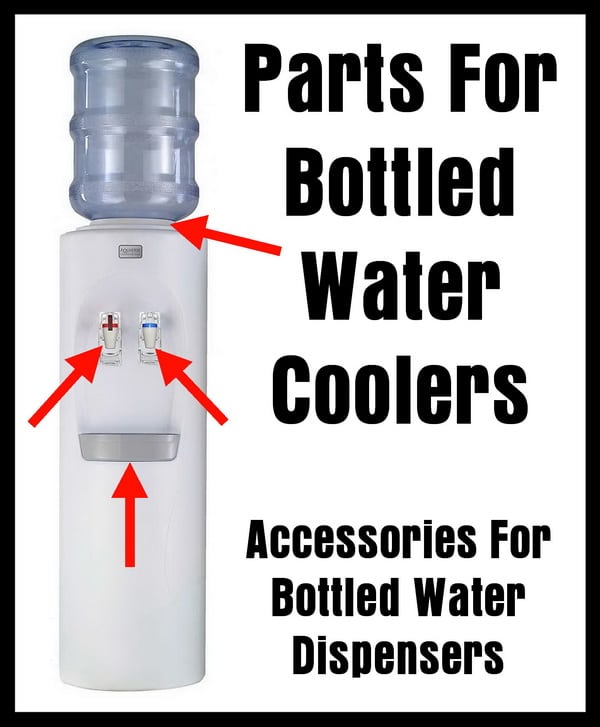
Run the bottle reseat, the airlock test and a full thaw first. A pass means water flows normally after those. A fail means the same symptom comes back with a fresh bottle and a fully thawed tank. Then find the exact part number on the rating plate or in your model’s manual, since parts differ between top- and bottom-loaders. For parts and accessories, our bottled water cooler parts page is a useful starting point.
A clogged tap or an airlock is a cheap fix. A repeated freeze-up almost always has a reason you can find.
When to call a pro: The cold system on some units uses a sealed refrigerant circuit. This part needs a licensed, EPA-certified technician. Call one if the cold side won’t cool at all, or if you smell burning or see water around electrical components. For a pump or sensor swap, compare the repair against the cost of a replacement unit before you commit.
How Do You Keep It From Happening Again?
Don’t let the bottle run dry before swapping, and seat the new one fully each time. Keep the unit away from cold spots and leave a little space behind it. Wipe the tap and drip tray regularly so buildup doesn’t narrow the outlet.
FAQ
Why does my Primo dispenser hum but not pour?
The pump is running, but it’s usually pulling air or fighting a blocked line. I’d check the bottle seating and the suction tube before anything else. On a bottom-loader, holding the button down can help it prime.
Why does hot water work but not cold?
The cold tank has most likely frozen and is blocking the cold outlet. Unplug it, let the ice melt fully (usually a day or more), then restart it. If it keeps freezing, check the thermostat setting in your manual.
Do all Primo dispensers have a pump?
No. Top-loaders mostly rely on gravity, and bottom-loaders use a pump to draw water up. That’s why pump priming advice only helps if yours loads from the bottom.
Can I use a hair dryer to speed up thawing a frozen cold tank?
I wouldn’t. Heat aimed at plastic and tubing can warp or crack parts. Unplug the unit and wait it out, because that’s the safer route.
Should I replace the dispenser or fix it?
If the cause is the bottle, an airlock or a thaw, it’s a free fix. I’d only think about replacement when the cold system fails or a repair costs close to a new unit. When a Primo water dispenser not dispensing turns out to be the pump or sealed system, compare the repair quote with a replacement.
Start with the free checks. They fix this more often than a new part does.

Written by Keith Schneerer
Certified Appliance Tech · Founder, RemoveAndReplace.com
Keith has spent 30+ years repairing machines, starting as a military mechanic and later maintaining food processing equipment before moving into appliance repair. He founded RemoveAndReplace.com to share field-tested repair advice.
More about Keith →