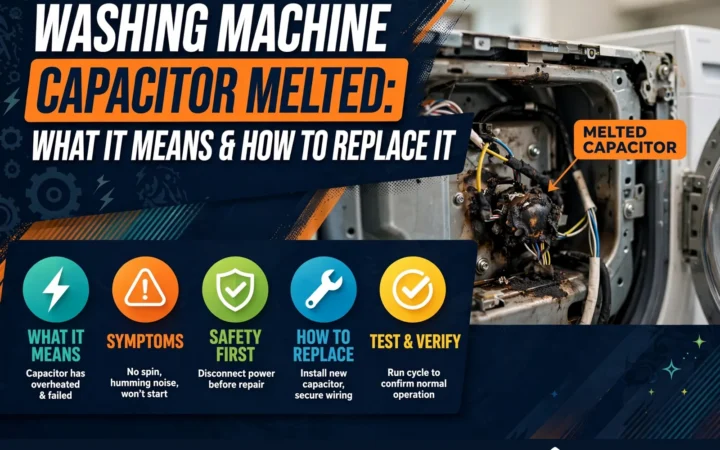
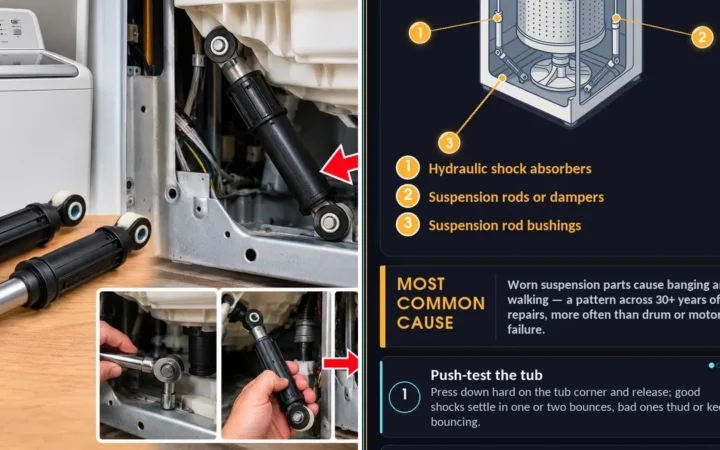
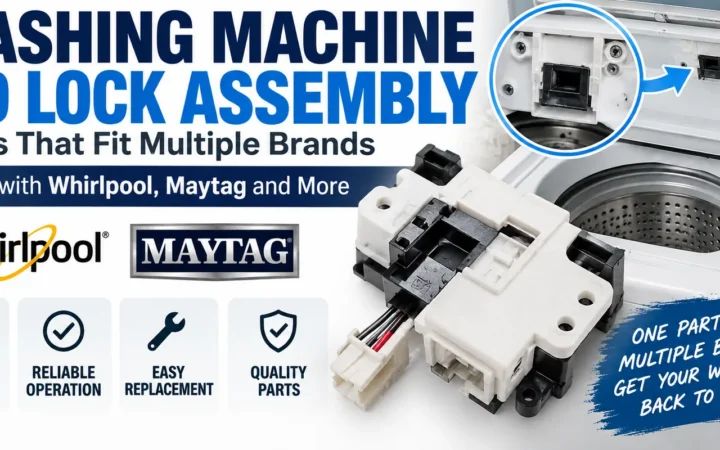
Three things tell you almost everything on these machines: whether the motor hums, whether the pulsator turns by hand, and whether anything at all happens when you press start. Before you buy a part or write the machine off, run through those three. Each one points to a different cause, and most of them cost nothing to check.
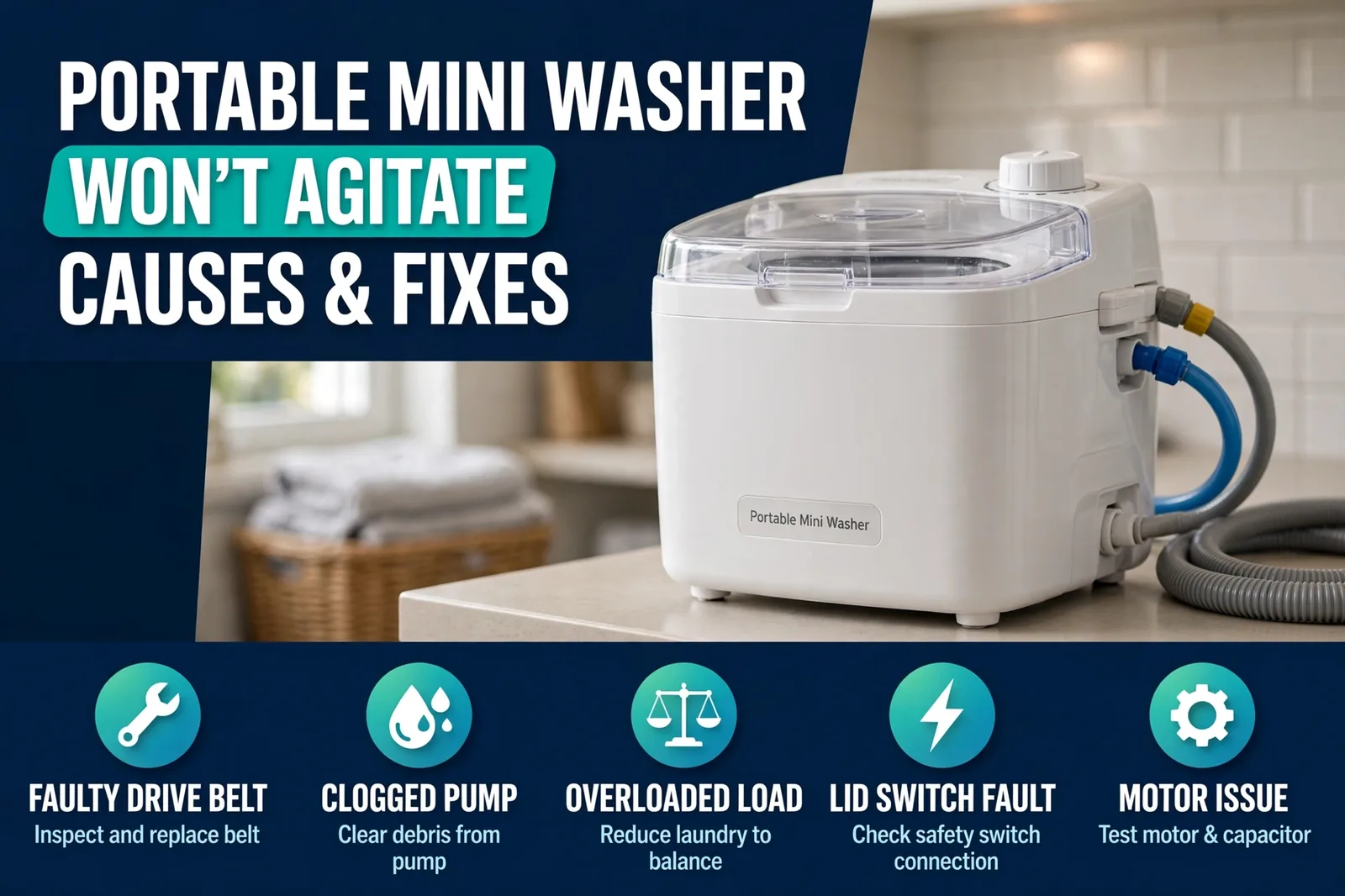
A common reason a mini washer stops moving clothes is an overloaded tub, or lint and a stray sock jammed around the pulsator, so no part is needed yet. Unplug it, empty the tub and turn the pulsator by hand: if it’s stiff, look for a jam; if it spins freely and the machine still won’t move clothes, suspect the timer, lid switch, capacitor or motor.
What “won’t agitate” really means on a mini washer
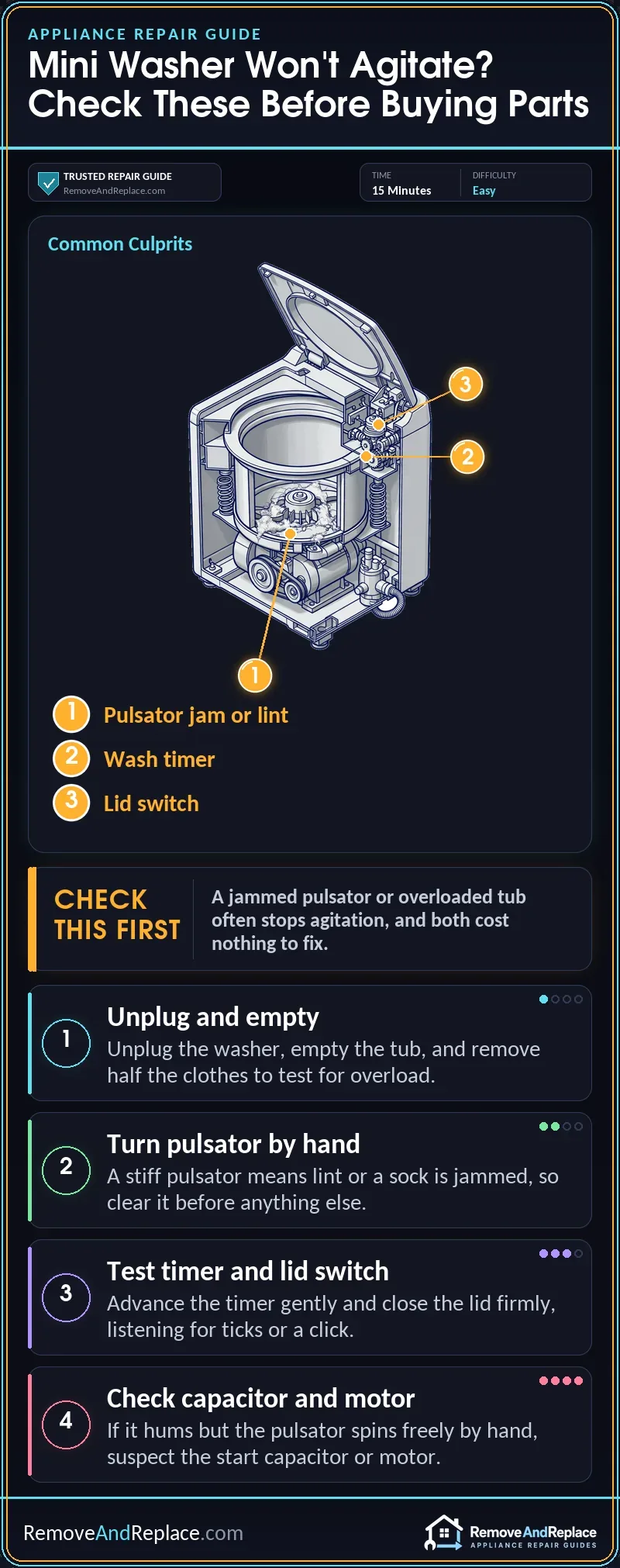
The complaint usually shows up as “it fills, it hums, and the clothes just sit there,” or “it worked last week and now it only twitches.” When a mini washer won’t agitate, a dead motor is rarely the first problem. These little machines run a low-wattage motor against a pulsator, so a heavy load, a wad of lint, or a sock wedged under the pulsator can stall the whole thing. The order below runs from free checks first, to cheap parts, to the question of whether the machine is worth the effort. One thing to avoid: don’t keep pressing start while it hums, because that can burn out a small motor.
Unplug the appliance or switch off its breaker before you touch anything. Shut off the water supply to the appliance before you disconnect any hose or valve. Don’t open the motor housing. A start capacitor can hold a charge even when the cord is out.
Likely causes, in the order I’d check them
- Overloaded tub. Pull out about half the clothes and run it again; if agitation comes back, that was it.
- Lint, a sock or debris jammed at the pulsator. Empty the tub and turn the pulsator by hand; stiffness or a grinding catch confirms it.
- Wash timer not set or not advancing. On a mechanical timer, advance the knob gently clockwise through its cycle positions (never force it backward, which can damage the mechanism) and listen for ticking or clicking. Silence suggests a faulty timer.
- Lid or safety switch not engaging, on units that have one. Close the lid firmly and listen for a click. Lid-lock design is model-specific, so don’t assume a full-size washer works like a mini; some Whirlpool top-loaders use a latch sensor talking to the control board, as in this Whirlpool lid lock case.
- Worn or slipped drive link, on models that use a belt. If the motor runs but the pulsator stays dead, the link between them is the suspect.
- Failed start capacitor or motor. A hum with no movement, while the pulsator turns freely by hand, points here.
Hums, but nothing moves
OK, so the pulsator turns freely by hand and the machine still just hums. That narrows it down. A hum means power is reaching the motor, and the motor is trying and failing to start. On a small unit that’s usually a failed start capacitor or a worn motor.
If the pulsator is stiff instead, you’re back to a jam, so go clear it. A repair-forum answer on iFixit for a portable washer that won’t spin or agitate names a failed lid switch as the usual cause, so don’t rule out the electrical side before you open anything up.
Motor runs, but the pulsator barely moves
Now the motor sounds fine, but the pulsator twitches or stalls when the tub has clothes in it. Two things cause this. One is an overloaded tub on a low-wattage motor. The other is a drive link that slips under load. Run it with a few lightweight items and no water first. If it agitates then, it’s load. If it still stalls, the link is slipping or the pulsator is loose on its shaft.
Check the rating plate for the machine’s recommended load. It’s easy to overstuff these because the tub looks big.
Spin side works, wash side is dead
On a twin-tub unit, the wash and spin sides run on separate timers. If the spin side runs but the wash side doesn’t, you’ve ruled out the cord, the outlet and the power supply. That points to the wash timer, the wash motor or the pulsator. On a full-size washer, the same symptom is covered in 4 reasons a top-load washer spins but does not agitate. If you’ve been turning the spin knob and expecting agitation, that’s the wrong control (an easy mistake to make).
Nothing at all happens
No hum, no click, no movement. Start with the cord and the outlet: plug in a lamp to test it. Then check the lid switch click (this washing machine lid switch repair shows how) and the timer tick. If the machine fills but doesn’t run, that’s a different fault from agitation.
Watch the diagnosis before you open anything
The video below walks through diagnosing a washer that has stopped agitating. Watch it with the checks above in mind so you know what a free-moving pulsator and a stalled one look like on a real machine.
How to clear a jammed pulsator
- Unplug the machine. Pull the cord out of the wall; don’t rely on the timer knob.
- Shut off the water supply if the machine is hooked to a faucet, then disconnect the hose.
- Drain the tub into a bucket or sink using the drain hose, and take out the clothes.
- Remove the pulsator. Many pop off or are held by a center cap or screw; check the manual for yours.
- Clear the shaft. Pull out lint, thread, hair or a sock, and rinse the pulsator.
- Reseat the pulsator and turn it by hand. It should move freely with no grinding.
- Reconnect the hose and turn the water back on to check for leaks, with the machine still unplugged.
- Plug it in and test with a light load, not a full one.
Is it worth fixing a cheap mini washer?
A free fix is always worth it. A small thermal or timer part might be, if it’s cheap and the unit is otherwise sound. A failed motor on a low-priced portable usually isn’t, because many are built so they’re not meant to be serviced. PartSelect’s guide to washers that won’t agitate is aimed at full-size top-loaders with transmissions and couplers; a mini may or may not have similar parts depending on its design.
Whatever the cause turns out to be, the free checks cost nothing. Clear the pulsator and cut the load before you buy anything.
Keeping it from happening again
Keep loads light, check the tub for socks before each wash, and wipe lint out of the pulsator area after every few loads. If clothes come out smelling off, my notes on sour-smelling laundry cover the buildup.
FAQ
Why does my mini washer spin but not agitate?
On a twin-tub, the spin and wash sides run separately, so a working spin side only tells you the power is fine. Check the wash timer, then the pulsator for a jam.
Can I fix a mini washer that won’t agitate without opening it?
Often, yes. If yours won’t agitate, start with the load, the timer knob and the lid. Many cases get sorted there. Only pull the pulsator if those checks don’t work.
How much can it handle?
The rating plate or manual lists the capacity for your model. Treat that number as a ceiling, not a target.
Should I replace it instead?
If the motor has failed, replacing the whole washer usually makes more sense on a low-priced portable, since many aren’t built to be serviced. A free fix like clearing a jam or cutting the load is always worth trying first.
If you smell burning plastic or the breaker trips when you press start, stop there and call a pro, or retire the machine.

Written by Keith Schneerer
Certified Appliance Tech · Founder, RemoveAndReplace.com
Keith has spent 30+ years repairing machines, starting as a military mechanic and later maintaining food processing equipment before moving into appliance repair. He founded RemoveAndReplace.com to share field-tested repair advice.
More about Keith →