Whirlpool washer bad bearing noise usually sounds like a roar, grind, or rumble that gets louder as the drum speeds up in the spin cycle. If that’s what you hear, the drum bearing is a likely cause, and you can check it for free in a few minutes: unplug the washer, empty the drum, and spin it by hand. Rough grinding or wobble is a strong sign of a worn bearing, though a smooth, quiet drum does not rule out other causes such as a loose drive block, spider arm, or suspension; the check is most reliable with the drive belt removed.
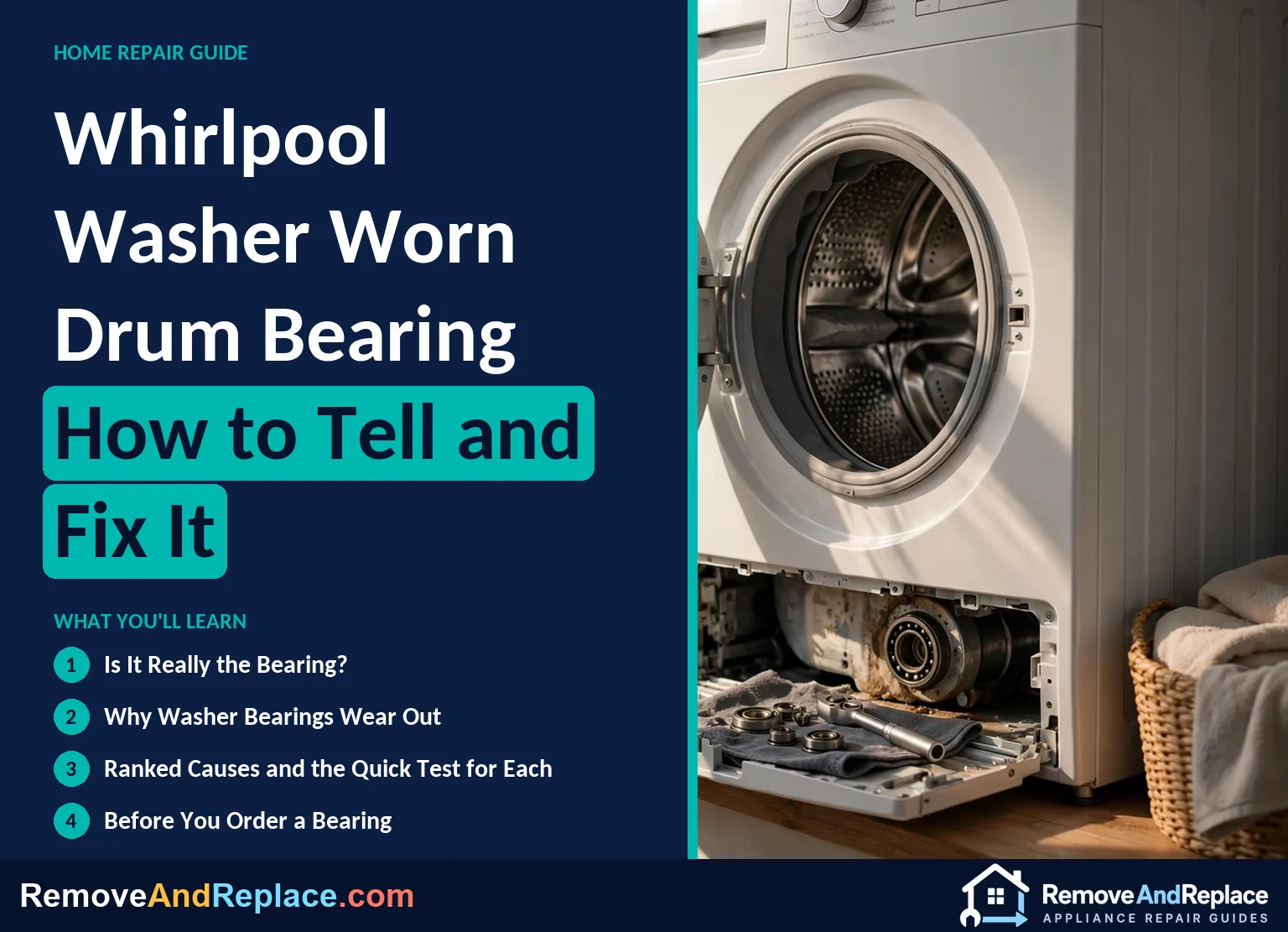
- The hand-spin test is free and takes a couple of minutes, so do it before you buy anything.
- Rust-colored seepage or grease at the rear of the tub points at the seal, which usually fails with the bearing.
- On many models the bearing is sold only with the rear outer tub, so check parts availability before you commit.
Is It Really the Bearing?
Don’t order a bearing kit yet. Whirlpool washer bad bearing noise has a pretty specific signature: a low rumble or roar that gets louder with drum speed, worst in the spin cycle, and still there with a small load. Unplug the washer, empty the drum, and spin it by hand. A healthy drum turns smoothly and quietly. A bad bearing grinds, drags, or feels like it’s rolling over gravel. Then grab the drum and pull it toward you and push it back; any clunk or looseness is play that shouldn’t be there. It’s a basic check that’s served me well across 30+ years of repair work, and it costs nothing. If the drum spins free and silent, the noise is probably something cheaper, and I’d start with this guide to washing machine noise during the spin cycle before touching a wrench.
Why Washer Bearings Wear Out
The rear seal keeps water out of the bearing, and once that seal wears, water and detergent get in, the grease washes out, and the bearing starts to rust and roughen. That’s why the noise tends to start as a faint hum and grow over time. Two habits make it worse: running the washer badly out of level, and stuffing it with heavy loads so the drum pounds on every spin. A drum that grinds when you spin it by hand has a bearing problem, not a load problem.
Ranked Causes and the Quick Test for Each
Every test below is free. Rank here is a judgment call, and the bearing goes first because it’s the one this article is about; the rest are what I’d rule out so you don’t tear apart a washer for nothing. Another good reference is the RepairClinic loud-noise page for Whirlpool washers, and our general washer troubleshooting guide covers the non-noise symptoms.
- Worn drum bearing: unplug, empty the drum, spin it by hand, and check for play. Grinding or wobble confirms it.
- Unbalanced load or an unlevel washer: run a small, even load and check that all four feet are firmly planted. If the noise goes away, the bearing is fine.
- Worn suspension or shock absorbers: the tub should settle smoothly when you push it, not bounce around or knock against the cabinet. Check the manual for how your model’s suspension should behave.
- Drive belt, pulley or motor trouble (belt-drive models): check the belt for glazing or fraying and spin the motor pulley by hand. A motor that hums but won’t turn is a different problem, and a melted capacitor is one thing to rule out.
- Foreign object: a coin or underwire rattling around between the drum and tub, or in the drain pump, sounds like a clatter rather than a steady roar. Check the pump filter and shake the drum.
Watch the Teardown Before You Start
This video walks through the diagnosis and the bearing replacement on a Whirlpool washer, so you can see how the tub comes apart before you commit to it. It’s worth watching once all the way through, because the order of what comes off matters.
Before You Order a Bearing
Find your model number on the nameplate (often inside the door frame or on the back of the cabinet), then look up the parts diagram. Whirlpool designs vary: front-load Duet-style washers, Cabrio-style and other top-loaders with a gearcase or tub bearing, and direct-drive models all come apart differently. On many models the bearing is only sold together with the rear outer tub, which turns a bearing job into a tub replacement. If the listing shows only the tub, a bearing replacement may not be an option for your model, so verify before you spend money.
Is It Worth Fixing or Should You Replace the Washer?
Compare the price of the kit or tub against the cost of a new machine, and weigh how old the washer is. A bearing kit on a washer that’s otherwise in good shape makes sense. A tub-only part, plus a day of work, on an old machine with a cracked boot and a tired motor usually doesn’t. I’d lean toward a new washer once the part pushes toward the cost of one.
Unplug the appliance or switch off its breaker before you touch anything. Shut off the water supply to the appliance before you disconnect any hose or valve. The tub assembly is heavy and awkward, so get a second person to help you lift it.
Replacing the Bearing and Seal
This is a big job, and plan on a full afternoon or more the first time. You’ll need basic hand tools, a way to press the old bearing out and the new one in (a bearing press or the proper driver, not a hammer and luck), and plenty of patience. Take photos at every stage so you can put it back together in the right order. The AppliancePartsPros bearing and seal guide is a good companion to follow alongside the video.
One wrong move I see people try is spraying lubricant at the rear seal and calling it fixed. It might quiet the noise for a few days, but it doesn’t repair a rusted bearing, and it won’t fix a seal that lets water through. Treat that as a stopgap at best. Likewise, don’t keep running a grinding washer for months, because a failing bearing can eventually damage the bearing seat or the tub.
- Pull the washer out and disconnect it. With the water off and the plug pulled, disconnect the hoses, drain any leftover water, and move the washer where you can reach all sides. If the door is locked and the panel is dead, see what to do when a Whirlpool washer is locked and the control panel won’t respond.
- Remove the outer panels. Take off the top and whatever front or rear panels your model needs, along with the door boot or other parts in the way. Photograph the wiring and hose routing first.
- Disconnect and lift out the tub assembly. Unplug the wiring and hoses, free the drive parts and suspension, and lift the assembly out with a helper.
- Open the tub and remove the drum. If the tub is a sealed one-piece unit, stop here. That’s the tub-replacement situation described earlier.
- Press out the old bearing and seal. Clean the seat, check it for damage, and press the new bearing and seal in straight. A crooked bearing will be noisy again quickly.
- Reassemble in reverse. Reconnect everything, level the washer, then restore the water only after the hoses are reconnected so you can check for leaks. Run an empty cycle and listen.
Call a pro if the tub is sealed and you don’t have a press, if the seat is damaged, or if lifting the assembly isn’t something you can do safely. Ask for the quote on the whole job and compare it with the price of a new washer first.
Keep It From Coming Back
Keep loads within the drum’s capacity and keep the washer level so the bearing and seal aren’t pounding on every spin. If you ever smell burning, see smoke, or the motor hums without turning, unplug the washer and call a licensed appliance technician.
Frequently Asked Questions
Can I keep using a washer with a bad bearing?
I wouldn’t for long. The noise gets worse, and a failing bearing can cause damage that makes the repair bigger. Use it only until you can fix or replace it.
How can I tell bearing noise from a drain pump or suspension noise?
Bearing noise follows drum speed and is still there when the washer isn’t draining. A pump clatters when water is moving, and worn suspension usually shows up as banging or knocking rather than a steady roar. When I’m unsure, I do the hand-spin test with the drum empty, because that isolates the bearing from everything else.
Is the bearing sold separately for my model?
Not always. Check your model’s parts diagram, and see the AppliancePartsPros noise guide for Whirlpool washers for what else can cause the noise.
Should I replace the seal at the same time?
Yes. A new bearing behind an old, worn seal will get wet and fail again, so replace both together. I learned to treat that as non-negotiable.

Written by Keith Schneerer
Certified Appliance Tech · Founder, RemoveAndReplace.com
Keith has spent 30+ years repairing machines, starting as a military mechanic and later maintaining food processing equipment before moving into appliance repair. He founded RemoveAndReplace.com to share field-tested repair advice.
More about Keith →