A washer that keeps filling past the top of the tub — or fills and drains at the same time, over and over — almost always comes down to one of four things: the water inlet valve, the pressure switch, the small hose that runs between the switch and the tub, or a drain hose pushed too far down the standpipe. Overloading, low supply pressure, and too much detergent are real causes too, but they’re a distant second. Shut off both wall taps before you do anything else, then work through the checks below in the order I use them.
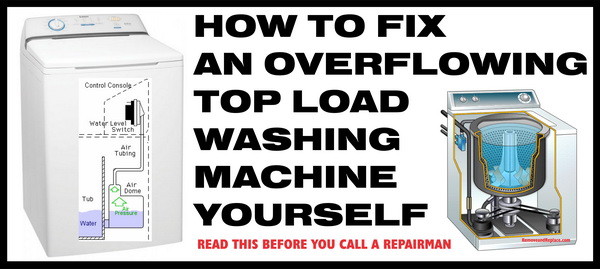
- If the tub keeps filling with the washer unplugged, the water inlet valve is stuck open mechanically and needs replacing — no wiring or control board test required.
- A clogged, kinked, or split air dome tube (the pressure hose) is one of the most common overfill causes, and it costs nothing to check.
- A drain hose shoved too far down the standpipe siphons water out while the machine refills — that’s the classic “fills and drains constantly” complaint.
- Shut off both wall taps and unplug the machine before you open the cabinet or pull a single hose.
What Causes A Washing Machine To Overflow — And How To Fix Each One
An overflow is one of the few appliance faults that can ruin a floor in ten minutes, so after 30-plus years of hands-on repair work I treat it as a valve and sensing problem first and a drain problem second. Below are the seven causes I work through, roughly in the order I check them, each with the test and the repair together.
1. Water Inlet Valve Stuck Open
Dirt, sediment, and rust flakes from the supply lines collect on the inlet valve screens and on the rubber diaphragm inside. When debris keeps that diaphragm from seating, water keeps trickling — or pouring — into the tub whether the machine is running or not.
The test I start with is dead simple: unplug the washer with the taps still on. If the tub level keeps rising, the valve is stuck open mechanically and no amount of control board diagnosis is going to help. Repair Clinic’s washer overflowing troubleshooting page walks through the same check.
Cleaning and testing the valve goes like this:
- Shut off both wall taps and unplug the machine.
- Remove the fill hoses where they attach to the valve.
- Clean the inlet screens and the valve body with a toothbrush and a mix of water and vinegar.
- Reattach the hoses, open the taps, and retest with the washer still unplugged.
If the valve still passes water with the machine unplugged, replace it — a diaphragm that’s already been chewed up by grit won’t hold once it’s cleaned, and I’ve never had one come back to life. OEM washer valves are model-specific, so match the part number off your existing valve rather than guessing.
2. Faulty Pressure Switch Or Water Level Control
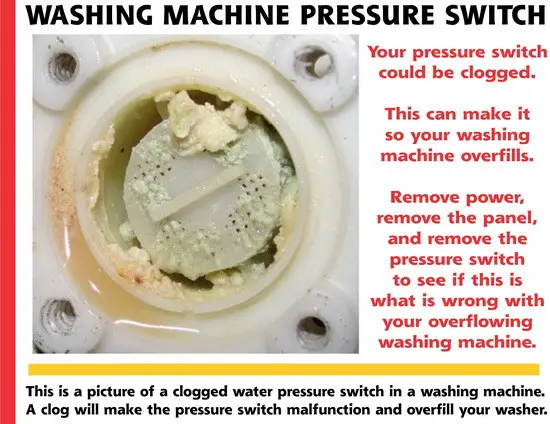
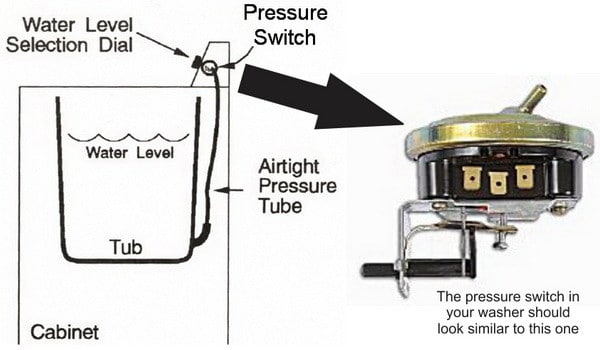
The pressure switch senses the column of trapped air pushed up the hose as the tub fills, and it’s what tells the machine to shut the water off at the set level. On older machines that’s a mechanical switch; on newer ones it’s an electronic level sensor reading frequency off the same air pressure signal. Either way, when it’s gummed up with detergent scum or its contacts are burnt, it never trips, and the washer keeps filling while the drain works against it. I’ve pulled switches that looked perfect from the outside and were completely packed with grey sludge at the port — that’s the failure I watch people miss most often.
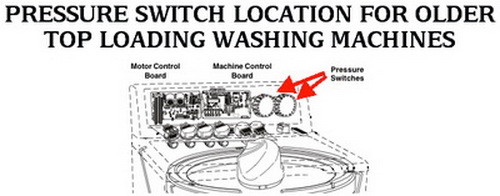
With the power disconnected, remove the control panel and find the switch. I always pull the hose off it and blow air into the port first; a good mechanical switch clicks as pressure builds and clicks again when you release. Check continuity across the terminals with a multimeter and look for it to change state as you apply pressure. While I’m in there I also inspect the housing for corrosion, cracked terminals, and loose connectors. If it doesn’t switch, replace it.
3. Blocked Pressure Hose (Air Dome Tube)
This is the part I check before I check anything expensive, and it took me a while to get there. My first instinct was always to condemn the inlet valve the moment a tub overfilled — order the valve, swap it, call it done. Then I learned that a valve stuck open keeps filling with the machine unplugged, and a bad pressure hose doesn’t. That one test told me I’d been replacing perfectly good valves for years (learned that one the hard way around 2005, and I paid for a few of those parts myself). You gotta test before you order anything.
The hose connects the switch to the air dome at the bottom of the tub. If it’s kinked behind the cabinet, split at either fitting, or plugged with lint and detergent film, the switch can’t read the level. Checking it goes like this:
- Unplug the washer and shut off both wall taps.
- Pull the small hose off the pressure switch port and run it through your fingers end to end, looking for kinks, splits, or soft spots at either fitting.
- Blow through the hose off the machine to confirm it’s clear — the tub end is where lint and detergent film pack in.
- Reconnect the hose to the switch, then blow gently into it from the tub end.
- Listen for a click at the switch as pressure builds, and a second click when you release. No click either way means the hose or the switch is done.
A blocked hose usually cleans up with a long brush or a pipe cleaner followed by a hot water flush to break up the detergent film. A split or hardened one gets replaced. When you put it back, route it without a low spot where condensation can pool — trapped water in that tube reads as a false level, and I’ve chased the wrong part for hours because of it.
4. Drain Hose Siphoning
This is the one almost nobody checks, and it’s a common explanation for a washer that “overflows and drains constantly.” If the drain hose is pushed too far down the standpipe or sits below the water line in a utility sink, it starts a siphon: water leaves the tub as fast as the machine puts it in, the level sensor never sees full, and the inlet valve keeps running. I rule this one out before I ever open a pump — it takes about a minute and costs nothing.
- Pull the drain hose out of the standpipe.
- Re-seat it no more than 6 to 8 inches down, leaving an air gap around it.
- Confirm the top of the standpipe sits above the washer’s high water mark.
- Leave that air gap open — never tape or seal around the hose, because the gap is what breaks the siphon.
- If the hose drains into a laundry tub instead, make sure the end never sits in standing water.
Fix the hose depth and that constant-drain complaint disappears without replacing a single part (I’ve had that be the whole repair more than once).
5. Malfunctioning Drain Pump
The drain pump removes water at the end of the cycle. A pump clogged with coins, hair, and lint — or one with a seized impeller — leaves the tub full, and the next fill goes straight over the rim. If I find water sitting in the drum between cycles, I start with our guide on how to get rid of standing water in a washing machine before tearing into the fill side.
On a front loader with a full tub and a locked door, drain it before you do anything else. I work in this order:
- Unplug the machine.
- Open the small access panel at the lower front.
- Lay towels and a shallow pan underneath — most of these hoses feed a pan slower than you’d like.
- Pull out the short drain hose beside the pump filter, uncap it, and let the tub empty in stages, recapping it when the pan fills.
- Once the water is out, try the door. It usually releases on its own; if it doesn’t, reach into the same panel for the manual release tab or cord and pull it.
If the door still won’t budge, follow our walkthrough on how to open up an LG washing machine door, which covers both front and top loaders. On a top loader that won’t let you in at all, I’d look at the lid switch instead — our guide to why a Kenmore washer lid lock light flashes covers the usual suspects there.
With the tub empty, unscrew the pump filter and clear the housing of coins, buttons, and lint. Spin the impeller by hand — it should turn freely. If it’s damaged or seized, replace the pump.
6. Overloading The Drum
Stuffing the drum obstructs water flow and displaces more volume than the tub was designed to handle, and an overloaded washer can push water out the top from sheer bulk. I tell people to wash large blankets and comforters by themselves rather than mixed into a regular load, and to follow the manufacturer’s capacity guidance. Chronic overloading beats up the drive components too, which is one reason a machine ends up spinning but not agitating. That flooding is entirely avoidable, and it’s the cheapest fix on this list.
7. Inadequate Water Supply Pressure
Most washers want roughly 20 to 25 psi and up at the valve. Below that, the inlet valve doesn’t get enough pressure differential to push its diaphragm closed, so it keeps dribbling water in after the cycle should have stopped. Partially closed shutoff valves, a kinked fill hose, or clogged inlet screens all drop pressure at the valve — I’ve found more than one machine where somebody never opened the tap all the way after a move. Open both shutoffs fully, straighten the fill hoses, and clean the screens, then retest.
Why Does My Washing Machine Keep Filling With Water When It’s Off?
Nine times out of ten that’s the inlet valve, and the unplug test settles it in under a minute. Kill the power at the outlet with both taps still open. If water keeps coming in, it’s coming through mechanically past a worn or debris-blocked diaphragm, and no control board test is gonna tell you otherwise — replace the valve. If the filling stops the second you unplug it, the valve is being told to open, which points you back at the pressure switch and its hose. I wouldn’t leave a slow filler sitting overnight either; a dribble past a bad diaphragm can flood a laundry room while you sleep. On an LG front loader, a door that won’t open afterward often throws its own fault code — our guide to the LG error code dE explains how to clear that one.
Preventive Maintenance For Your Washing Machine
Clean The Water Inlet Valve Regularly
I inspect and clean the inlet valve screens once or twice a year to keep clogs from forming. A clean valve seats properly and avoids the overflow and constant draining problem in the first place. I’ve found this matters most on well water or on older galvanized supply lines that shed sediment.
Use The Correct Detergent
Regular detergent in a high-efficiency machine, or simply too much of any detergent, builds a foam column that rises well above the actual water level. The suds spill out the drawer or over the tub rim, and on some models they throw off the level sensor reading too. Use the type and amount the manufacturer specifies for your machine — HE detergent in an HE washer, and measured, not eyeballed. When a machine oversuds, I check the dispenser drawer for caked-up soap at the same time.
Regularly Inspect Hoses And Connections
Check fill hoses, the drain hose, and the pressure hose for wear, bulges, damage, or leaks. Replace damaged hoses and tighten loose connections before they let water out onto the floor. I replace rubber fill hoses with braided stainless every five years and then I don’t think about them again.
Schedule Regular Maintenance
A yearly once-over catches small problems before they flood a laundry room. If you’d rather not open the cabinet yourself, a professional maintenance check once a year is cheap insurance against overflow and constant draining issues.
If your washer is still overflowing after everything above, don’t start buying parts on a hunch — I’d write down what the machine does and exactly when it does it. Leave a comment below with the brand, model number, and where in the cycle the overflow happens — that timing tells me a lot — and we’ll help you get it fixed.
Related Guides

Written by Keith Schneerer
Certified Appliance Tech · Founder, RemoveAndReplace.com
Keith has spent 30+ years repairing machines, starting as a military mechanic and later maintaining food processing equipment before moving into appliance repair. He founded RemoveAndReplace.com to share field-tested repair advice.
More about Keith →
I have a top load washer that overfills. The pressure switch functions normally and the pressure tube is clear. When the tub is filling, I can see water going into the pressure chamber but only fills slightly; leaving no water to run up the water tube. When I unplug the pressure tube from the pressure chamber, I notice the water begins to rise in the chamber. What is the problem?
Matt,
If the water level pressure switch is securely connected electrically, then check the water level pressure switch with a meter to be sure it is working and is getting power.
If so, then check the water inlet valve as it may not be shutting off in time.
Also if there is a small clear tube attached to the water pressure switch, be sure it is clean and securely attached.
At times the small clear tube will clog up and prevent the pressure switch from working properly.
-RR