A motor under the tub spins an impeller that shoves water up through the spray arms, and everything rinsed off your plates lands in the filter and chopper area right on top of it. Anything hard enough to survive that trip gets pulled into the spinning parts.

A dishwasher making grinding noise almost always has something hard trapped in the pump area — a chip of glass, a fruit pit, a stray metal washer. Unplug it, pull the lower spray arm and the filter screen, then clear the pump housing underneath. Most people find the culprit in under an hour, no parts needed.
- Noise that starts and stops with the wash cycle means loose debris. A steady drone that never changes pitch points somewhere else.
- A Phillips driver and a Torx set are the only tools this job needs.
- The lower spray arm fastener is reverse-threaded on a lot of models — read that step before you turn anything.
- Every major brand comes apart in roughly the same order: Bosch, GE, Whirlpool, Frigidaire, KitchenAid, Maytag, Kenmore, LG.
Why Is My Dishwasher Making a Grinding Noise?
Eleven years of repairing commercial food service equipment taught me that the pattern here barely varies: most of the time it’s a foreign object, not a failing part. Something hard — a chip of glass, an olive pit, a stray metal washer — drops past the filter screen and lands where the impeller and chopper blade are spinning, and the impeller slams it against the plastic housing over and over. That impact is the grinding you hear. A dishwasher that grinds but still cleans and drains normally has a healthy motor underneath it. Everyone assumes a $200 pump assembly is coming. It almost never is.
My first instinct on a grinding machine was always to condemn the motor and start pricing a pump assembly. Then I learned to listen to when the noise happens, and that one habit sorted out nearly every one of these for me. The listening test takes one minute:
- Start a wash cycle and stand there for the first minute. That’s when the impeller comes up to speed and anything loose gets thrown around.
- Note whether the noise comes and goes. Grinding that hits at startup, quiets down, then flares back up is loose debris getting kicked around by the impeller.
- Note whether it’s one steady pitch instead. An unchanging drone for the whole cycle is a different animal — that’s bearings.
The debris version is free to fix: cut the power at the outlet under the sink (or the breaker if it’s hardwired), pull both racks and the lower spray arm, lift out the filter screen, and clear the pump housing and chopper area underneath. Put it back together and run a short test cycle before you spend a dollar on parts.

| Cause | Likelihood | Fix Cost | DIY Time |
|---|---|---|---|
| Foreign object in filter, chopper, or pump housing | Most common | Free | 30-60 min |
| Broken or chafing wash impeller blades | Less common | $20-$60 | 1-2 hrs |
| Cracked drain impeller or failing drain pump | Less common | $40-$120 | 1-2 hrs |
| Worn circulation pump motor bearings | Least common | $80-$200 | 2+ hrs |
Kill The Power Before You Reach In There
Look under the sink, find the dishwasher’s power cord, and unplug it. If yours is hardwired, flip the breaker instead. You’re about to put your hands into a spinning assembly, and a machine sitting on a delay start can come alive without warning. (I pull the plug every time, even when I’m certain the thing is dead.)
Unplug it — don’t just press Cancel. A dishwasher that’s been told to stop can still get power to the motor. And wear a glove for the next part. Broken glass in the chopper area is sharp, small, and you will not see it before you feel it.
How To Take The Bottom Of The Dishwasher Apart
This sequence works on almost any brand — the names of the pieces change a little, the order doesn’t. I shoot a phone photo of each layer as it comes off, because I know I won’t remember which screw came from where.

- Pull both racks out. Set them aside — you need clean access to the tub floor.
- Remove the lower spray arm assembly. It’s usually held by a single screw or nut in the center. Once it lifts off, look around the tub floor before you go any further — I find the culprit sitting right there more often than I’d expect.
- Remove the dishwasher screen. It sits directly under the lower spray arm, and on a lot of models you’ll need a Torx set (a $6 tool worth owning). Scrub the screen with soap and water while it’s out — a loaded filter is also the reason for a dishwasher leaving food particles on the dishes. Some brands have another cover plate above the screen that has to come off first.
- Remove the pump housing cap. This plastic cover is usually held by two screws. Underneath it is the food disposer blade, and big chunks of food and debris collect right there — it’s the most common place the noise is coming from.
- Remove the upper impeller. One bolt or screw holds it. With that off, the food grinder plate is visible and you’re at the true bottom of the machine. I stop here and wipe the whole area out.
- Reassemble in reverse. Snug is enough — I’ve cracked a plastic housing leaning on a screwdriver, so now I stop the second a part seats.
Common mistake: the spray arm fastener doesn’t budge counterclockwise, so people lean into it harder and round off the head. Plenty of models use a reverse thread there — turn it clockwise to loosen. If it still won’t move, look up the removal procedure for your exact model number rather than forcing it.

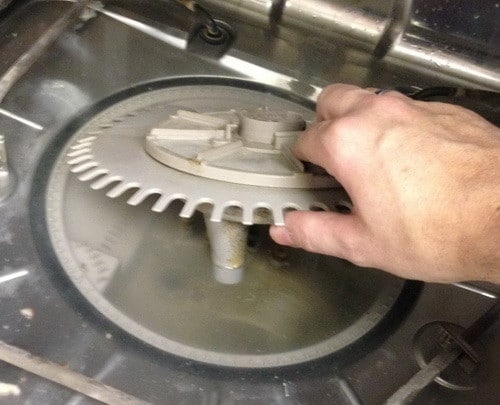
What You’re Actually Going To Find Down There
Small flat metal washers. Olive pits. Chicken bone chips. The corner of a broken plate, twist ties, staples that rode in on a takeout bag, the plastic tab off a bread bag. Glass is the sneaky one — a chip the size of a grain of rice will sit in the chopper area and produce a noise you’d swear was a dying motor (trust me on this one, it sounds far more expensive than it is). One reader who wrote in about this exact problem found three small flat metal washers in the bottom of the machine — enough to turn a working Whirlpool into a rock tumbler.
A washer wedged against an impeller isn’t going to flush itself out no matter how many empty cycles you run. Clear out everything down there, not just the piece you think is guilty, then put it back together and run a test cycle before you start shopping for parts.

If you’re working on a portable unit rather than a built-in, the guts are identical — the wheels and the faucet coupler are the only real difference, and our portable dishwasher installation and maintenance guide covers those. If the control panel starts blinking after reassembly, that’s usually just an interrupted cycle, not damage; our guide to resetting blinking dishwasher lights walks through it.
Everything Cleaned Out And It Still Drones
What you’ll hear: a continuous, unchanging hum or drone that runs the entire wash cycle, not the intermittent grinding and vibrating noise you had before.
What’s happening: the circulation pump motor bearings are worn. They don’t fail suddenly — they get louder over a year or two until one day you notice you can hear the dishwasher from the next room.
What to do: this is a parts job, not a cleaning job. The motor and pump assembly runs $80-$200, and on some models you’ve gotta pull the whole machine out from under the counter to get at it. That’s where I’d stop and get a quote. RepairClinic’s rundown of why dishwashers make loud noises is a decent second opinion.
Impellers, Drain Impeller, And The Drain Pump
What you’ll see: a wash impeller with blades snapped off, or one that’s rubbing the sides of its housing. A drain impeller that’s visibly cracked. Sometimes debris packed into the drain pump itself.
What’s happening: the motor spins the wash impeller to push water through the spray arms. Break a blade off and it goes out of balance instantly — a loud, uneven racket rather than a grind. A cracked drain impeller or a bad drain pump gives you noise specifically at the end of the cycle, when the water goes out.
What to do: if I only hear it when the machine is draining, I go straight to the drain side — we cover that separately in what to check on a dishwasher that’s noisy during the drain cycle. A wash impeller runs $20-$60 and a drain pump $40-$120. PartSelect keeps a noisy dishwasher parts breakdown if you want to match a part number to your model before ordering.
About That Monthly Vinegar Cycle
Running an empty cycle with vinegar every month gets recommended everywhere, and it does help with hard water film. But vinegar is acidic, and running it hot every month is rough on the rubber door gasket and the flexible seals around the pump over several years. I’d back it down to once a quarter and use a real dishwasher cleaner in between (I keep one under the sink so I’m not tempted to reach for the vinegar jug). It also won’t touch the problem you came here for, because acid doesn’t dissolve a metal washer.
The actual prevention is dumber and more effective: scrape plates before loading, wash the filter screen every two to three months, and check the rinse aid dispenser while you’re in there — a gummed-up rinse aid dispenser is a five-minute clean most people never do.
When It’s Worth Calling Someone
A service call for a dishwasher noise diagnosis runs roughly $150-$250 before parts. If the fix turns out to be three washers in the chopper area, you just saved the whole call for the price of an hour and a Torx set.
Call a pro if:
- You’ve stripped it down, found nothing, and the drone is still there — bearings on some brands mean pulling the whole machine out.
- Water is pooling under the unit in addition to the noise.
- It’s hardwired and you can’t confidently isolate the circuit at the panel.
Common Questions About A Grinding Dishwasher
Is it safe to run my dishwasher while it’s making a grinding noise?
For a cycle or two, probably. But every cycle you run with a hard object bouncing around in there is a cycle where it can chip an impeller blade or score the pump housing, and that turns a free fix into a $60 part. I wouldn’t keep running it for weeks — if it were mine, I’d have the filter out this weekend.
Why does it only grind when the wash cycle starts up?
That’s the impeller coming up to speed and slinging whatever’s loose against the housing. Once the object settles into a corner it goes quiet again until the next surge of water moves it. That start-and-stop pattern is honestly the best news you can get — when I hear it, I already know I’m looking at debris and not a worn part.
Can I clear it without taking anything apart?
Not reliably. People pour in a cleaner or run a hot empty cycle hoping to flush it out, and I’ve never seen that work on anything solid. Glass, metal, and bone don’t dissolve — you gotta reach in and get them.
My dishwasher only grinds at the very end of the cycle — same problem?
Probably not. Noise that shows up only while the water is going out points at the drain side: a cracked drain impeller, a failing drain pump, or debris packed into the drain pump housing. Still clear the filter and chopper area first since you’re already in there, but if the noise only ever happens during the drain, that’s where I’d put my money.
Does a dishwasher making grinding noise mean I need a new machine?
Almost never, and I’d push back hard on anyone who tells you that about a five-year-old unit in good condition. Worst case you’re looking at a motor and pump assembly, and even that’s a fraction of a new dishwasher. Clean it out first — I’d bet on that fix long before I’d bet on a replacement.
Set your screws somewhere you won’t lose them, photograph each layer as it comes off, and give yourself a full hour even though the work is maybe twenty minutes of it. Nothing here is difficult — just fiddly. I still get a small kick out of prying the offending chip of glass out with a pair of needle-nose pliers.

Written by Keith Schneerer
Certified Appliance Tech · Founder, RemoveAndReplace.com
Keith has spent 30+ years repairing machines, starting as a military mechanic and later maintaining food processing equipment before moving into appliance repair. He founded RemoveAndReplace.com to share field-tested repair advice.
More about Keith →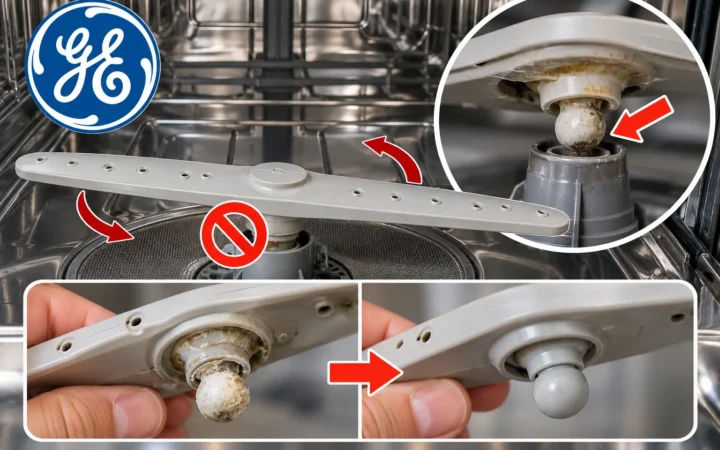
My KitchenAid new dishwasher KDTM404KPS has a grinding sound coming out when it starts to run and that sound stays as is when spray arms are spraying. Late in the cycle when pump turns on, sometimes it has a moaning sound to it. Most of the time the pump sounds okay. Any idea if this is normal…
My dw has been making an awful sound for quite awhile. My husband has been too busy to look at it, so I’ve decided to try to fix it myself. This video has been very informative and to the point-thank you!
Our GE gdf510pmd0sa is making a loud grinding noise during the wash cycle. Initial filling is normal and draining is normal (now – see below).
The design is not the same as the one in your post. I have taken all the parts out on the inside bottom: spinner, fine filter, filter, the cover of the inlet that feeds water to the channel going up the back (under which are two openings with the orange ball inside), and then the ring holding a little tower in place that seems to house a sensor that has wires connected from underneath. On the underside of the dishwasher a cylinder attaches to the side of the central basin via a boot – I’m guessing it’s the inlet. That’s where the grinding is coming from if I grasp the boot I can change the tone of the noise.
Other info: we’ve had a terrible time with it not draining properly and starts to stink. I went through all the checks and thought it was a kink in the drain tube. (No compactor, no air gap, canceling will fully drain it.) Taking everything apart on the inside was originally a cleaning project. Rotting food was stuck in and behind every single part throughout. Maybe something may have gotten pushed back down the inlet from inside?
So besides asking for opinions and advice, my questions are: what is the part that is connected by the boot (it’s half white, half black), and do I tip the dishwasher over some way to get at it?
Bonus question: is that part something that can be opened and looked at to see if something is stuck inside?
Thanks VERY much for any help.
So many reports of noise from your dishwasher. Mine is without the food grinder.Of course check for objects that might get stuck. BUT, I have found that noise can come from using to much soap or bad soap. Sounds crazy! If the soap suds to much, the pump can suck up the suds causing the pump motor to cavitate. Making a very load noise. Use less soap or better soap. Very easy to do.
Jacqueline,
Use the parts manual online and it will show the screws or bolts that need to be removed to get deeper into the dishwasher to remove the foreign objects causing the noise.
-RR