If your area rug creeps across the hardwood every time someone walks over it, you don’t need a new rug pad system or a trip to the flooring store. A box of inexpensive 3M hanging strips — the same kind sold for hanging picture frames — will anchor a rug in place, and they come off later without pulling up finish or leaving a sticky residue behind. I’ve picked up this kind of fix over 39 years of hands-on repair work, and it’s one of the simplest floor problems I run into.
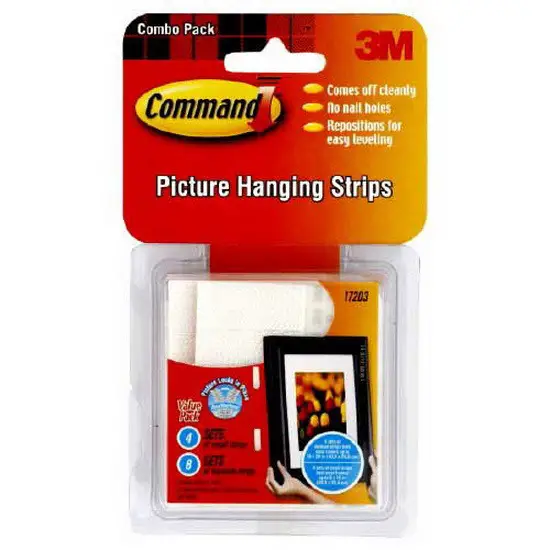
I’ve tried more “rug grip” products over the years than I can count, and this is the one I keep going back to for smaller and medium-sized rugs. In my experience the failure point with most anti-slip products isn’t whether they grip — it’s whether they damage the floor when you take them off, and these strips genuinely don’t.
Why Do Rugs Slide on Hardwood Floors?
Hardwood, laminate, and tile all have smooth, low-friction surfaces, and most area rugs have a flat woven backing with nothing to grab onto. Add foot traffic, a rolling office chair, or kids running through the room, and the rug walks across the floor a little more every day. Over time that shifting rug can also bunch up at doorways or under furniture legs — and if you’ve got tile underneath, I’ve seen a rug that keeps sliding into furniture become part of what eventually cracks a tile at the edge when a chair leg catches it wrong.
What You’ll Need
This is a simple anchor job — no adhesive residue, no cutting into the rug, and I can usually get through an average-sized room in a short amount of time.
- 3M hanging strips (the picture-hanging or “Command” style strips) — a standard box is inexpensive and gives you enough strips for one to two rugs.
- A handful of strips per rug, depending on rug size and how much traffic the area gets — smaller rugs and low-traffic spots need fewer; a rug in a hallway or under a rolling chair needs more.
- A clean, dry cloth or alcohol wipe to clean both the floor and the underside of the rug corner before applying anything.
- A pair of scissors if the strips need trimming to fit a corner.
How to Install the Strips Step by Step
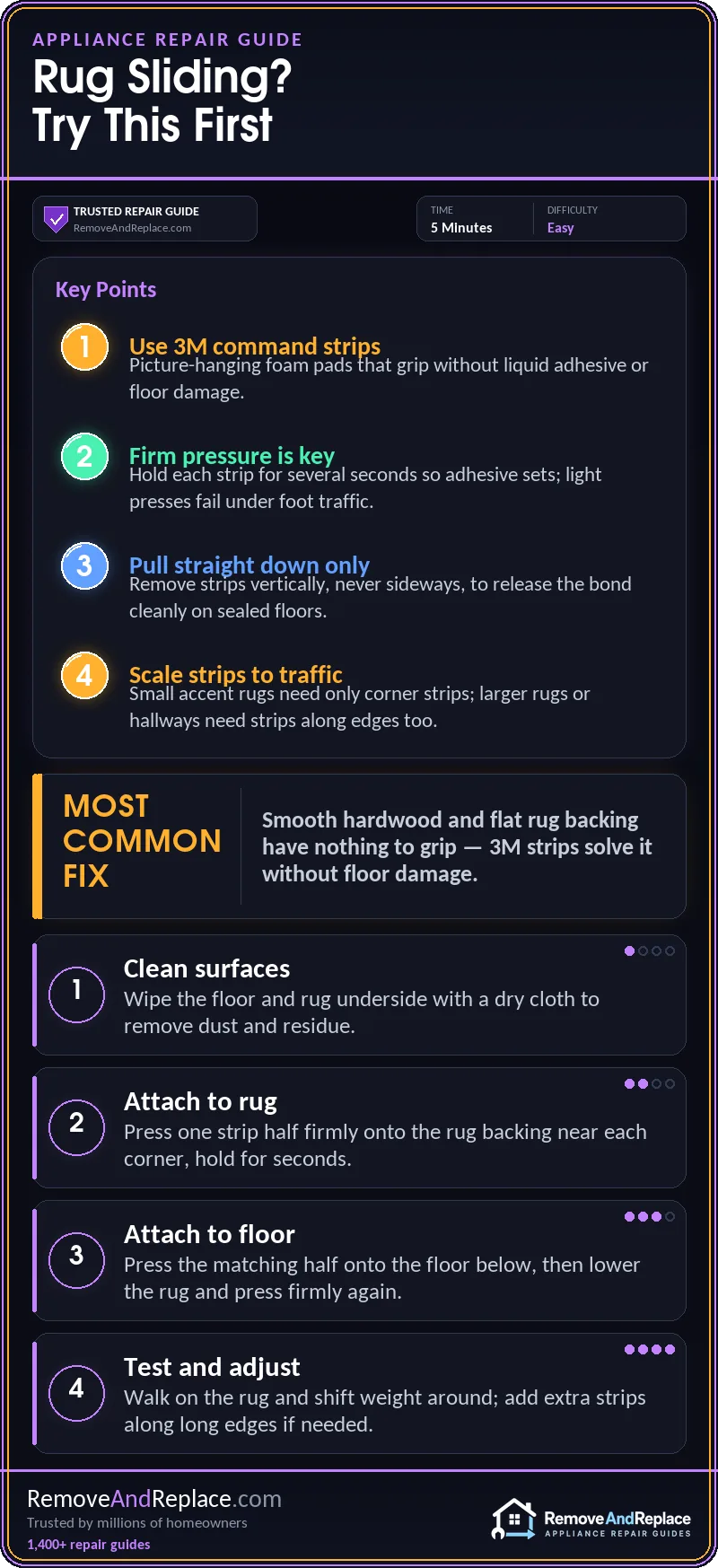
- Clean the floor and the rug backing. I always wipe both surfaces with a dry cloth so the strips bond to clean material, not dust or floor polish residue.
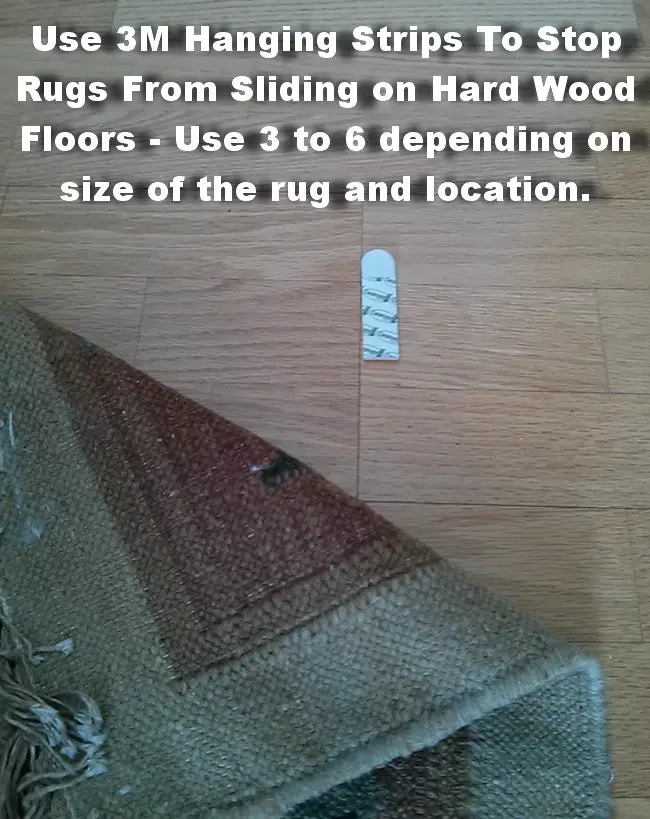
- Lift each corner of the rug and press one half of a strip firmly onto the underside of the rug near the corner, holding for a few seconds so the adhesive sets.
- Press the matching strip half onto the floor in the corresponding spot, then lower the rug corner down and press firmly for several seconds so the two halves interlock.
- Repeat at each corner, and add strips along the edges of longer sides if the rug is on the larger side or sees heavy foot traffic — I’d use just a few strips on a small accent rug, but closer to a full set on a living room-sized rug.
- Walk on the rug and shift your weight around after installing to confirm it’s holding before you consider the job done.
Removing the Strips Without Damaging the Floor
When you’re ready to take the rug up — for cleaning, moving, or seasonal storage — pull each strip slowly and straight down rather than yanking it sideways. Pulling straight down releases the adhesive bond cleanly on sealed hardwood, laminate, and most finished floors. I’ve had nothing but success with this on sealed hardwood specifically; if your floor has an unusual wax finish or unsealed wood, I’d test one strip in a hidden spot first before committing the whole rug.
Other Ways to Keep a Rug From Sliding
3M strips work well for smaller and mid-sized rugs, but they’re not the only option I’d consider. A rubber or felt rug pad cut to size adds cushioning and grip across the entire rug rather than just the corners, which in my experience is worth it for larger area rugs. Double-sided rug tape and non-slip rug corner grippers are two more low-cost options worth comparing — Lowe’s has a good rundown of the different anchoring methods, and both Zerorez and MasterClass cover a few additional tricks if strips alone don’t do the job on a bigger rug.
Whichever method you go with, I’d say the goal is the same: keep the rug flat and anchored so it isn’t shifting into furniture legs or bunching up at doorways where someone could trip over it.