A garbage disposal humming instead of grinding means the motor has power but the impellers are locked. Cut the power at the switch and the breaker, fit a 1/4-inch Allen wrench into the hex socket on the bottom of the unit, and work it back and forth until it spins freely. Press the red reset button and test.

Before You Grab Anything
- The hum is proof the motor still has power — a dead motor makes no sound at all.
- Most bottom-hex disposals take a 1/4-inch Allen wrench, but plenty of Waste King units have no bottom socket.
- An overheated unit that tripped its thermal overload needs several minutes to cool before the reset will hold.
- If the wrench turns freely and it still hums with an empty chamber, you’re pricing a replacement.
Why Does My Garbage Disposal Hum But Not Grind?
Almost every time, something is wedged between an impeller and the shredder ring and the motor can’t turn it. Jammed disposers were routine work across my 30+ years of hands-on repair, and the fix is almost always free. That steady low hum is the motor sitting stalled under load — still getting power, just unable to move. Kill the power at the wall switch and the breaker, seat a 1/4-inch Allen wrench in the hex socket on the underside, and crank it back and forth until the shaft turns a full circle without resistance. Then press the red reset button on the bottom, restore power, and run cold water while you flip the switch. Most jams clear in under ten minutes with no parts and no plumber. Only when the wrench spins freely and the unit still hums do I start looking at the motor itself.
Most people who ask me about this have already decided the motor is burned out. I always point at the hum as proof that it isn’t — a failed motor is silent. What you’re hearing is a working motor held still by something the size of a bottle cap, and a bottle cap is one of the more common offenders I find. I’d bet on a jam over a bad motor every single time.

| Cause | Likelihood | Fix Cost | DIY Time |
|---|---|---|---|
| Foreign object jamming the impeller | Most common | $0 | 5-10 min |
| Overheated motor, thermal overload tripped | Common | $0 | 5 min plus cool-down |
| Impeller seized from rust or hard-water scale | Less common | $0 | 15 min |
| Worn or failed motor | Least common | Replacement unit | 1-2 hrs |
The Jam Itself: What’s Actually Wedged In There
A jam is the first thing I rule out and the easiest thing to fix, so start here. What’s stuck isn’t caught on a blade — there are no blades in a disposal. Two blunt metal lugs swing on the spinning plate and fling waste against a stationary shredder ring, and a jam happens when something gets pinched in that gap. That narrow gap is where I find nearly every jam. The culprits I pull out most are what you’d guess: a teaspoon handle, a bottle cap, a twist tie, a chicken bone, a peach or avocado pit. Fibrous stuff like celery strings and onion skins doesn’t wedge so much as wrap, binding the plate like fishing line around a prop.
The sound tells you which one you’ve got. A flat, steady hum at one pitch — no rattle, no change when you tap the sink — is a solid object jam. Something loose and rolling gives you a hum with a metallic clatter under it. And if you smell hot varnish or scorched plastic, shut it down right there — that’s the one symptom I won’t work around.
Never put your hand into the grinding chamber, even with the switch off. There’s usually chipped glass or a broken bone edge down there, and a switch is not a lockout. Turn the disposal off at the wall and at the breaker panel before anything goes into that opening. A stalled motor also draws locked-rotor current the entire time it hums — that’s what cooks the windings, and it happens in seconds, not minutes.
Free The Impeller With A 1/4-Inch Allen Wrench
The hex socket on the bottom of nearly every disposal takes a 1/4-inch Allen wrench, and that one tool frees most jams without taking anything apart. Manufacturers tape a little offset wrench to the side of the unit at the factory, and it is the single most-lost item in any kitchen. I tape mine to the drain pipe under the sink. When mine walks off, I grab a plain hex key out of the toolbox and I’ve never needed anything fancier.

- Kill the power. Wall switch off, then the breaker off. I confirm the switch does nothing before I go under there.
- Look before you turn. Shine a flashlight down the drain and pull out anything visible with pliers or tongs — never fingers.
- Find the center socket. Reach under and feel for the recessed hex hole dead center in the bottom housing.
- Work it both directions. Seat the wrench and rock it back and forth. You’ll feel a solid clunk when it breaks loose. Keep turning until the plate spins a full revolution each way with no drag.
- Clear the debris. Breaking it loose isn’t the end of it — you’ve still gotta fish the object out, or it’ll wedge right back in on the next run.
- Reset and test. Press the reset button on the bottom, restore the breaker, run cold water, then flip the switch.
If the object won’t release from below, I’ll put a plunger over the drain opening and work it — I’ve had that shift an object enough to break the pinch when the wrench alone wouldn’t. InSinkErator’s own jam procedure walks the same steps.
Brand note: I check the brand before I go feeling around under there, and here’s why. InSinkErator’s Badger line — Badger 1, 5, and 5XP — all have the hex socket centered on the underside and ship with that offset wrench. The Evolution series adds a jam-sensor circuit that auto-reverses the motor, and I see those hum far less often. Most Waste King Legend models have no bottom socket at all; those come with a flat wrenchette you drop into the chamber from the top and lever against the impeller lugs. Don’t waste ten minutes feeling around under a Waste King for a hex hole that was never there.
Stop Flipping The Switch
The move I’d talk people out of most often is flipping the wall switch a dozen times to jolt the impeller loose. It doesn’t jolt anything — each flip is another locked-rotor surge through a motor that’s already stalled, and that’s the fastest way to turn a garbage disposal humming problem into a replacement job. I’d rather you leave the switch alone completely until the wrench turns free, because if it hummed once it’s gonna hum again until the jam is out.
When The Hum Is Overheating, Not A Jam
There’s a second reason for a garbage disposal humming that has nothing to do with a jam: the motor got hot and its internal thermal overload opened. I see this after a big cleanup — a sink full of holiday scraps, or half a bag of potato peels fed in without enough water. The unit runs, bogs down, then either quits or sits there buzzing. Nothing is stuck; the protector just won’t pass full current until the windings cool. The fix costs nothing, and I don’t even reach for the wrench.
- Turn the disposal off and leave it off. Let it cool — I give it a solid ten to fifteen minutes.
- Run cold water down the drain the whole time to pull heat out of the housing. I always leave the tap going while it cools; it drops the housing temperature a lot faster than air alone.
- Press the garbage disposal reset button on the bottom. It should click and stay in. If it pops back out, the motor hasn’t cooled or something is still jammed.
- Restore power and run it with cold water only, feeding scraps in small handfuls.
If it now spins fine but the sink still won’t empty, stop chasing the disposal — a disposal that spins but won’t drain is a clog downstream of the unit, not a jam inside it.
The Weird One: A Disposal That Seized From Sitting
A disposal that sat unused for months — a vacation house, a rental between tenants, a second sink nobody touches — can hum with nothing at all in the chamber. The impeller plate rusts to the shredder ring right where the two meet, and in hard-water areas scale packs into that same gap and sets up like cement. You can feel the difference on the wrench: a food jam breaks loose with one clunk and then spins easy, while a seized plate fights you through the entire first revolution and keeps dragging after. That drag is how I tell the two apart before I ever look down the drain. Work it both directions fifteen or twenty full turns, flush with cold water, then you’ve gotta actually use the thing weekly — if it sits again, it’ll seize again.
When It’s The Motor, And What A Pro Costs
Wrench turns free, chamber’s empty, reset button holds, and it still just hums? That’s a failed start winding or capacitor, and on a residential disposal it isn’t worth repairing — the labor to pull, open, and rebuild one costs more than a new unit. I don’t rebuild residential disposals, and I wouldn’t want you paying someone else to try. Before you buy, run the complete broken-disposal checklist so you’re not replacing a good unit over a bad wall switch, and if you’re shopping anyway, our list of the best disposals you can install yourself will save you a second trip. For the short version, skim the two most common disposal problems.
A plumber’s service call for a jammed disposal typically runs $100 to $200 in most markets — for a repair that costs you nothing but a hex key and ten minutes.
I’d call a pro if:
- Water is dripping from the bottom of the motor housing (a failed seal — that unit gets replaced, not repaired)
- You smell burnt insulation or see scorch marks around the electrical cover plate
- The breaker trips when you restore power and won’t reset after one try
Keeping It From Jamming Again
Nearly everything here is a habit, not a product. This Old House covers the mechanical side well, but the day-to-day stuff is what keeps you out from under the sink.
- Run cold water before, during, and after every use. Cold, not hot — hot water melts grease so it re-solidifies further down the line.
- Keep fibrous food out. Celery, corn husks, and onion skins wrap the plate instead of grinding.
- No grease or oil down the drain, ever. It hardens in the trap and the disposal has to fight through it.
- Bones go in the trash. They wedge in the gap and can chip the shredder ring.
- Cut big scraps smaller and feed them a handful at a time instead of packing the chamber.
- Clean it monthly by grinding a tray of ice cubes and some lemon peels.
The cold-water habit is the one I push hardest, because it prevents more jams than everything else on that list combined. And don’t skip the ice trick. It sounds like a folk remedy, but the ice scours buildup off the impeller lugs and shredder ring — exactly the gunk that turns a small scrap into a hard jam.
Garbage Disposal Humming FAQs
What causes a garbage disposal to hum but not grind?
A garbage disposal humming without turning means the motor has power but the impeller plate is locked — almost always by an object pinched between an impeller lug and the shredder ring. The motor keeps trying, can’t rotate, and that stalled draw is the hum you hear.
Is it safe to run a garbage disposal that’s humming?
No. A stalled motor pulls locked-rotor current continuously and the windings start taking damage in seconds. The thermal overload is trying to save the unit, and every time you re-energize it you’re working against that. Units that would have been a two-minute wrench job get scrapped this way.
Will pressing the reset button fix a jam?
On its own, no. The reset only restores power after the thermal overload has opened — it does nothing to the object that’s pinched in the gap. I clear the jam with the wrench first, then press reset. If you push the button while the plate is still locked, it’ll either pop right back out or trip again the second you flip the switch.
My disposal has no hex hole on the bottom — now what?
Then it’s most likely a Waste King or a similar design that clears from the top. Use the flat wrenchette that came with it: drop it into the chamber, seat it against an impeller lug, and lever the plate back and forth. If the wrenchette is long gone, a sturdy wooden broom handle levered against a lug works — just don’t pry against the shredder ring.
Can a humming disposal mean something bigger than a jam?
It can. If the wrench spins freely, the chamber is empty, and the reset holds but the unit still hums, you’re looking at the motor’s start circuit rather than a blockage. Leaking from the bottom housing points the same direction, and I’d treat either one as replacement territory on a residential unit.
Whoever decided the reset button belongs on the underside of the unit, in the dark, behind the trash can and a bottle of dish soap, has clearly never had to press one. Anyway — if the wrench turns free, the reset holds, and it’s still buzzing at you, drop the brand and rough age in the comments and I’ll tell you whether it’s worth opening up or whether you’re shopping.
Related Guides

Written by Keith Schneerer
Certified Appliance Tech · Founder, RemoveAndReplace.com
Keith has spent 30+ years repairing machines, starting as a military mechanic and later maintaining food processing equipment before moving into appliance repair. He founded RemoveAndReplace.com to share field-tested repair advice.
More about Keith →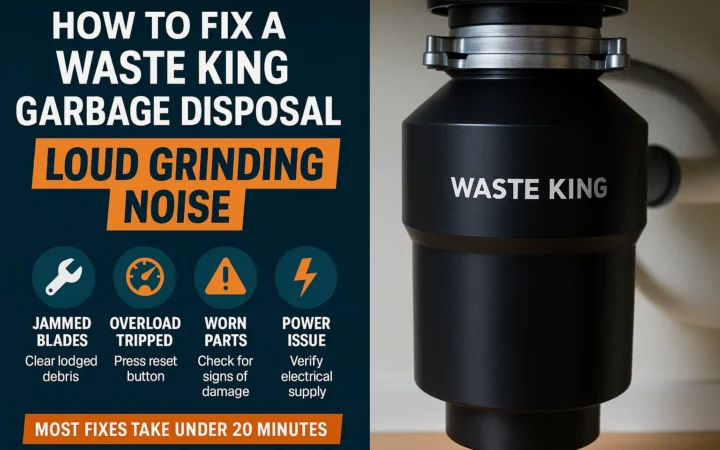

Garbage disposal – I have done all the troubleshooting and can only get the hex wrench to go half way.
Have cleaned out teeth, nothing in each groove, but still won’t grind, hums only like it is on but no grinding noise to indicate it’s working. Did hot water, soap and vinegar try also, nothing. Is next step removal???
The Allen wrench really worked. For some reason, there were pieces of a plastic cup in the disposal. I removed all that I could, and then tried the wrench. Worked, but it made a noise when it was running. I think there is something still in there, but will use the ice cubes as suggested to clear out any remaining pieces of plastic. Thanks.
My garbage disposer hums when I turn it on. The hex bar won’t let me spin it. I’ve inspected it and I can’t find anything stuck. I also tried the baking soda/vinegar/hot water thing twice. I also tried pressing reset button. It’s an Insinkerator brand that’s about 2 years old. Any recommendations? I only want to call a plumber as a last resort.
Thanks so much for this video. This problem started this morning. The fix using the wrench worked for me. How did you know I was about to have a party :-)