If your garbage disposal spins normally but water still won’t drain, it’s a clog — not the motor. Grind a tray of ice cubes with cold water running, then flush hard. That clears the disposal and waste line more than half the time and costs nothing. If the sink stays full, the clog is downstream in the P-trap.
- A disposal that spins but won’t drain is almost always a clog, not a dead motor — start with ice cubes and water before you touch a wrench.
- No noise at all? Check the breaker, then press the red reset button on the bottom of the unit.
- Humming with no spin means something jammed the wheel — free it with the allen wrench, never your hand.
- A spinning disposal that still backs up means the clog is in the drain line or the sideways “T” before the trap. Unplug the unit before opening any plumbing.
- Nine out of ten of these are a $0 fix done in under an hour. A plumber for the same call runs $100-$250.
I’ve been fixing kitchen equipment since my nine years in commercial food service, where a dead disposer in a busy kitchen meant a line cook standing there with a full sink and no place to put it. So I’ve torn into more of these than I can count. And here’s the thing most people get wrong before they even start: they assume a disposal that won’t drain needs a new motor. It almost never does. Nine times out of ten it’s a clog, and the fix is free.
The Disposal Spins and Sounds Normal But the Sink Won’t Drain
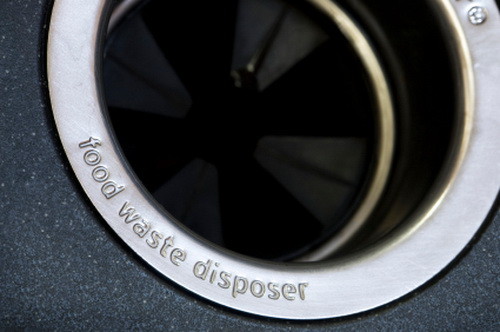
This is the most common one I see — probably 60% of “not draining” calls. The motor runs fine, the grinding sounds right, but the water just sits there. That tells you the mechanism is healthy and the blockage is in the disposal chamber or the waste line, not the motor. Don’t spend a dime on parts yet. Run a tray of ice cubes through it first: fill the disposal with ice cubes, turn the cold water on, and run the disposal until the grinding stops. The ice scours the grind chamber and knocks loose the greasy sludge that builds up on the walls. If ice alone doesn’t do it, pour a bag of uncooked pasta down there and run it with the water going — the pasta acts like a mild abrasive too. About half the time, one of those two tricks clears the line and the sink drains. Costs you nothing but a bag of penne.
If ice and pasta don’t move it, the ice trick told you something useful anyway: the disposal itself is turning, so the clog is farther down the line. Skip ahead to the section on the spinning-but-not-draining fix — that’s where you’ll actually solve it.
The Disposal Makes No Noise At All When You Flip the Switch
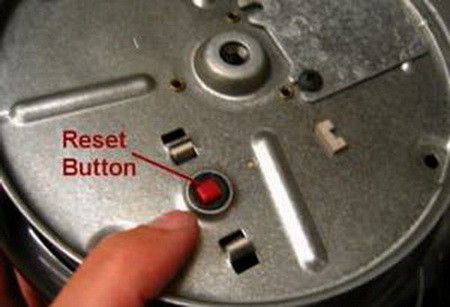
Dead silence when you hit the switch is a different animal — the motor isn’t even getting power. First thing, walk to your breaker panel and make sure the disposal circuit didn’t trip. If the breaker’s fine, there’s usually a red reset button on the very bottom of every garbage disposal. Reach under the sink, feel around the bottom of the disposer body, and you’ll find a button sticking out. Press the red reset button in firmly until it clicks and stays, then test the disposal. This trips whenever the unit overheats or overloads, and resetting it fixes a dead disposal shockingly often. I learned to check this first the hard way — I once spent twenty minutes pulling a unit apart on a service call back in my food-service days before I noticed the reset had popped. Felt like an idiot. Now it’s the first thing I check.
Still nothing after the reset? At that point you’re looking at a wiring issue, a failed switch, or a burned-out motor, and that’s when I’d tell you to weigh a replacement. A basic disposal runs $80-$120 at any hardware store, and swapping one in yourself beats paying an electrician to chase a dead motor. If you’re comfortable working under the sink, our complete garbage disposal repair checklist walks through the electrical checks step by step.
The Disposal Just Hums and Won’t Spin
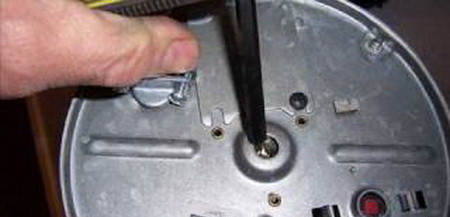
A humming disposal that won’t turn means the motor’s got power but something’s physically jamming the flywheel — bone, a fruit pit, a bottle cap, whatever fell in there. Do NOT leave it humming; that overheats the motor fast and’ll cook it. Turn it off. Grab the allen wrench that came with your disposer and insert it into the center of the hole on the very bottom of the unit. Work the wrench back and forth in a clockwise motion until the wheel spins freely — you’re manually breaking whatever’s wedged in there loose. No allen wrench? A sturdy wooden kitchen spoon works. Unplug the disposal first, put the spoon down into the sink hole and against the wheel, and try turning it that way.
If the wrench frees the wheel and it spins clean, you fixed it. If it’s still stuck, get a flashlight and look down into the disposal from the top. Spot a large object wedged against the impellers? Pull it out with a pair of tongs or long pliers — never your bare hand, even with the unit unplugged. If nothing’s visible and the wheel still won’t budge after working the wrench, the motor bearing has likely seized, and that’s a replacement. Here’s what the manual won’t tell you: that grinding-then-humming sound a lot of folks describe usually means a jam that’s about to become a burned motor, so kill the power the second you hear it. Our guide on a humming garbage disposal and the one on glass jammed in a disposal both go deeper on freeing stubborn jams.
How Do You Fix a Garbage Disposal That Spins But Still Won’t Drain?
If the disposal spins normally and you’ve already run the ice and pasta with no luck, then positively there’s a major clog sitting in the plumbing downstream — usually the sideways “T” line before the trap. This is the fix nobody online shows properly, and it’s what actually clears the stubborn ones. About 25% of drain complaints land here. You’ll get your hands dirty, but it’s still a $0 repair. MAKE SURE TO UNPLUG THE DISPOSAL FIRST. Water and an electric motor with your hands nearby is not a gamble worth taking.
Unplug the disposal at the outlet under the sink before you loosen any plumbing — don’t just flip the wall switch off. You’ll have your hands right in the drain path, and a switch can be bumped. Pull the plug.
Here’s the full teardown, the same way I’ve done it dozens of times:
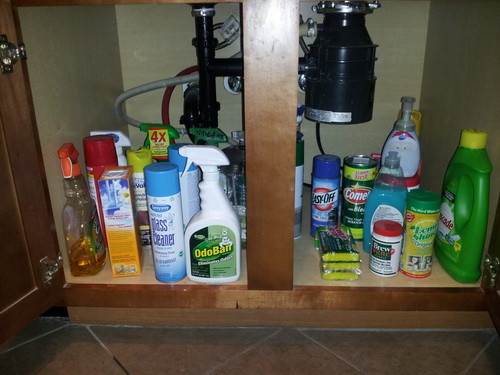
- Remove all cleaning products from under the sink. You need a clear workspace and this is about to get wet.
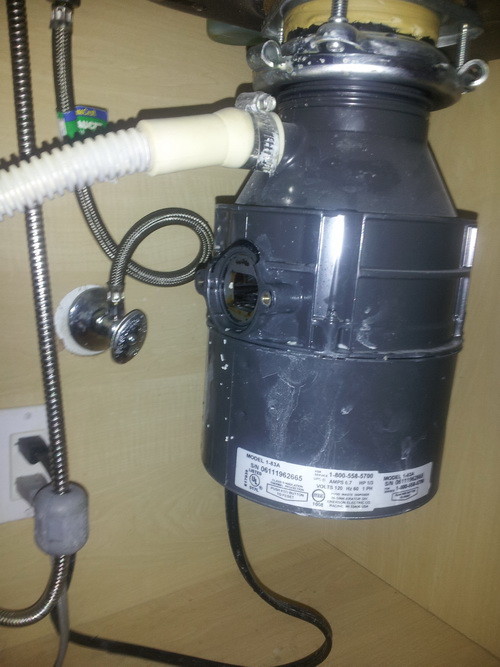
- Locate the disposal and begin removing the drain line. Ours was held in with screws, but yours may vary — some use slip nuts you turn by hand.
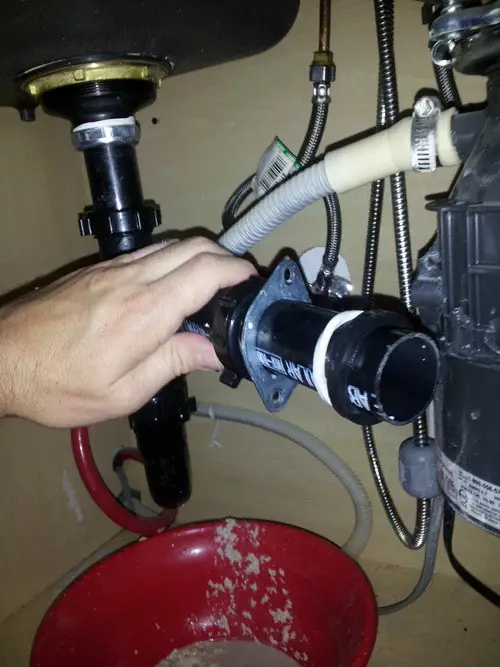
- Remove the drain line from the disposal. You’ll usually have to loosen the other line attached to it to get it free.
- Fully pull the drain line and look into the hole for the object causing the clog. Ours was clear at this point, which pointed us further down the line.
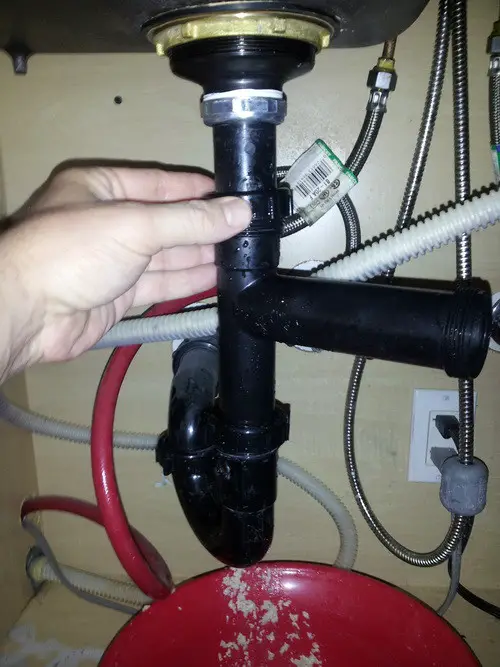
- Locate the plumbing line before the trap. It’s the sideways “T” line. Unscrew the plumbing and take the “T” out.
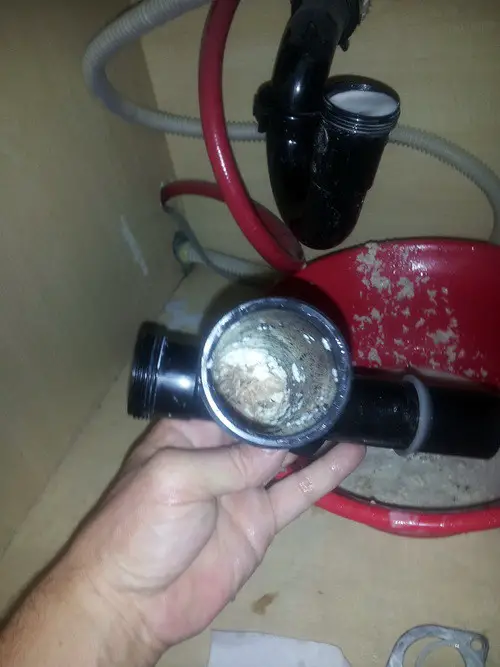
- Look inside the “T” for jammed or clogged food. Ours was full of gunk — that greasy packed sludge was the whole problem.
- Spray it clean. Since the sink is apart, do NOT run water from your faucet or it’ll leak out all over the cabinet. Use a garden hose and blast the clogged food out of the “T” plumbing.
- Reassemble and test. Once you’re sure all the clogs are gone, put the plumbing lines back in place and firmly tighten. Run water from the faucet and run the disposal — there should be no leaks, no clogs, and it should drain clean.

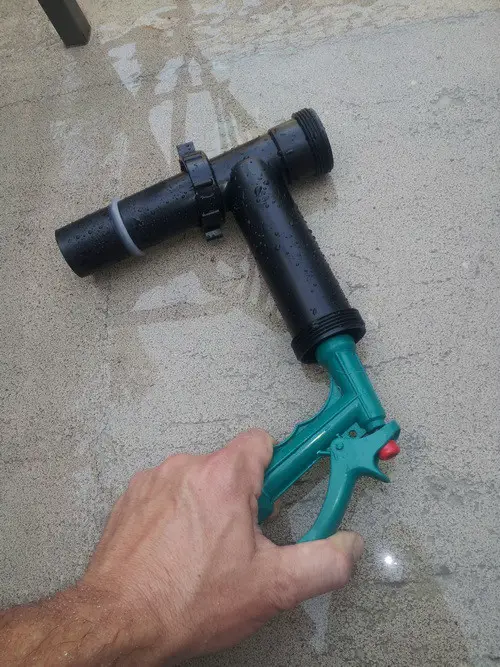
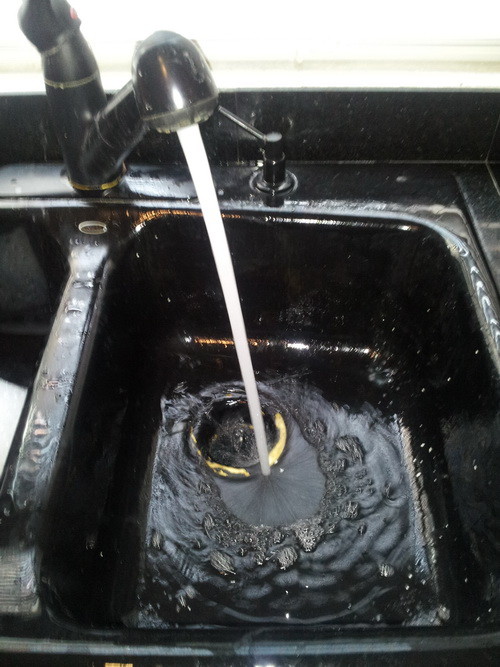
Watching it done end to end helps more than reading it. This walkthrough covers the same spinning-but-not-draining diagnosis and clearing the line:
Know the Parts Before You Dig In
You don’t have to be a plumber to fix this, but it helps to know what you’re looking at down there. The disposal body, the discharge tube, the sideways “T,” and the P-trap all bolt together in a chain — and a clog in any one of them backs the whole thing up into your sink.
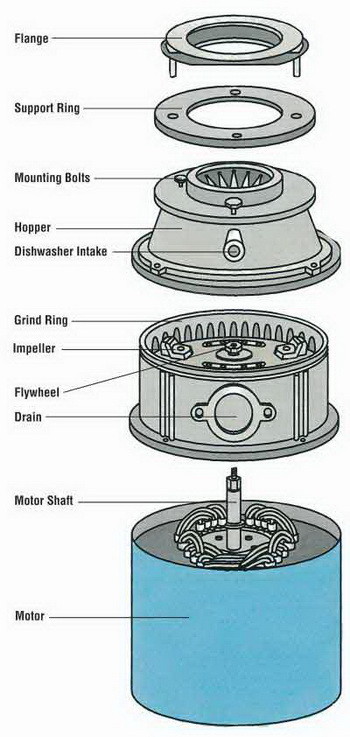
If you’re comfortable with this repair, you can probably knock out a bunch of other kitchen fixes too — our roundup of 15 easy appliance repairs you can do yourself is a good next stop. For more disposal-specific help, AppliancePartsPros has a solid troubleshooting guide for a disposal that spins but won’t drain, and PartSelect keeps a full food waste disposer repair guide with parts if you decide the unit’s shot.
When to Skip the DIY and Call a Pro
Most of these fixes cost you $0 in parts and about an hour of your time. Where I’d draw the line: if you’ve reset it, freed the flywheel, and cleared the trap and it still won’t run or drain, you’re likely into a seized motor or a clog deep in the branch line past the trap. A basic replacement disposal runs $80-$120 at the hardware store; a plumber for the same job runs $100-$250 depending on where you live. If the clog’s past the P-trap and into the wall, that’s a plumber’s snake — not a garden hose. I’d swap the unit myself but hand the deep-line clog to someone with a proper auger.
Keep It From Clogging Again
The reason that “T” fills with gunk is almost always grease and starchy food packing the line over months. Run cold water — not hot — for 15 seconds before and after you use the disposal every single time; cold keeps grease solid so it grinds and flushes instead of coating the pipe. Never pour bacon grease or fat down there, and go easy on stringy stuff like celery and potato peels. Once a month, run a tray of ice cubes through to scour the chamber. Do that and you probably won’t be back under the sink for a couple years. If your slow-draining sink is more of a whole-line problem than a disposal one, here are 5 ways to clear a clogged drain without chemicals.
FAQ — Garbage Disposal Not Draining
Why does my garbage disposal spin but not drain?
Because the motor’s fine and the clog is downstream — usually greasy food packed into the sideways “T” line before the trap. I’ve pulled that “T” a hundred times and it’s full of gunk more often than not. Run ice cubes first; if the sink still won’t drain, the fix is opening that plumbing and spraying it clean.
Should I use Drano or chemical cleaner in my garbage disposal?
No. I never pour chemical drain cleaner into a disposal — it sits in the chamber against the metal and rubber seals, and if you do end up opening the plumbing it splashes back on you. Ice cubes, hot water flushes, and pulling the trap are safer and work better anyway.
How do I reset a garbage disposal that makes no noise?
Look on the very bottom of the unit for a red button sticking out and press it in until it clicks. If it won’t stay in, let the motor cool for ten minutes and try again. Check your breaker first though — I’ve seen plenty of “dead” disposals that were just a tripped breaker.
Can I put my hand in the garbage disposal to clear a clog?
Never — even unplugged. Use tongs, pliers, or a wooden spoon. I don’t care how confident you are; I’ve seen the results when someone got comfortable around those impellers and I won’t take that chance and neither should you.
Is it worth repairing an old garbage disposal or should I replace it?
If it’s a clog, always repair it — that’s free. If the motor’s seized or it’s leaking from the body, replace it. A new basic unit is $80-$120 and I can swap one in about 45 minutes, which beats paying a plumber $100-$250 for a job you can handle with a screwdriver.
Still stuck after all this? Lowe’s has a decent garbage disposal repair how-to with a few extra tips, but honestly, between the reset, the wrench, and pulling that “T,” you’ve got 90% of what’s ever gone wrong with one of these covered.

Written by Keith Schneerer
Certified Appliance Tech · Founder, RemoveAndReplace.com
Keith has spent 30+ years repairing machines, starting as a military mechanic and later maintaining food processing equipment before moving into appliance repair. He founded RemoveAndReplace.com to share field-tested repair advice.
More about Keith →

Patty drake,
The penny is jammed in the disposal and causing the problem.
Unplug the garbage disposal.
Try to retrieve the penny out of the disposer.
Once removed, plug the disposal back into power.
Test the disposal and it should be working now.
-RR
My garbage disposal will not spin!
I have used the wrench but it still is jammed, even after moving it back and forth several times.
I can not make it move around in a circle.
When I push the reset button there is a humming sound and then it stops humming by itself!
What am I doing wrong?
I never used it other than putting ice cubes in it once a week!
A penny fell down it one day by accident and that must be the problem but I don’t understand why the wrench doesn’t help to unjam it?
Can you help me please?
Thank you for all your help with my disposal issue with the water not going down. I ended up using a (clean) toilet bowl plunger and after several dozen attempts it finally worked. I do not know what the problem was as I rarely put anything down the disposal anymore!
Thank you again and I hope my hard work will work for others!
Thank you! Saved Thanksgiving 2020!
I have InSinkErator Badger 500 in my sink. I use it maybe once a month last 8 years. It did not run from last month. When I turned on the switch, it just sounded zoo~ noise but not running.Therefore, as usual, I inserted an allen wrench into the center of the bottom of the garbage disposal and tried to turn it clockwise with all my strength. But it did not turn at all. I was able to turn it last year but not this time. Is it the time to replace to new one? Water is draining very slowly.
THANK YOU SO MUCH!!!! I was able to open up the piping under my sink and cleared out a whole bunch of debris and now my sink is draining properly. Having to get a plumber out over the weekend would have cost big bucks and I had a real sense of accomplishment fixing the problem myself!