Here’s what’s happening inside your dryer when it runs but won’t produce heat: a small one-shot safety device called the thermal fuse has done exactly what it was designed to do — it detected dangerously high temperatures and cut power to the heating circuit to prevent a fire. The dryer motor keeps spinning. The timer keeps counting. The drum keeps tumbling. But there’s zero heat, and you open the door to find a load of cold, damp clothes that have been tumbling for 45 minutes going nowhere.
The thermal fuse is a brilliant piece of engineering — simple, cheap, and completely reliable at doing its one job. Understanding why it trips, and more importantly what caused it to overheat in the first place, is the difference between a $5 fix that lasts and a $5 fix you’re doing again in three weeks.
A dryer that tumbles but won’t heat has almost certainly blown its thermal fuse — a small one-time safety switch on the exhaust duct or heating element housing. It costs $3–$10 and takes about 30 minutes to replace. Before you order the part, clean out your dryer vent completely — a clogged vent is what blew the fuse in the first place, and skipping that step means your new fuse blows within weeks.
- A dryer that tumbles but produces no heat is a blown thermal fuse roughly 90% of the time — not a failed heating element
- The thermal fuse is a one-time device — it cannot be reset, only replaced
- A clogged exhaust vent causes most thermal fuse failures — clean the vent before replacing the fuse or the new one will blow too
- Testing takes about 5 minutes with a multimeter set to continuity — a blown fuse reads open (no continuity)
- Parts run $3–$10; a service call for this same repair runs $150–$200
What the Thermal Fuse Actually Does — and Why It Blows
What you see: the dryer runs a full cycle, the buzzer goes off, you open the door expecting dry clothes, and everything is still damp and cold. The drum spins fine. The controls work. The machine acts completely normal except for one thing — no heat.
What’s happening: the thermal fuse is a one-time electrical switch that sits in the heat path — usually mounted on the exhaust duct just before it exits the dryer cabinet, or on the heating element housing itself depending on the brand. It’s rated to open (blow) at a specific temperature, typically somewhere between 196°F and 309°F depending on the model. When airflow is restricted and heat builds up past that threshold, the fuse opens permanently. Power to the heating circuit is cut. The motor circuit is on a separate path, so the drum keeps spinning — which is exactly why the symptom is so confusing if you’ve never seen it before.
What to do: before you touch anything else, I want you to understand the most important thing I’m going to say in this entire article. The thermal fuse is not your problem. It’s the symptom. Your problem is almost certainly a clogged exhaust vent. I’ve replaced hundreds of thermal fuses over the years and I’d say 80% of the time, the vent was the root cause. Replace the fuse without fixing the vent and I guarantee you’ll be back doing this repair again in a month.
Is It the Thermal Fuse? Start Here Before Buying Anything
I want to give you a quick diagnostic flowchart before you start pulling panels. This takes two minutes and saves you from ordering the wrong part.
Does the dryer drum spin? → Yes → Keep going.
Does the dryer produce any heat at all — even a little? → No heat whatsoever → Thermal fuse is your prime suspect. Jump to the testing section below.
Does the dryer trip the house breaker when you run it? → Yes → Stop. You have a different electrical problem. Check your circuit breaker troubleshooting guide before proceeding.
Does the dryer heat but not dry clothes fully? → Partial heat → More likely a weak heating element or clogged vent than a blown fuse. A blown fuse means zero heat, not reduced heat.
Still pointing at the thermal fuse? Good. Let’s test it.
How To Find, Test, and Replace the Thermal Fuse
I’m gonna walk you through this the way I’d explain it to someone standing in their laundry room. No unnecessarily complicated steps, no tool list that reads like a NASA manifest.
What you need: a Phillips screwdriver, a ¼-inch nut driver or socket, a multimeter (you can get a basic one for $12 on Amazon if you don’t have one — it’ll pay for itself on this job alone), and the replacement fuse once you confirm the old one is blown.
- Unplug the dryer from the wall outlet. Don’t just turn it off at the controls. Unplug it. If it’s a gas dryer, leave the gas line alone — you’re not going anywhere near it for this repair.
- Pull the dryer away from the wall about 18 inches so you can access the back panel comfortably.
- Remove the back panel. On most dryers — Whirlpool, Maytag, GE, Amana — it’s 6 to 8 screws around the perimeter. Remove them and set the panel aside. On some Samsung and LG models you’ll access the fuse from the top or front panel instead — check your model’s diagram if the back panel doesn’t give you clear access to the exhaust duct area.
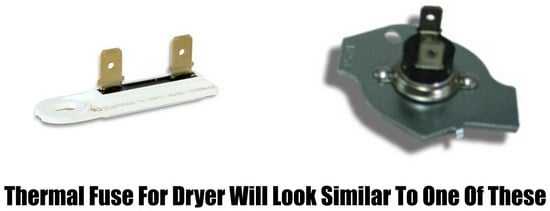
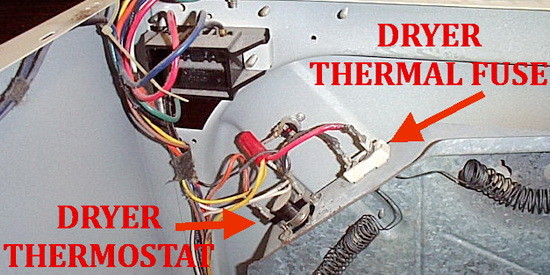
- Locate the thermal fuse. It’ll be a small white or silver component — roughly the size of a AAA battery cut in half — mounted directly on the exhaust duct or on the heating element housing. Two wires attach to it with push-on terminals. See the diagram below for typical placement.
- Disconnect the wires from the fuse terminals. They pull straight off — no tools needed. Note which wire goes where (they’re usually not interchangeable on polarized fuses, though most dryer thermal fuses aren’t polarized).
- Set your multimeter to continuity (the setting that beeps when current flows). Touch one probe to each terminal of the fuse. A good fuse beeps — continuity confirmed. A blown fuse shows no reading and no beep. That’s your answer.
- If it’s blown, remove it — usually one or two screws holding it to the duct — and take it to an appliance parts store or look up the part number online. The fuse will have a part number printed on it. Match it exactly. You can find the right fuse for your model on RepairClinic by entering your full model number — they’ll show you the exact part with a diagram confirming the location.
- Install the new fuse, reconnect the wires, reassemble the panel, push the dryer back, and plug it in. Run a test cycle.
Safety first: Always unplug the dryer before opening any panel — don’t rely on the power switch. If it’s an electric dryer on a 240V outlet, unplugging is the only way to guarantee both legs of power are disconnected. For gas dryers, this repair doesn’t require touching the gas line, but if you smell gas at any point, stop, ventilate the area, and call your gas company.
The Part That Actually Caused This — Your Clogged Vent
What you see: a blown thermal fuse. What’s actually happening: your exhaust vent is restricted enough that hot air can’t escape fast enough, heat backs up inside the cabinet, and temperatures climb until the fuse trips. What to do about it: clean the entire vent run, not just the lint trap, before you even order the replacement fuse.
I learned this the hard way early on. My first instinct for years was to replace the fuse and call it done. I did that for longer than I’m proud of before I started seeing the same dryers come back with blown fuses again inside of a month. Once I started making vent cleaning mandatory before any fuse replacement, the repeat failures almost completely stopped.
Here’s the common mistake I see constantly: people clean the lint trap — which takes 10 seconds and does almost nothing for airflow — and consider the vent “cleaned.” The real restriction is almost always in the duct run behind the dryer and in the exterior vent cap. Use a dryer vent cleaning kit (a flexible rod brush that attaches to a drill — about $20 at any hardware store) and run it through the full duct length from the dryer connection to the exterior cap. Check that the exterior cap flap opens freely when air is blowing. A stuck or half-closed exterior cap is responsible for more thermal fuse failures than any other single thing I’ve seen — (and it takes about 30 seconds to check once you’re outside looking at it).
About 80% of thermal fuse failures trace back to a restricted vent. Another 10% are from a failed cycling thermostat that lets the dryer run too hot. The remaining 10% I’d call genuine one-off overheating events — a too-long duct run, a kinked flex duct behind the dryer, that kind of thing. In any of those cases, cleaning the vent is still your first step.
Brand-Specific Notes Worth Knowing
Most dryer thermal fuse replacements follow the same basic process regardless of brand — find it on the exhaust duct, test it, swap it. But a few things worth knowing by brand:
Whirlpool and Maytag direct-drive machines (basically the same platform) are dead simple for this repair — back panel off in 5 minutes, fuse is right there on the duct. I’ve done this repair on Whirlpool machines so many times I could do it with my eyes closed. Great machines if you maintain them, and this is genuinely a 20-minute job.
Samsung front-loaders from roughly 2016 onward sometimes require front panel removal instead of rear access, which adds a step. Check your model’s service diagram before assuming it’s a back-panel job.
LG dryers — I’ve had mixed experiences, honestly. Some are straightforward, some require more disassembly than you’d expect for what should be a simple component. Pull the model number and look up a specific diagram before you start.
GE dryers pre-2010 are typically very easy to work on and the fuse location is almost always obvious once the back panel is off.
DIY vs. professional repair: The thermal fuse itself runs $3–$10 on RepairClinic or AppliancePartsPros — search your dryer’s model number for the exact part. A service call for this same repair typically runs $150–$200 depending on your area. If you’re comfortable with a screwdriver and a multimeter, you’re looking at saving $140+ on a 30-minute job. I’m genuinely not sure why anyone pays a tech to do this one — it’s about as beginner-friendly as appliance repair gets.
How To Keep the Thermal Fuse From Blowing Again
Clean the exhaust vent completely — the full duct run from dryer to exterior cap — once a year. Set a reminder. That’s it. That’s 90% of the prevention right there.
Specifically: I use a dryer vent brush kit with flexible rods every fall before heavy use season. Takes 15 minutes. Check the exterior cap while you’re at it — bird nests, accumulated lint, stuck flaps are all common and all invisible from inside. If your duct run is longer than about 20 feet, or if it has more than two 90-degree bends, consider having it professionally cleaned annually because restriction builds up faster in longer runs.
Also worth doing every few months: pull the dryer away from the wall and check the flex duct connecting the dryer to the wall duct. Accordion-style plastic flex duct gets kinked and compressed over time, especially if the dryer gets pushed back too far against the wall. A kinked flex duct cuts your airflow as effectively as a clogged vent. Replace plastic flex duct with rigid or semi-rigid metal duct if you haven’t already — it’s less prone to kinking and lint doesn’t cling to it the way it does to plastic.
Frequently Asked Questions
Can I bypass the thermal fuse to test if that’s the problem?
Technically you can — you’d just jumper the two terminals with a short wire and run the dryer briefly to see if heat returns. I’ve done this in the field to confirm a diagnosis before ordering a part. But I want to be honest with you: don’t leave it bypassed. The thermal fuse is there to prevent a fire. Run it bypassed for 30 seconds to confirm your diagnosis, then get the real fuse installed before doing any more laundry. A bypassed thermal fuse in a dryer with a clogged vent is genuinely a fire hazard.
Why did my thermal fuse blow if I just cleaned the lint trap?
The lint trap catches maybe 70% of airborne lint — the rest makes it into the duct system and builds up over months and years. The trap being clean doesn’t mean the duct is clear. I’d bet the duct behind your dryer hasn’t been cleaned since the machine was installed. That’s where your restriction is.
How long does a dryer thermal fuse replacement take?
Plan on about 30 minutes your first time — 10 minutes to get the panel off and find the fuse, 5 minutes to test it, 10 minutes to swap it, 5 minutes to reassemble. Add another 20–30 minutes if you’re also cleaning the vent at the same time, which you absolutely should be.
My dryer heats up but doesn’t dry clothes fully — is that still the thermal fuse?
No. A blown thermal fuse means zero heat — the heating circuit is completely open. If you’re getting some heat but clothes aren’t fully drying, you’re looking at a partially clogged vent (most likely), a weak heating element, or a cycling thermostat that’s not letting the dryer reach full temperature. I’d start with the vent — it solves that symptom more than half the time and costs nothing to check.
Do I need to match the exact thermal fuse part number?
Yes. Thermal fuses are rated to trip at specific temperatures — using one with the wrong trip temperature means it’ll either blow prematurely or not blow when it should, which defeats the whole safety purpose. Enter your dryer’s full model number on RepairClinic or AppliancePartsPros and they’ll show you exactly the right part. Don’t guess on this one.

Written by Keith Schneerer
Certified Appliance Tech · Founder, RemoveAndReplace.com
Keith has spent 30+ years repairing machines, starting as a military mechanic and later maintaining food processing equipment before moving into appliance repair. He founded RemoveAndReplace.com to share field-tested repair advice.
More about Keith →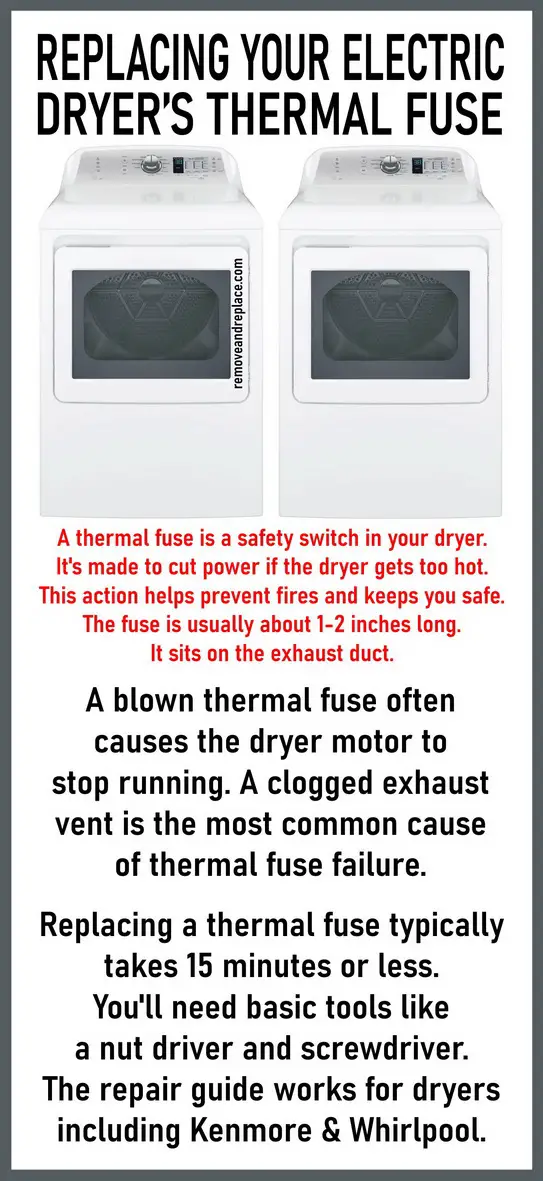

I have a samsung DV4@h5000 GW/A3 gas dryer. It is not healting up. i have cleaned the ducts and the filter even disconnected the ducts to see if it will heat that way. it is not not stopping when the power buttonis pushed to turn it off. the panel turns off but the dryer keeps running, the only way to turn it off is to either open the door or unplug it, the panel works with all the selections, just no heat and does not turn off.
hi I have a question,Kenmore Elite model 110-62952100 start and running good and heat for maybe one minute but then no more heat just running and cold air,I check all fuses and thermostat and everything is good, any ideas what else and missing to check,thank you for your answer
Ashley,
Have you checked the thermal fuse?
-RR
I have a Samsung front loading dryer, model # dv42h5200EW/A3
It is 13 months old, so just out of warranty of course, and will not heat.
I have done troubleshooting, the vent is clear and i have disconnected vent and ran dryer on a timed cycle, high heat, to no avail.
It is not on one of the sensor dry cycles or on a no heat cycle.
I have also unplugged it and that didn’t help either.
I would prefer not to pay and arm and a leg if i don’t have to.
What else can i check myself? I’m not opposed to opening up the dryer, just need to know what I’m looking at or for.
George,
Is it possible something became disconnected or came loose when you moved the dryer? When you feel air blowing out it is not HOT air, correct? Everything is working, tumbling, lights up, but NO HEAT? Have you made sure that the power getting to the dryer is the correct voltage? Usually 240V 220V depending on where you live. Is it possible you have the dryer outlet set on a 2 breaker system and possibly one of the breakers is off and one is on? Have you checked the thermal fuse? Checked the electrical block on back to be sure wires are tight and secure? Do you have the correct cord?
-RR