

If your old or new washing machine makes noise during the spin cycle we have some useful DIY repair tips here to fix your machine. A washing machine making a loud noise when spinning means a part has become worn out or loose.
The issue that is causing the loud noise could be a number of different parts inside your washer. If the loud noise only happens when the washer is in spin mode, this can be a sign that the main tub bearing is worn out. To fix your washer yourself, you may need to find your Washing Machine Service Repair manual.
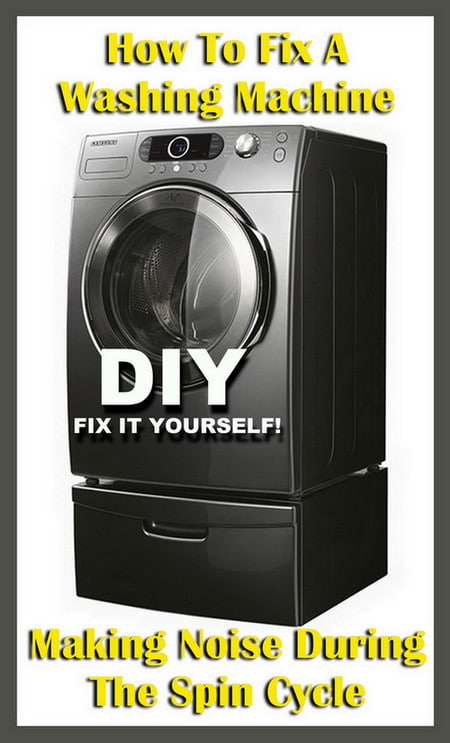 Washing Machine Making Noise During The Spin Cycle
Reasons a washer will make noise during spin mode:
1. Main tub bearing faulty
2. Main drive pulley
3. Motor coupling worn
4. Bad clutch
5. Worn out drive belt
6. Clogged or damaged drain pump
7. Transmission is worn out
8. Shock absorber (front loader washers)
9. Springs or dampening straps (top load washers)
10. Agitator directional cogs aka “agitator dogs” (top load washers)
NEED WASHING MACHINE PARTS? Over 6,000 New and Discounted
Washer Replacement Parts For ALL Washing Machine Models
When the washer spins, it rides on a bearing that allows the tub to move freely with zero resistance. If this bearing is worn out, a loud noise will be heard when the washer spins. A good way to tell if your washer problem is the main tub bearing will be that the washer noise will get worse or louder as time goes on. This means the bearing is becoming more worn out and close to complete failure.
The bearing in your washing machine is a circular metal object that has many small little metal balls inside. These small metal balls inside the bearing sit in a track and move when the washer is spinning. If the tub bearing begins to wear out, usually the small metal balls inside can fall out one by one causing the noise you hear.
(If your washing machine is a front load washer, open the door and turn the drum by hand. If you hear a rubbing sound or the drum spins uneven, then the main tub bearing is most likely bad and needs replaced.)
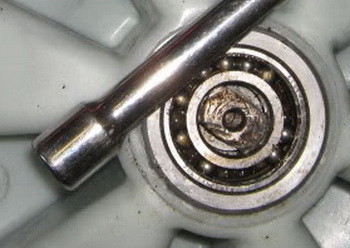 Washing machine tub bearing
Washer has noise during spin cycle
The bearing may also be without lubrication. If the sound you hear is more of a squeaking noise than a grinding noise, it may mean the bearing needs to be lubricated with a mechanical grease. If the sound is more of a grinding noise, then this usually means the bearing is falling apart and will need to be replaced ASAP.
If you suspect your washers main tub bearing is worn out, the repair process is one of the most difficult to perform yourself. A worn bearing can also damage the tub of the washer. This means the tub (inner or outer) may need to be replaced also.
A washer making a loud noise during spin cycle can also be caused by a faulty drive pulley. The pulley is what the belt (if applicable to your washer) rides on to spin your washers tub.
The pulley can be made of plastic or metal. It could be simply worn out or just loose. To find out if the drive pulley is causing the noise, you will need to take the washer apart and inspect the pulley for signs of damage.
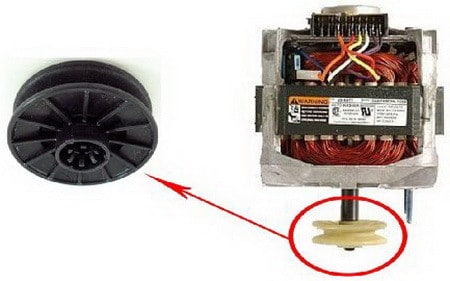 WASHER MOTOR PULLEY
The motor coupling could also be the cause of the loud noise. The motor coupling in your washer connects the washers transmission to the motor.
It is made of plastic and built to break if the washer gets overloaded. This is so the motor and the transmission do not become damaged. The motor coupling is an easier repair and can be done by most people.
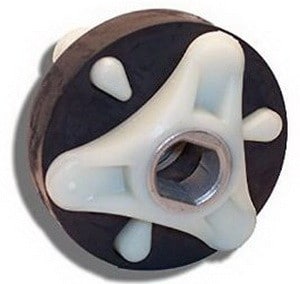 Washer Washing Machine Motor Drive Coupling Coupler
The clutch in a washing machine connects the inner wash tub to the transmission. The clutch lets the washer get to the proper spin RPM in a gradual way.
If the clutch is worn it can make noise when the washer is spinning. A bad clutch needs to be removed and replaced to stop the noise.
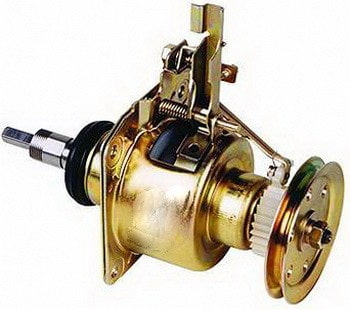 Washing Machine Clutch
The belt in your washer can become worn and cause noise while spinning. If worn out, replace the belt. Replacing the drive belt on a washing machine is an easy task and can be ordered online for less.
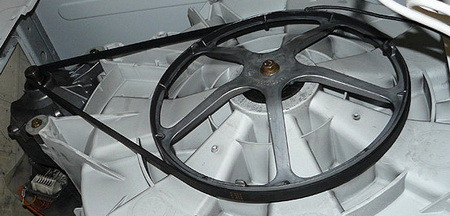 Washing machine belt
The drain pump in your washer that drains the water out could be clogged or damaged. While in spin mode, your washer may drain out the water by using the drain pump.
If the loud noise only happens at certain intervals during the spin cycle, it may be the drain pump. Usually this can be fixed by simply removing the drain pump and removing any debris that may be clogging it up causing the noise.
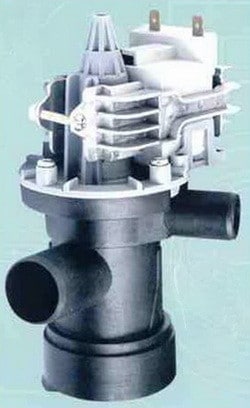 Drain Pump for Washing Machine
The next part of your washer that can be causing a loud noise is the transmission. If the transmission is bad, usually the cost to fix this outweighs the cost of a new washer.
If you have a front loading washing machine, they all have shock absorbers. The shock absorbers are used to center the tub movement while in the spin cycle.
These shock absorbers are connected from the washer frame to the outer tub. If the shock absorbers in your front loader become weak the washer will make a loud banging sound during the spinning cycle.
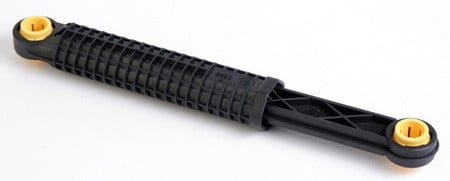 Shock Absorber for washing machine
Top load washers usually have springs or dampening straps holding the tub centered. If a spring or strap falls off or becomes weak, a loud noise will be heard in spin mode. Simply replace the strap, spring, or springs to remedy this issue.
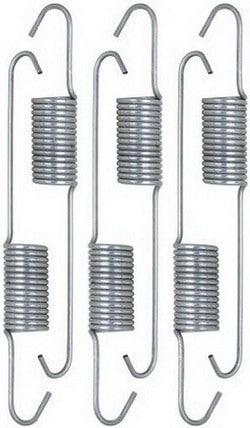 Washing machine suspension springs
Agitator directional cogs are used to operate the upper part of dual action agitators (Top load washers). They engage the cogs on the inner area of the agitator as it turns in one direction. They release when the agitator reverses its direction. This lets the top part of the agitator to ratchet in only one direction.
The bottom part will agitate in both directions. The cogs are made of plastic and wear out with regular use. They will start slipping and make a grinding noise. Another way to be sure that this part is bad is if you notice the top portion of the agitator does not move in a smooth motion. Removing the top half of the agitator to see if the cogs are worn out.
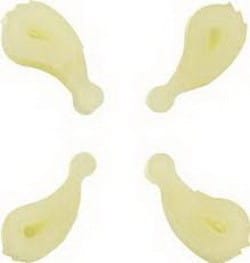 Washer Agitator Cogs or Dogs
Looking for WASHING MACHINE ERROR CODES?
Here are error codes for Amana, Asko, Beko, Bosch, Frigidaire, GE,
Hotpoint, Kenmore, LG, Maytag, Samsung, and Whirlpool washers.
Here is a web page with ALL ERROR CODES for all washing machines.
Do you know of other common or uncommon reasons a washing machine will make noise during the spinning cycle? please help out all of our other readers and leave a comment below.

I had the same issue with my front load Whirlpool. At first I thought I had to buy and replace the whole rear tub which was about $400. Then someone said I could just buy a repair kit for my model to replace the bad bearings and seal. I got a good quality kit on ebay about $75 and put into work, following the videos found on youtube that really helped. It took me a few hours of hard work, but I am glad I did it. Was thinking i had to buy a new washer. But mine runs really nice and quiet now.
My Samsung diamond drum makes a sound while in spinning mode like a belt hitting against the wall of the washing machine.
I have the same problem with my whirlpool. Sounds like a jet engine taking off during spin cycle. Where is the bearing located at
I have the same problem with my whirlpool. Sounds like a jet engine taking off during spin cycle
I have a whirlpool washing machine. Wtw4800bq1. When machine goes to spin cycle it sounds like a jet engine taking off. Could anyone help me figure this problem out?
Beko Washing machine spin for 1-2 secs and stop!
If i put clothes then it start bouncing for 1-2 secs and stop.
all self test complete perfectly no error. do you know what will be the reason?
check all the pipes, shock absorber, drainage all ok
belt, pully everything look fine to me
Did you ever figure it out? I have the same exact problem.
Whirlpool Heavy Duty Extra Large Capacity Washing Machine squeals when on spin cycle. Found a broken seal (?) on ground.
Kenmore front load washer 592. (500 series) Works perfectly and quietly until the spin cycle reaches its fastest peak, then it makes a loud vibrating and squealing sound and immediately goes out of spin and continues on in the cycle, therefore not spinning enough water out of my clothes. I have tried lighter loads and have cleaned out the pump filter many many times, once finding a small bit of rubber trim about 1/4 of a cm wide and 5 inches in length and a chunk of curved hard plastic which would have been approx. 1″ in diameter had it not been chunked smaller. What could be the problem with the spin? There has been nothing else come out of the cleanout, I even did it without draining the water first to see if anything would swish out of the line.
Karen Tench,
Bearing, Transmission, Possible some foreign object is stuck in between tub?
Take off panel and visually check for obvious signs of wear and noise.
-RR